


Egyptian president calls for deeper BRICS cooperation to build resilient economies amid global challenges
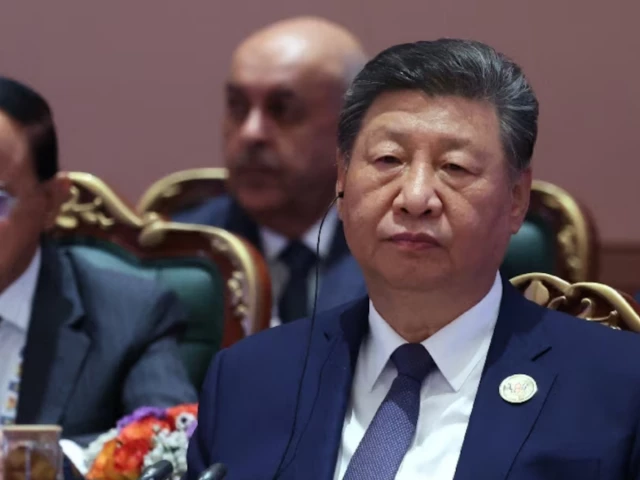
Chinese President Xi Jinping attends a session on day two of the BRICS Summit in New Delhi, India, September 13, 2026. PHOTO: REUTERS
Chinese President Xi Jinping on Sunday called on expanded BRICS members and partner countries to keep industrial and supply chains “stable and unimpeded” amid disruptions to shipping through the Strait of Hormuz due to the US-Iran war.
“Greater BRICS” should leverage strengths in being rooted in emerging markets and connected with the Global South, uphold openness and cooperation for “mutual benefit and win-win outcomes,” keep industrial and supply chains “stable and unimpeded,” and foster integrated markets, Xi said during the final day of the two-day 18th BRICS Leaders’ Summit in New Delhi, according to state-run news agency Xinhua.
He was speaking at an open session titled “Resilience, Innovation, Cooperation and Sustainability: Shaping the Future for Inclusive Global Growth.”
The Chinese president said that the Global South has become a “key force driving the world toward multipolarity,” and urged countries to uphold multilateralism and international rule of law.
Xi added that the international rules should be jointly written by all, and that “might makes right” logic should have been discarded long ago.
The Global South countries should “uphold authority and role of the UN,” while supporting reforms to improve the efficiency of multilateral institutions, Xi said.
Read: Iranian president says US, Israeli attacks show economic resilience ‘unsustainable’ without security
Xi called for improving international financial architecture, enhancing representation and say of developing countries, as well as a WTO reform in the “right direction.”
“China will further advance voluntary and unilateral opening-up,” he added.
He urged support for the operation and development of the New Development Bank, as well as stronger Global South cooperation.
The Global South should accelerate efforts to establish a global AI governance framework based on broad consensus, Xi said, adding that China would take the lead in establishing an AI open-source zone for BRICS and promoting a digital industry cloud platform for BRICS countries.
The Chinese president also called on the “greater BRICS” to upgrade traditional industries, develop emerging sectors, and make forward-looking plans for future industries, foster integrated markets and “lay a solid foundation for practical cooperation.”
He also proposed initiatives on science and technology talent development, smart manufacturing, digital industry, trade and investment facilitation, and “open and inclusive” AI, as well as a BRICS alliance for engineer training.
Xi additionally proposed building special economic zones partnership of BRICS countries.
China will host the BRICS Services Trade Forum in 2027, he also said, while Beijing is also due to host the bloc’s annual summit next year.
Egyptian president calls for greater BRICS cooperation
Egyptian President Abdel Fattah al-Sisi on Sunday called for deeper cooperation among BRICS members and partner countries to build more resilient economies amid rapid changes and challenges facing the global economy.
Addressing an open session of the 18th BRICS Summit in New Delhi, Sisi said economic resilience requires diversifying sources of growth, strengthening supply chains, investing in people and technology, and expanding cooperation among Global South countries.
He said Egypt attaches importance to cooperation in innovation and artificial intelligence, as well as technology transfer and localization, to enable developing countries to benefit more from technological transformation.
On sustainability, Sisi called for expanded cooperation in clean and renewable energy, greater efficiency in the use of resources, and easier access for developing countries to financing and technology.
He also highlighted Egypt’s investment in ports, transport corridors, and logistics networks, saying the Suez Canal remains at the heart of this system as one of the world’s most important international trade routes.
“Economic resilience cannot be separated from our ability to ensure food and energy security, maintain the smooth flow of trade and investment, and address supply-chain disruptions,” he said.
Read more: China, Russia, India seek economic cooperation at BRICS
Sisi called for increasing trade and investment among BRICS members and partners and encouraging joint projects to strengthen economic integration and reduce the impact of external shocks.
He also called for strengthening the role of development finance institutions, particularly the New Development Bank, in financing infrastructure and development projects and expanding developing countries’ access to concessional financing.
The Egyptian president said BRICS, through the diversity of its members and partners, has an opportunity to build a practical model of cooperation among Global South countries based on resilience, innovation, cooperation, and sustainability.
The remarks came on the final day of the two-day BRICS summit in New Delhi. The expanded 11-member grouping comprises Brazil, Russia, India, China, South Africa, Egypt, Ethiopia, Indonesia, Iran, Saudi Arabia, and the United Arab Emirates.
Putin says intra-BRICS trade reaches $1.2T
Russian President Vladimir Putin said on Sunday that trade among BRICS countries has reached $1.2 trillion.
Speaking at a meeting of the BRICS Outreach format in New Delhi, Putin said that the population growth rates in the BRICS countries are increasing from year to year, domestic markets are strengthening, and infrastructure of all kinds has been built.
“Domestic trade within our association has already reached $1.2 trillion. The participating countries account for almost a quarter of global exports, and it is the BRICS that provides the main dynamics of global GDP – 49%,” he said.
Putin emphasised that the potential for further development of BRICS is “far from exhausted.”
“One of the main reserves that has not yet been fully utilised is the complementarity of the economies of the participating countries. Differences in their structure and specialization provide ample opportunities for practical cooperation, for the creation of new production chains, technologies, services and markets,” he said.
“In fact, we are talking about forming a common BRICS growth platform that organically combines the competitive advantages of our economies,” Putin noted.
The Russian president added that attention to BRICS activities in the world continues to grow.
He said the group’s values and ideals were becoming increasingly attractive, adding that BRICS advocates equal and unrestricted opportunities for all countries to achieve social and economic growth.
Putin also said the group was actively contributing to the formation of a more just multipolar world order.