


Tehran claims attacks forced US forces farther from Iran as Pentagon watchdog reports strategic munitions shortfalls
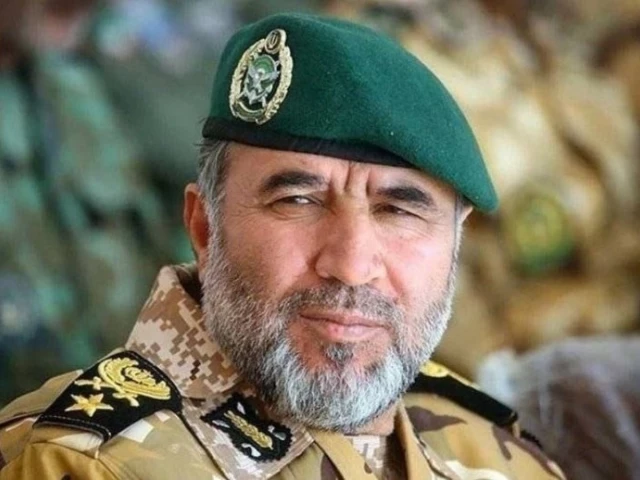
Iran appointed Brigadier General Kiumars Heidari as Deputy Chief of Staff of Iran’s Armed Forces on August 10, 2026. Photo: Tehran Times/X
Iran’s deputy chief of staff of the armed forces, Brigadier General Kiumars Heydari, has claimed that Iranian missile strikes inflicted serious damage on US warships and forced American forces to move hundreds of kilometres farther from Iran, as new US reports and photographs point to extensive damage to American military facilities across the Middle East.
Speaking at a meeting of the Council of the Foundation for the Preservation and Publication of Sacred Defence and Resistance Values on Wednesday, Heydari said Iran had emerged victorious because its forces had prevented the United States from achieving its objectives.
“Today, there is no doubt that our armed forces are victorious on the battlefield,” Iran’s state-run Press TV quoted him as saying, arguing that a defender prevails when it prevents an attacker from reaching its objectives at a predetermined time and place.
Heydari said the United States, which Iran had accused of seeking to overthrow its system, was now responding to Iranian military actions. “The enemy that dreamed of overthrowing the system is now acting passively on the battlefield,” he said. “If it carries out any action, it is in response to our actions.”
The Iranian commander also claimed that Iranian missiles had struck US warships and frigates, describing the attacks as evidence of the vulnerability of American naval power. “The peak of American military capability is its navy and its warships,” Heydari said, adding that Iran had recently targeted “heavy warships and frigates” and inflicted serious damage on them.
He further claimed that Iranian attacks had compelled US forces to move at least 500 kilometres away from Iran.
Read: Houthis claim attack on Aramco facilities in Yanbu, airbase in Khamis Mushait
There was no independent confirmation in the material reviewed of Heydari’s specific claim that US warships had suffered serious damage.
However, a Pentagon inspector general report released this week provides evidence of substantial damage to US military infrastructure across the region during the conflict.
According to the report, US Central Command told investigators that Iranian strikes damaged or destroyed hundreds of buildings and structures at American bases in Kuwait, Bahrain, Qatar, the United Arab Emirates, Saudi Arabia, Iraq, Oman and Jordan.
The report also said US diplomatic facilities in four countries suffered physical damage from Iranian strikes, with the State Department estimating the cost at about $184 million.
The extent of the damage was also illustrated by photographs obtained exclusively by CBS News from active-duty US service members who provided them anonymously because of military restrictions on the media.
One photograph from Prince Sultan Air Base in Saudi Arabia showed what CBS described as a direct hit on a Boeing E-3 Sentry aircraft, with its tail severed from the charred fuselage. The aircraft’s rotating radar is used for airborne intelligence and surveillance.
Other photographs showed damaged buildings, barracks and vehicles at US positions in Saudi Arabia and Kuwait, including Camp Buehring and Camp Arifjan.
One US service member told CBS that the damage to American bases had not been fully communicated to the public. The Pentagon did not respond to CBS’s request for comment.
Read more: Iran war exposed ‘strategic’ US munitions shortfalls: Pentagon watchdog
The Pentagon watchdog’s report also detailed losses of military equipment. CBS reported that the inspector general put equipment losses at up to $3.7 billion, while its report listed four F-15s destroyed, one F-35 damaged, seven KC-135 tanker aircraft damaged, and as many as 30 MQ-9 Reaper drones destroyed.
The report also highlighted pressure on US weapons stocks after months of fighting.
Between February 28 and June 30, Operation Epic Fury had an estimated cost of $33.4 billion, according to the inspector general. Of that amount, $22.3 billion was spent on munitions alone.
The report said the scale of expenditure had resulted in “strategic inventory shortfalls” and exposed bottlenecks in the US industrial base responsible for replenishing weapons.
The findings came despite repeated assurances from US officials that American weapons stocks remained sufficient. President Donald Trump has publicly dismissed concerns over ammunition shortages, saying the United States had extensive supplies and was producing munitions at unprecedented levels.
The scale of the problem has nevertheless prompted US defence officials to push manufacturers to expand weapons production. CBS reported that a Patriot missile production facility operated by Lockheed Martin was producing about 750 missiles a year, with each missile costing roughly $4 million.
The inspector general’s findings also add to broader estimates of the cost of the conflict. CBS reported that US officials had previously estimated the cost of Operation Epic Fury at around $25 billion in April, while officials familiar with internal assessments subsequently put the figure closer to $50 billion at that stage.
Iran points to domestic capabilities
Heydari attributed Iran’s ability to sustain the confrontation to its domestic defence industry, saying the country had relied primarily on indigenous capabilities despite years of sanctions.
“If we had not relied on our domestic capabilities, our stockpiles and reserves could not have met the demands,” he said.
Also Read: Chinese FM urges Iran, US to return to Islamabad MoU in meeting with Iranian counterpart
Iran has developed an extensive indigenous military-industrial base that produces ballistic and cruise missiles, drones, anti-ship systems and other weapons. Tehran has repeatedly highlighted these capabilities as a means of deterring attacks and threatening hostile military assets in and around the Persian Gulf.
Heydari said Iran had responded to what he called every “brazen move” by the enemy with large-scale missile attacks.
“Today, in response to every brazen move by the enemy, we are raining a barrage of missiles across the region and have surprised the enemy,” he said.
He also warned that a continuation of the war would expose US forces in the region to further losses.
“If the Americans continue the war, large numbers of their forces … will return to their country on the decks of those same warships, while many others, God willing, will sink to the bottom of the region’s waters,” he said.
Heydari said Iran’s military measures were calibrated to widen the distance between the two sides and ultimately enable Tehran to declare victory.