


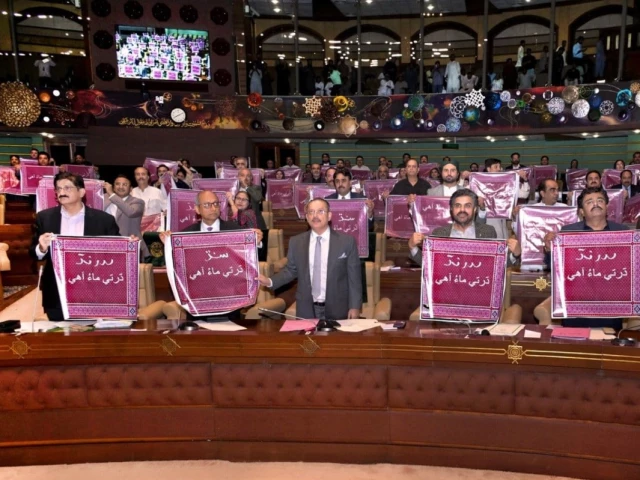
Members of the Sindh Assembly display banners carrying the Sindhi inscription “Sindh Ji Dharti Munhinji Maa” (The Land of Sindh is My Mother) during a session in Karachi on Thursday. Photo: X/ SindhCMHouse
The Sindh Assembly on Thursday unanimously passed a resolution rejecting any proposal to divide the province or alter its territorial limits, as opposition lawmakers staged a walkout in protest.
The resolution was moved by senior Pakistan Peoples Party leader Nisar Ahmed Khuhro and approved unanimously by the members present in the house.
The resolution came amid a renewed public debate over the creation of new provinces and administrative units in Pakistan, including proposals that could alter the existing territorial limits of Sindh.
It described Sindh as a “historic, civilisational and constitutional entity” whose identity and territorial continuity extended over centuries, and recalled that the province had entered Pakistan as a distinct and undivided province.
The resolution also highlighted Sindh’s role in the creation of Pakistan, noting that the Sindh Legislative Assembly was the first provincial legislature of British India to adopt a resolution in support of the establishment of Pakistan on March 3, 1943.
It further recalled that at a special sitting on June 26, 1947, the assembly passed a resolution declaring that Sindh would join the newly created Pakistan as a constituent state.
Read: PA digs in as ‘new provinces’ debate enters third day
The house said the people of Sindh had repeatedly expressed, through their elected representatives, their determination to preserve the unity and territorial integrity of the province.
It noted that the assembly had previously adopted resolutions in 1948, 2012, 2013, 2014, 2019 and, most recently, on Feb 21, affirming the unity and territorial integrity of Sindh and rejecting attempts to divide the province or detach any part of it.
The resolution said the Constitution established a federal system based on the autonomy, integrity and constitutional rights of the federating units.
It referred specifically to Article 239(4), which provides that a constitutional amendment that would alter the limits of a province cannot be presented to the president for assent unless it has been passed by the provincial assembly concerned by at least two-thirds of its total membership.
“ہم سب اور سندھ کا بچہ بچہ اس بات پر متفق ہے کہ ہم سندھ کو تقسیم نہیں ہونے دیں گے، ہم سندھ کا سودا نہیں کریں گے، یہ دھرتی ماں ہماری ہے اور ہم اس کی حفاظت کریں گے۔”
صدر پاکستان پیپلز پارٹی شعبہ خواتین محترمہ فریال تالپور صاحبہ کا سندھ اسمبلی کے اجلاس سے خطاب@FaryalTalpurPk pic.twitter.com/8FKYisjRs9
— PPP (@MediaCellPPP) September 3, 2026
The house “unequivocally” rejected any proposal, plan, scheme or constitutional arrangement seeking to divide Sindh, alter its existing territorial limits or create a new province out of its territory.
It also rejected any plan to detach any district, division, region or territory from Sindh or place any part of the province under a separate or federal administrative arrangement.
The resolution declared that “Sindh is one and shall remain one” and that every district, division and region currently forming part of the province were integral and inseparable parts of it.
Also Read: Nationalists see red over new administrative units
The assembly reaffirmed that it would not consent to any alteration of Sindh’s territorial limits and would exercise its constitutional authority under Article 239(4) to safeguard the province’s unity and territorial integrity.
It also called for the constitutional rights and integrity of all federating units to be respected, saying any discussion on restructuring the federation should take place strictly within the framework of the Constitution, democratic consent and the will of the people concerned.
KARACHI (September 3rd, 2026): Sindh Chief Minister @MuradAliShahPPP displays a banner bearing the Sindhi inscription, “Sindh Ji Dharti Munhinji Maa” (“The Land of Sindh is My Mother”), during the Sindh Assembly session on the unity of Sindh. pic.twitter.com/N4hWjSE908
— Sindh Chief Minister House (@SindhCMHouse) September 3, 2026
The resolution called upon the federal government, Parliament, political parties and state institutions to respect the “clearly and repeatedly expressed democratic will” of the people of Sindh and their elected provincial assembly and refrain from initiating, supporting or entertaining any proposal that would alter the territorial integrity of the province.
It further said Sindh’s unity and territorial integrity transcended party politics, adding that the house stood united in safeguarding the province’s historic, constitutional and territorial identity through peaceful, democratic and constitutional means.
As many as 105 PPP lawmakers were present in the house and stood on their benches after the resolution was passed. They also raised banners carrying the slogan “Sindh Dharti Maa” (Sindh, the motherland) inside the assembly.
Murad rejects calls for division
Addressing the session, Sindh Chief Minister Murad Ali Shah said that the province could never be divided, stating that the decision regarding the division would be “made by members of the Sindh Assembly, not businessmen from Lahore.”
“If you have the courage, bring a resolution for the division of Sindh and show us. As long as even one member among us is alive, the province will not be divided,” CM Shah warned.
The chief minister stated that it would be the Sindh Assembly which would decide on the matter, saying that there would be a debate in the assembly and that “no one will decide on division on TV or at a rally.”
Read More: Sharjeel Memon slams Mustafa Kamal over ‘politics of hatred’, new administrative units
CM Shah added that Pakistan Peoples Party (PPP) Chairman Bilawal Bhutto Zardari had stated that they would do what the people wish, so let there be debate and if needed they would pass the resolution again.
He said that in the previous session, some people had spoken in favour of the division of Sindh. However, he stressed that “Sindh will always remain one.”
He also noted that the provincial assembly had passed several resolutions in the past against the division of Sindh. These resolutions were passed in 1948, 2000, 2014, 2019 and 2026.
Earlier, speaking before tabling the resolution, Khuhro criticised opposition lawmakers for staging a walkout.
“When it is time for voting, they walk out,” he said, adding that they had “run away with their tails between their legs”.
He said those who wanted Sindh to be divided had to live in Sindh. “What greater betrayal and hypocrisy towards Sindh can there be?” he asked.
Khuhro said the resolution had been presented eight times, but its opponents could not say even once in practical terms that “Sindh is mother”.
He said there was a race among the MQM leadership, recalling that when there was only MQM, its founder had turned it into Muttahida. He added that MQM-Haqiqi had also been formed and its members had demanded a southern province.
Khuhro said federal ministers had stated that new provinces would have to be created, while the planning minister had said there should be 18 provinces.
“When such statements come, the idea of a motion to adjourn came to mind,” he said.
He said if he had brought the resolution at the beginning of the session, the opposition would have complained that it had not been given an opportunity.
The Sindh Assembly session was adjourned until 2:30pm on Friday.
The debate over the new province started last month when Interior Minister Mohsin Naqvi called for the creation of additional administrative units or provinces to overhaul the country’s outdated governance system, stressing that meaningful structural reforms were essential to ensure justice and create opportunities for young people. This has resulted in a series of remarks thrown back and forth from major political parties in Sindh.
A few days after the suggestion, CM Shah rejected Naqvi’s claims that the governance system had collapsed, saying that no bloodshed would be allowed over the issue of creating new provinces.
“The people of Sindh say that the provinces will be built on our dead bodies. My brother, we will not let anyone’s dead bodies fall. Don’t dramatise it so much. There is a way in the constitution to build provinces. And in that constitution, it is written that if an assembly of a province passes a resolution with a two-thirds majority to divide the province, then it is possible,” he said.
Also Read: Sindh CM rejects call for new provinces, terms it ‘outdated’
Later, MQM-P said it would launch a grand national dialogue with other political parties on the creation of new provinces and administrative units, arguing that Pakistan’s growing population, poor governance and concentration of political power had made further administrative devolution necessary.
Kamal also said the proposal for administrative units in Sindh was not directed against Sindhis but was intended to give residents greater political control over their own affairs. “Creating administrative units is not against Sindhis; it is for Sindhis,” he said.
MQM-P leader Farooq Sattar supported the division proposal, arguing that further administrative units were essential for Pakistan’s survival, development and stability. “If the status quo is not ended, rebellions will emerge in different parts of the country,” he said.
However, Sindh Information Minister Nasir Hussain Shah criticised the MQM-P, saying its call for new provinces and administrative units reflected political frustration and isolation. Rejecting the party’s demand for administrative changes in Sindh, Shah said, “Sindh will not be divided, but I certainly see the Muttahida being divided.”
Later, Sindh Labour and Human Resources Minister Saeed Ghani joined in opposition to the suggestion, saying that the people of Sindh, including political parties, were united in their opposition to the creation of a new province in Sindh.
Reacting to comments by leaders of MQM-P, Ghani said the constitutional authority to decide on the creation of a new province rested with the people concerned. He also accused Siddiqui, Sattar and Kamal of attempting to revive what he described as politics of hatred.