


Taybeh, occupied West Bank – Underneath a painting of Jesus and his disciples, Sandra Basir brought out what she and her husband, Roland, now keep to protect their home: a couple of fire extinguishers.
They keep them because the last time Israeli settlers set fire to a neighbour’s car outside their house, no one else came. “Civil defence – when did they even show up? After everything was already over,” Roland says.
Recommended Stories
list of 3 itemsend of list
The couple’s nightly routine in their Palestinian Christian town is now similar to the majority-Muslim rural Palestinian communities besieged by settler attacks and nighttime military raids for years. Sandra checks the doors more than once before bed. They got a dog to stay outside to alert them of any trespassers. Sandra is, by her own description, always half-awake – listening for whoever might be coming for her four small children while they sleep.
Their seven-year-old son has stopped playing outside, Sandra says, and for months, the little boy told his father not to go to work – scared he might not return. “That’s what our life has become,” says Sandra, who was on the verge of tears throughout the conversation. “A child that age should just be playing.”
For more than 20 years, Roland built up a stone quarry and concrete-block factory on the edge of town, investing an estimated $5m in the business. After employing 40 local Palestinians, he has found his life’s work snatched by marauding settlers, both armed adults and some barely teenagers.
In the past three years – and with the situation deteriorating even more severely this past year – he and his workers were frequently chased off by settlers at gunpoint, with his quarry’s heavy-machinery equipment set on fire. The most brazen attack came in March, when Roland says some 30 to 40 settlers stormed the quarry site in a coordinated mass incursion. Videos and photos show them raising Israeli flags over the grounds and performing prayers on the land. Before leaving, they smashed his office, destroyed electrical panels, and pulled cameras from the walls.
![Damage after a settler attack on Roland Basir’s quarry in the town of Taybeh in the West Bank [Courtesy of Roland Basir]](https://voxpoint.news/wp-content/uploads/2026/08/Fear-and-attacks-grip-Taybeh-the-last-all-Christian-town-in.jpg)
Roland documented everything on video, filed complaints with the liaison office, the police, and every institution he could reach. All his efforts to mobilise help to protect his land, however, were for naught. The settlers were back the next day, with their attacks continuing ever since.
Meanwhile, Roland showed Al Jazeera donation pages online for the settlers that he says carried out the attacks. He also alleges that stone taken from his land was registered under a settler’s name and resold.
This past week, he finally stopped trying to continue operations, leaving his stone quarry business all but abandoned.
“They’ve taken the quarry, taken the factory, taken the land,” Roland says. “What’s left for them to take? My children? My house?”
![Fire extinguishers that Sandra and Roland bought to extinguish fires they say are lit by Israeli settlers [Al Jazeera]](https://voxpoint.news/wp-content/uploads/2026/08/1786686516_88_Fear-and-attacks-grip-Taybeh-the-last-all-Christian-town-in.jpg)
A once-safe haven now in the crosshairs
A few years ago, nobody in Taybeh thought trouble like this was coming their way.
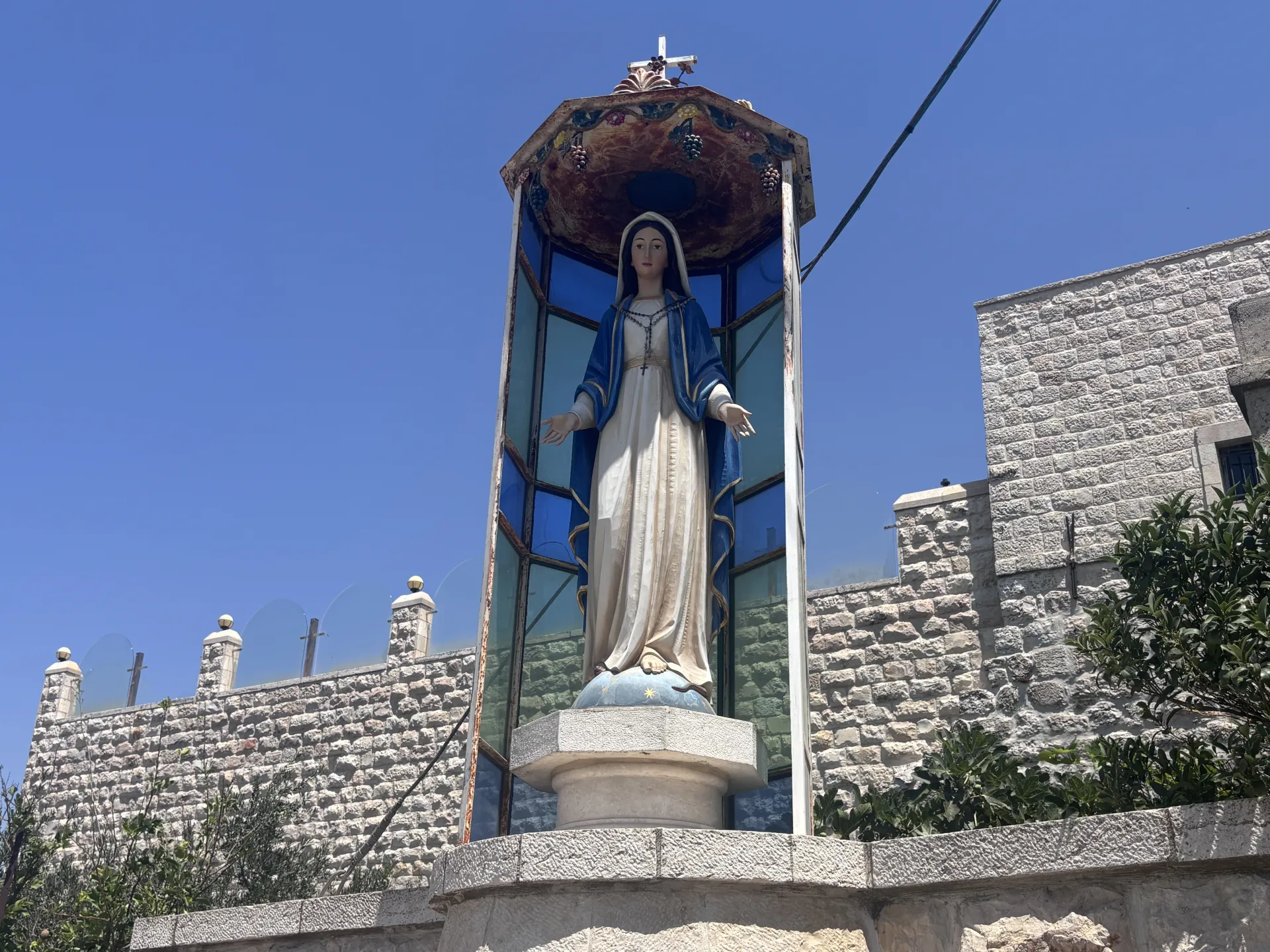
Madees Khoury, who runs the Taybeh Brewery her family founded in 1994, lived in Taybeh through the second Intifada, the Arab Spring, and every war on Gaza – but none of it ever really touched the quaint town filled with centuries-old churches, well-built homes, and street-corner statues of Mother Mary and Jesus. “Taybeh was always safe, untouched – never, never, never did I imagine it would come to this,” says Madees.
The town is traditionally identified with biblical Ephraim – the place Jesus is said to have withdrawn to before his final journey to Jerusalem – and is the last Palestinian town left in the West Bank whose population is entirely Christian, home now to roughly 1,200 people and to the ruins of the fifth-century Church of St George, one of the oldest Christian sites in the Holy Land.
Things began to change as Israeli settlers, after driving Bedouin and herding communities from areas to the east, increasingly turned their attention to the hills around Taybeh itself, commencing attacks within the town last year. Mayor Suleiman Khourieh estimates roughly seven settler outposts now surround the town – four or five, by his count, sitting directly on Taybeh’s municipal land.
The attacks that followed mirror those taking place across the rural West Bank, with Sandra – who says her mother’s arm was broken by a settler during last year’s olive harvest – and Roland showing Al Jazeera photographs and videos of the frequent settler incursions within the town’s central confines.
Repeatedly, settlers graze cattle, sheep and camels on private agricultural land. Last year, Christian leaders say fires were deliberately set near the church and its adjoining cemetery. A couple of months ago, armed settlers set large fires along the village’s farmlands and prevented firetrucks from reaching them, according to local residents who drove to the scene.
Residents of Taybeh now face routine restrictions on accessing their farmlands and resources, including the now depopulated Ein Samiya spring. The spring supplies all the water to Taybeh Brewery and other Palestinian communities in the area, but settlers have since taken control of it.
Madees Khoury remembers one morning, in February this year, when a group of settlers walked into the centre of town claiming to search for a horse that didn’t exist – while her cousin’s actual horse and its foal, kept in a small structure on her father and uncle’s land for years, stood a few metres away. When she and her family called Israel’s Civil Administration to have the settlers removed, she says the officials who arrived instead walked in alongside them, broke open the door, and helped carry the horses out. “Instead of removing them,” she says, “the officials who came walked alongside the settlers onto my father and uncle’s private property … took the horse and the foal, and walked out.”
The newest outpost, established just last week, sits on the western edge of town, in Area B of the West Bank – nominally under Palestinian civil administration, though security in these hills has long since fallen to whoever is willing to enforce it on the ground.
On his own land in Area B, Mayor Khourieh has watched a settler take over his vineyard and its well over the past month, following the establishment of a settler outpost nearby. Sitting in his office, Khourieh described the settlers cutting his locks, bringing sheep there to graze, at one point pitching a tent by the well and furnishing it with sofas, and even bathing in the water meant for his vines.
According to the mayor, the army eventually removed the settlers’ tent, but the settlers still come back daily to water their flock from Khourieh’s own well. “We still don’t know whether I’m even allowed to go to my own vineyard or not,” says the town mayor inside his office.
Israeli officials have, at least on paper, acknowledged the problem. Prime Minister Benjamin Netanyahu said earlier this year that outposts established in Area B should be evacuated. But despite reported pressure from career military officials to remove the outposts over security concerns, enforcement has frequently been blocked amid opposition from officials in Netanyahu’s far-right government. By Peace Now’s latest count, of the approximately 390 illegal outposts and farms across the West Bank, at least 21 sit in Area B.
Al Jazeera has reached out to the Israeli authorities for comment on the attacks on Taybeh, and the accusations that their response has not been sufficient, but has yet to receive a response.
![Madees Khoury at her family’s Taybeh Brewery [Al Jazeera]](https://voxpoint.news/wp-content/uploads/2026/08/1786686517_495_Fear-and-attacks-grip-Taybeh-the-last-all-Christian-town-in.jpg)
Hollow protections from the state
Following attacks in the area – including the invasion of a then-empty home of a Taybeh family on August 5 – on August 9, the Israeli army declared Taybeh, along with the neighbouring village of Rammun, a closed military zone.
The order itself has confused almost everyone tasked with living under it. It bars entry to Israelis and foreigners without a specific connection to the village, and the army has offered little clarity on the terms and enforcement. “It’s unclear,” Madees Khoury says. “The whole thing was strange.”
What almost no one in Taybeh believes is that the order will actually keep settlers out. Especially in the past year, such closed military zone orders have been issued in cases where settlers are attacking local Palestinians – only for those orders to be enforced selectively to remove activists attempting to offer protective presence to local Palestinians, while doing little to remove the violent settlers themselves.
Instead, the removal of visitors adds to the town’s growing isolation.
“The decision hasn’t amounted to anything practical,” the mayor says, “because the settler is still exactly where he was.” Father Bashar Fawadleh, priest of Taybeh’s Christ the Redeemer Church, put it more bluntly: “We don’t feel that they’re actually forbidding the settlers from coming to Taybeh.”
According to Roland, the day the military zone closure was announced, settlers broke into his office at the stone quarry and smashed cabinets, equipment, and anything they could reach inside. The following morning, he tried to go back to what remains of his quarry, but settlers confronted him again. He called the police; two and a half hours later, he says, they arrived, but the settlers had already left.
![Mayor Suleiman Khourieh looking at a map of the closed military zone around Taybeh [Al Jazeera]](https://voxpoint.news/wp-content/uploads/2026/08/1786686517_631_Fear-and-attacks-grip-Taybeh-the-last-all-Christian-town-in.jpg)
‘The cross we have to carry’
Emigration of Palestinian Christians has been an issue in Taybeh and elsewhere for years, as the Palestinian Christian population has shrunk to about 40,000 in the West Bank, or just more than 1 percent of the entire population. But under the pressures of severe restrictions on land access by Israeli authorities and settlers, movement restrictions, and the threat of unchecked settler attacks, in Taybeh, the quiet of emptiness is being replaced by a quiet borne of fear.
Madees Khoury says people avoid the roads now because no one wants to risk a checkpoint that might swallow four hours of their day, or a stretch of road where a settler’s car might slow down alongside theirs.
Tourism is gone; a well-known hiking trail that begins at the brewery sees almost no visitors any more. Among a wider economic depression and skyrocketing export costs imposed by Israeli authorities, Taybeh Brewery’s revenues are down 80 percent compared with before October 2023, according to Madees Khoury.
Fifteen families have already left Taybeh in the past two years, according to Father Bashar, along with dozens of individuals who left parents behind and moved on alone, mostly to the United States and Europe.
And yet almost no one who spoke to Al Jazeera described leaving as a real option for themselves. “Where is there to go?” asks Roland Basir, reiterating a common refrain heard across the West Bank these days.
“This land is ours,” says Father Bashar. “We cannot leave it easily … we want to resist by staying rooted in this land, to be part of this land, for dignity, for security, for peace, and for justice.”
Mayor Khourieh, whose own vineyard now sits behind a settler’s fence, put it in starker terms. “We are Palestinian Christians,” he says. “We have been in this town since the Lord Christ walked in it. This is our town. We will not leave it. Even if we die, we’ll be buried in it, because it’s holy ground.”
These days, Father Bashar frames the threats to this bastion of the wider Palestinian Christian community in the context of the suffering that Jesus endured. “For me, our cause, our problems, are the cross we have to carry on our shoulders,” he says.
He pauses before offering the line he says he carries into every house he visits after a new attack: “In the midst of this cross, in the hardest time, still we have hope. Inside our hearts, we have to put hope instead of the fear.”