

DUBAI, (UrduPoint / Pakistan Point News / WAM – 06th Aug, 2026) The Arab Media Union, a member of the United Nations Economic and Social Council (ECOSOC), announced the submission of an official contribution to the open consultations for the preparation of the internet Governance Forum (IGF 2026) programme, as part of civil society organisations’ participation in shaping the forum’s priorities and strengthening the global digital governance framework.
The Union’s contribution, submitted by Dr. Ahmed Noor, President of the Arab Media Union, focused on the importance of transforming the Internet Governance Forum from a platform for dialogue and the exchange of views into one that supports practical implementation, follow-up and evaluation.
The proposal aims to contribute to achieving the outcomes of the World Summit on the Information Society (WSIS), the Global Digital Compact, and the 2030 Sustainable Development Goals.
The Union stressed that the next phase requires the establishment of institutional follow-up mechanisms based on measurable key performance indicators, while linking the forum’s outcomes to the WSIS action lines, the commitments of the Global Digital Compact and the Sustainable Development Goals, thereby enhancing the forum’s international impact.
The Union also presented the Global Media Observatory Initiative, describing it as a collaborative platform designed to analyse digital content trends, promote information integrity, support transparency standards in the media environment, and strengthen the capacity of media institutions to adopt professional and ethical practices in the digital sphere.
It explained that the observatory could serve as a model supporting the Internet Governance Forum by providing objective data and analysis to strengthen digital trust, combat misinformation, protect cultural diversity and support evidence-based policymaking.
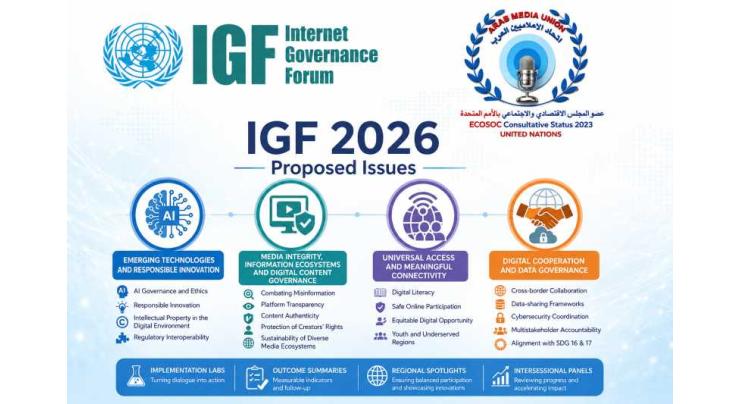
The submission included a number of proposals to further develop the forum’s work, most notably the establishment of Implementation Labs to translate discussions into actionable plans, the preparation of concise and standardised reports incorporating monitoring indicators and implementation timelines, and the allocation of dedicated sessions to review progress between forum meetings.
The Union also proposed strengthening partnerships with independent observatories, universities and civil society organisations to monitor the implementation of digital policies and assess their impact.
It further suggested that the next forum adopt “Trust, Equity and Implementation: Advancing Responsible Digital Governance for Sustainable Development” as its main theme, reflecting the need to move from dialogue to implementation while reinforcing the forum’s role as an international platform for developing digital policies through multi-stakeholder cooperation.
The vision outlined four principal tracks for the forum: emerging technologies and responsible innovation; media integrity and digital content governance; universal access and meaningful connectivity; and digital cooperation and data governance.
The Union also highlighted newly established mechanisms within its structure, including the creation of a Media Justice Court tasked with examining both traditional and digital media cases.
The Arab Media Union affirmed that strengthening international cooperation, promoting the principles of transparency and accountability, and developing practical mechanisms to monitor the implementation of international commitments are essential to building a safer, more inclusive and sustainable digital environment. It also expressed its readiness to cooperate with the United Nations and international partners to support the development of digital governance policies and strengthen trust in the digital environment at both the regional and international levels.