



Former British prime minister claims Pakistani generals fear Khan’s popularity, warns his death in prison would leave a “terrible stain” on Pakistan’s reputation
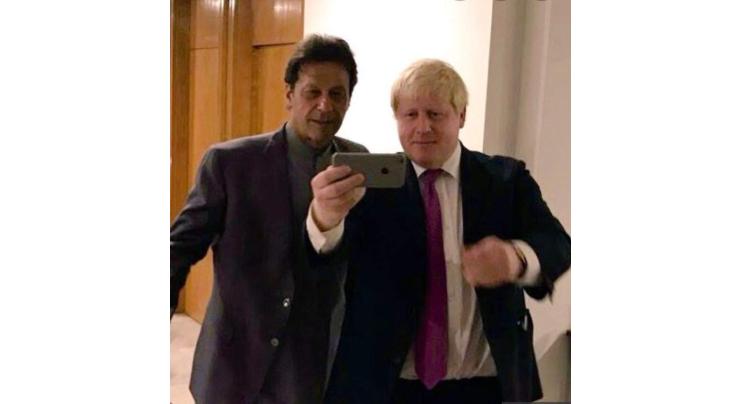
LONDON: Former British prime minister Boris Johnson has called for the immediate release of Pakistan’s jailed former premier Imran Khan, making a series of strong allegations about his imprisonment and claiming that Pakistan’s military leadership fears his enduring political popularity.
In an article for the Daily Mail, accompanied by a video message, Johnson raised concerns over Khan’s health, prison conditions and legal cases, while urging Britain to use its influence to press for his release.
Johnson ended his article with a direct appeal to Pakistani authorities:
“Unlock that cell and set Imran Khan free.”
The former British prime minister painted a grim picture of Khan’s incarceration, claiming that the 73-year-old former premier is being held in a small, damp and insect-infested cell and has repeatedly spent prolonged periods in solitary confinement.
Johnson claimed Khan’s cell, including its toilet, measures only six feet by eight feet and has no window.
He further alleged that Khan has at times been left without lights for extended periods and has faced restrictions on exercise, books, newspapers and meetings with family members.
He also raised concerns about Khan’s health, citing claims that delayed and inadequate medical treatment had severely affected the vision in his right eye.
‘They are afraid of Imran Khan’
Johnson argued that Khan’s continued imprisonment was not fundamentally about corruption but, in his view, about keeping one of Pakistan’s most popular political figures out of public life.
He accused Pakistan’s military leadership of seeking to remove Khan from the political landscape after the former prime minister attempted to exercise his constitutional authority while in office.
Explaining what he believed to be the reason for Khan’s continued incarceration, Johnson wrote that the answer was simple:
“They are afraid of Imran Khan.”
He pointed to Khan’s extraordinary popularity as a cricketer and politician, recalling his role in leading Pakistan to its historic 1992 Cricket World Cup triumph.
Johnson claimed Pakistan’s generals fear that if Khan were released, millions of supporters could propel him to a major electoral victory in the next available elections.
He repeated the argument in his video message, asking why the former Pakistani prime minister remained behind bars after more than three years.
Johnson said he did not believe Khan’s continued imprisonment could be justified merely by the possibility that he could return to politics and receive overwhelming public support.
Johnson acknowledges political differences with Khan
Despite his strong defence of Khan, Johnson made clear that he has not always agreed with the former Pakistani premier.
He referred to disagreements over Khan’s position following Russia’s invasion of Ukraine, his approach towards the Taliban and some of his views regarding the United States.
However, Johnson argued that none of those differences justified the treatment Khan was allegedly receiving in prison.
He said that even if there were questions for Khan to answer in the Al-Qadir case — something Johnson himself questioned — the former prime minister did not deserve what he described as mental and physical suffering.
Johnson argued that Khan should, above all, be given a prompt hearing of his appeal before an independent court.
Praise for Khan’s environmental and education policies
Johnson, who said he knows and likes Khan personally, also highlighted some of the policies pursued during Khan’s tenure as prime minister.
He praised his interest in forests and environmental protection and highlighted his focus on improving female literacy in Pakistan.
Johnson said Khan understood the importance of keeping girls in school and had sought to introduce financial incentives aimed at improving female education, although progress was disrupted in part by the Covid-19 pandemic.
Kasim and Sulaiman Khan mentioned
Johnson also highlighted the situation of Khan’s sons, Kasim Khan and Sulaiman Khan, both of whom hold British passports.
He criticised the difficulties they have faced in seeing their father in prison and questioned the British government’s response to the case.
Kasim Khan subsequently thanked Johnson for speaking out in support of his father and shared the former British prime minister’s article on social media platform X.
Kasim and Sulaiman have also stepped up their public campaign over their father’s imprisonment, health and treatment in custody.
Johnson criticises UK response
The former British prime minister also criticised what he described as an inadequate response from the British government.
Johnson pointed to the longstanding ties between Britain and Pakistan and said the UK should now use its influence to demand Khan’s release.
He also referred to Khan’s longstanding connections with Britain, including his education and cricket career in the country, and noted that the former Pakistani premier has a significant following in the UK.
Johnson directly mentions Field Marshal Asim Munir
Johnson also directly referred to Field Marshal Asim Munir, arguing that Pakistan’s military leadership was in a strong position and had no reason to fear an ailing 73-year-old former prime minister.
He suggested that Khan should be released or, if considered necessary, placed under house arrest while his appeal is heard.
‘A terrible stain on Pakistan’s reputation’
Johnson reserved some of his strongest language for the conclusion of his article, expressing fear that Pakistani authorities appeared to be actively hoping Khan would die in prison.
“At the moment I fear it looks as though the Pakistani authorities are actively hoping that Khan will die in jail. If that happens it will be a terrible stain on the reputation of Pakistan. Unlock that cell and set Imran Khan free.”
In his accompanying video message, Johnson also urged the public to read his Daily Mail article and join the campaign calling for Khan’s release.
Pakistan’s government and prison authorities have previously rejected allegations of mistreatment and unlawful solitary confinement, maintaining that Khan is being held in accordance with prison rules and relevant judicial orders.
Johnson’s assertions about the reasons for Khan’s imprisonment, the motives of Pakistan’s military leadership and Khan’s treatment in custody represent the former British prime minister’s allegations and assessment of the case.