


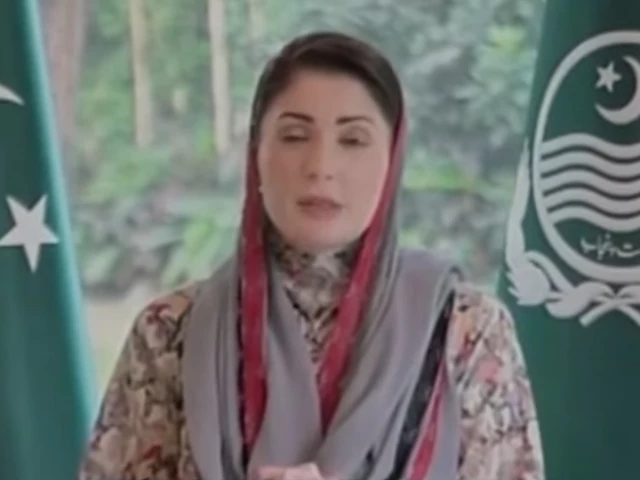
Punjab Chief Minister Maryam Nawaz Sharif reacts to AJK election results in a televised address on Tuesday. SCREENGRAB
LAHORE:
Punjab Chief Minister Maryam Nawaz Sharif has ordered a zero-tolerance campaign against corruption and malpractices with a confidential cell established to identify and initiate action against those involved.
According to a statement, a helpline 1350 has been made functional to receive public complaints regarding corruption and malpractices.
The chief minister ordered that reports prepared by the cell be submitted directly to her and arrests be initiated where necessary. She decided to monitor the action against corruption and made mandatory an independent review of the quality and expenditure on every development project.
The chief minister ordered that action on complaints of corruption be ensured within the stipulated timeframe.
She appealed to the public to immediately report any instance of corruption, demand for bribe or misuse of authority.
“Action will be taken on every complaint and the identity of the complainant will be kept completely confidential,” she said, adding that a single piece of information from the public could help expose an entire network of corruption and bribery.
Chief Minister Maryam Nawaz said action against corrupt elements would continue until the looted money was fully recovered.
“Corruption is not merely theft of money; it is theft of the rights and trust of the people,” she asserted. “Any hand reaching for public money will be stopped.”
She said a modern monitoring system would be utilised to oversee development projects.
“Public trust is the greatest asset of this government and I will not allow it to be compromised,” she said.
The chief minister said extensive funds had been released for development projects and warned that no one would be forgiven if even a single penny was not spent transparently.
“Those who perform well will be encouraged through the CM Merit Badge, while those involved in corruption will face the law,” she said.
She declared that every person involved in misappropriation of public money would be sent behind bars.
“Public money will be spent only on the people. I will not allow anyone to eat up public funds. Position, personal connections or recommendations will not be able to save anyone in corruption cases,” she maintained.
Chairing a meeting, Chief Minister Maryam Nawaz ordered restructuring of the Directorate General of Public Relations (DGPR) and called for third-party validation to assess the department’s performance. “Communication has evolved from an art into a science, and it is important to understand this,” she said.
Veterinary fleet
Chief Minister Maryam Nawaz also inaugurated a veterinary fleet aimed at providing livestock treatment and diagnostic services at farmers’ doorsteps.
During a ceremony, she inspected a state-of-the-art mobile veterinary dispensary, laboratory and X-ray unit.
She directed the livestock department to organise a livestock conference and approved the proposed design of model veterinary hospitals across the province.
According to a briefing by Livestock Minister Ashiq Hussain Kirmani and Secretary Ahmed Aziz Tarar, 30 additional mobile veterinary dispensaries and 17 laboratories have been launched, bringing the number of functional facilities to 262.
The mobile dispensaries will be equipped with ultrasound and X-ray facilities, while the laboratories will be capable of conducting 40 tests at the site.
The mobile veterinary hospitals will also undertake disease screening and surveillance among livestock.
X-ray facilities woul d be available at 10 divisional hospitals, while 36 district-level facilities would have operation theatres and laboratories. As many as 138 ultrasound machines would be provided in tehsils.
The government plans to deploy veterinary assistants on 6,964 motorbikes to provide treatment at livestock farmers’ premises. Under the CM Internship Programme, 1,000 veterinary doctors and assistants have so far treated around 3.4 million animals across Punjab.
The chief minister was informed that 230 veterinary hospitals would be constructed or rehabilitated at the tehsil level, with a model hospital to be established in each tehsil. The model hospitals will have cattle, mechanical and horse crushes, while operation theatres will be equipped with hydraulic tables and modern lighting systems.