


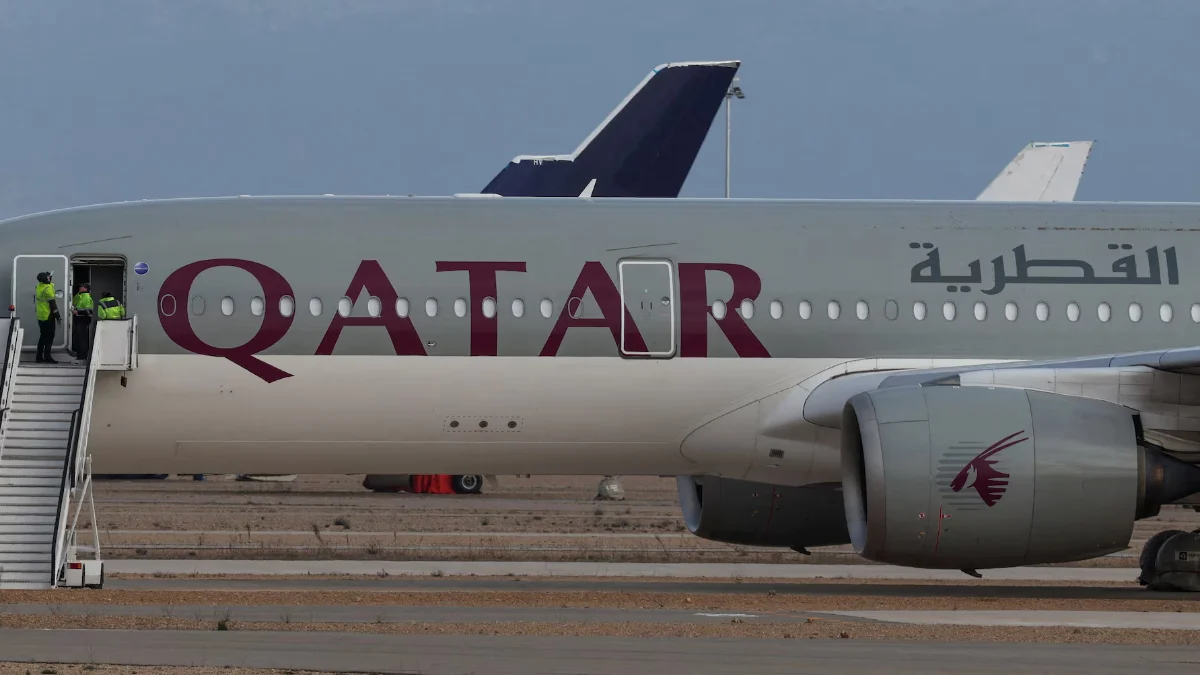
LONDON – Qatar Airways has retired its last Airbus A330 passenger jets and seconded some pilots to Rwanda’s flag carrier as the prolonged Iran war disrupts Gulf aviation and accelerates the global phase-out of older jets, according to two people with knowledge of the matter and data reviewed by Reuters.
The move is the latest sign of the impact of a doubling of jet fuel prices since the war began, ending an industry-wide scramble for older jets to meet post-COVID travel demand.
Qatar Airways leased four Airbus wide-body A330 jets from Oman Air last year and planned to keep flying them through 2026, but the aircraft never entered commercial service, the people said. The carrier has now fully retired its A330 fleet.
One of the A330s was acquired earlier this year by Rwandan flag carrier RwandAir. Qatar Airways has longstanding ties to the airline and the people said a group of pilots, some of whom had not flown commercially since the start of the war, have been seconded to RwandAir.
The secondments and details of the fleet retirements have not previously been reported.
A Qatar Airways spokesperson said it was normal for the airline to regularly review its fleet, “retiring older aircraft and introducing newer, more efficient aircraft as they are delivered”. In the next five years it expects to receive 138 new aircraft, the spokesperson added.
The carrier operates a mixed Airbus and Boeing fleet of 239 passenger jets and 30 freighters, according to the company. A330s made up 7% of the passenger total, as of March, according to company data.
“A group of Qatar Airways A330 pilots are being offered a voluntary short-term secondment opportunity with RwandAir,” the Qatar Airways spokesperson said, adding the scheme offered valuable flying opportunities for pilots while supporting the operational requirements of both airlines, without saying how long the secondment would last.
COSTS SPIKE AS WAR CONTINUES
The war has impacted airlines globally but particularly the Middle East aviation hubs of Dubai and Doha following the February 28 US-Israeli strikes on Iran, although flight volumes have recovered to near pre-war levels.
By grounding the less fuel-efficient and older A330 fleet, Qatar is containing jet fuel costs. Parking the planes is substantially cheaper than flying them at current high oil prices, analysts said.
The remaining aircraft Qatar Airways leased from Oman Air are parked either in Teruel, Spain, or in Doha, according to flight tracking data, and have remained parked in recent months, as the Iran war has dragged on. Two of the A330s parked in Doha, which Qatar is leasing from aircraft lessor Jetran, will be returned to the lessor in October.
PASSENGER CAPACITY FALLS
Analysts said older planes like the out-of-production A330 operated by Qatar Airways would have been phased out by now, but have remained in service longer than expected due to manufacturing delays and high post-COVID travel demand.
Now, surging oil prices have made it less attractive to operate older jets, with global A330-200 and A330-300 flight operations down by about 12% from September 2025, according to seven-day averages calculated by Cirium Ascend, which tracks global fleet movements.
Cirium data shows there are overall some 801 active A330-200 and A330-300 jets globally. A total of 1,437 of the two models were built and delivered, Airbus data show. Those early models of A330 are no longer in production.
Qatar’s operational headache has been compounded by widespread disruption to Gulf carriers since the war began and the loss of some transit passengers to competing hubs.
“Middle East carriers are not flying the aircraft as much because of restrictions on the use of airspace there,” IBA’s head of consulting Dan Taylor said earlier this month.
As of September, Qatar Airways’ seven-day average available seat kilometres (ASK) – the industry’s standard measure of passenger-carrying capacity – was 10% lower than a year ago, according to Cirium Ascend, compared with a 10% decline at Emirates and flat global industry capacity.
Qatar Airways is on average operating 12% fewer flights versus a year ago, and using 4% fewer planes, although it is on track to return to capacity and network growth by 2027, Cirium said.
FLEET RENEWAL PLANS
While short-term demand has weakened, Qatar still expects growth to resume once regional disruption eases and will soon start recruiting pilots for newer aircraft, it said.
The secondment of just over a dozen staff to RwandAir would ensure pilots trained to fly A330s can continue flying, the spokesperson said. Airlines do sometimes offer secondments to their pilots based on international partnerships with other carriers.
RwandAir, which has a codeshare agreement with Qatar, did not respond to a request for comment. It said in a post on X in August that it had received the first of five expected A330 jets.
Qatar Airways, which runs one of the world’s busiest hubs and competes mainly with Dubai-based Emirates, continues to take delivery of new jets. It has received two large wide-body jets each from Airbus and Boeing this year, company data shows.
The Qatar Airways spokesperson said that between September 2026 and the end of 2027, the carrier was planning 6 aircraft exits and 19 new plane deliveries.
To meet growth objectives stretching into the 2030s, the airline has a total of 410 planes still on order from Boeing and Airbus, including 160 announced during a visit to the Gulf Arab state by US President Donald Trump in May last year.
Reporting by Joanna Plucinska, Alessandro Pardodi and Gianluca Lo Nostro; Additional reporting by Tim Hepher in Paris, Federico Maccioni in Dubai and Philbert Girinema in Kigali, Rwanda; Editing by Adam Jourdan and Elaine Hardcastl