


Saudi airstrikes on port city of Mokha kill 6, says Houthi-affiliated news agency
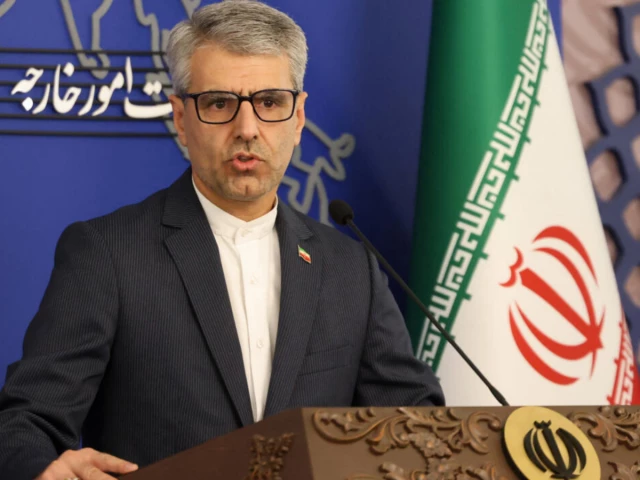
Iran’s Foreign Ministry Spokesperson, Esmaeil Baqaei. PHOTO: AFP
Iranian Foreign Ministry Spokesperson Esmaeil Baghaei said on Tuesday that the US was attempting to shift blame onto Iran for rising fuel prices, adding that the public would not forget “who actually initiated the war of aggression, and whose actions created the crisis that led to the closure of the Strait of Hormuz.”
U.S. officials blame Iran for rising fuel prices, as if the public’s memory is short enough to forget who actually initiated the war of aggression, and whose actions created the crisis that led to the closure of the Strait of Hormuz and the disruption of commercial shipping.…
— Esmaeil Baqaei (@IRIMFA_SPOX) September 22, 2026
He likened the US’ shifting of blame to how “Hitler similarly framed his invasion of Poland as a defensive action.”
Read: All Iranian airlines to shut down worldwide by Sept 23, US Treasury chief says
“When the instigator of an unlawful ‘war of choice’ blames the victim for the fallout, should this be viewed as ‘strategic brilliance’, or is it simply a textbook symptom of ‘The March of Folly’?!”
Primary objective to advocate for ‘legitimacy, rights, and interests’ of Iran’s people: Araghchi
Iranian Foreign Minister Abbas Araghchi said in comments carried by IRNA that the primary objective in taking part in the summit in New York was to “advocate for the legitimacy, rights, and interests of the Iranian people.”
As he began his journey to New York, Iranian Foreign Minister @araghchi stated that their primary objective is to take part in a significant international forum in order to advocate for the legitimacy, rights, and interests of the Iranian people. pic.twitter.com/zPNQ7pbnkU
— IRNA News Agency ☫ (@IrnaEnglish) September 22, 2026
Earlier, Baghaei released a statement on X regarding Araghchi’s visit, saying that “In addition to participating in the various agenda items of the United Nations General Assembly [UNGA]… Foreign Minister will hold talks and consultations with a large number of officials and foreign ministers attending the summit.”
ورود وزیر امور خارجه به نیویورک جهت شرکت در اجلاس سالانه مجمع عمومی سازمان ملل متحد
سيد عباس عراقچی وزیر امور خارجه جمهوری اسلامی ایران، بعد از ظهر امروز دوشنبه در راس یک هیات دیپلماتیک برای مشارکت در مباحث اجلاس سالانه مجمع عمومی سازمان ملل متحد وارد نیویورک مقر سازمان ملل…
— Esmaeil Baqaei (@IRIMFA_SPOX) September 22, 2026
Iranian Foreign Minister Abbas Araghchi arrived in New York on Monday to participate in the 81st session of the UNGA.
Minister of Foreign Affairs of the Islamic Republic of Iran @araghchi , arrived in New York on Monday local time to participate in the 81st session of the United Nations General Assembly. pic.twitter.com/IJsgPyKkOd
— IRNA News Agency ☫ (@IrnaEnglish) September 21, 2026
The top diplomat, who is leading a high-level delegation, was received at John F. Kennedy International Airport by Gholamhossein Darzi, Iran’s permanent representative and charge d’affaires to the United Nations, according to Iran’s state-owned news agency IRNA.
On his way to New York, Araghchi made a brief stop in Doha, where he held discussions with Qatari officials about the latest developments in the region.
Read more: Naqvi assures Iranian president of Pakistan’s determination to expand multisector cooperation
Iranian President Masoud Pezeshkian is also scheduled to travel to New York on Tuesday to attend and address the 81st UN General Assembly.
During the summit, he is expected to meet and consult with several world leaders and officials on the sidelines.
Saudi airstrikes on port city of Mokha kill 6, says Houthi-affiliated news agency
Saudi airstrikes on the strategic Red Sea port city of Mokha killed at least six people and injured eight others, according to a report on Tuesday by the Houthi-affiliated Saba news agency.
“Six civilians, including two children and a woman, were killed and eight others, including a child and a woman, were injured in Saudi-led airstrikes on Mokha,” Saba said.
The Houthis are fighting Yemen’s internationally recognised government in a civil war, with Saudi Arabia backing the government.
In recent days, the Houthis have claimed responsibility for drone and ballistic missile attacks targeting the Saudi capital Riyadh as well as energy facilities along the country’s Red Sea coast.
G7 foreign ministers call on Iran to stop arming Houthis
G7 foreign ministers called on Iran on Tuesday “to end its arming of and support for the Houthis,” warning that the escalating attacks threaten international trade and global stability, according to Al Jazeera.
They also called on the Houthis to “immediately cease all military actions, all threats and attacks against civilian shipping, and to return to the political process in good faith,” the leaders representing Canada, France, Germany, Italy, Japan, the United Kingdom and the United States said in a statement.
They alleged that Tehran was in violation of past UN Security Council resolutions.
US eyes $5B fund to rebuild Gulf energy sites hit in war against Iran
The US has floated committing $5 billion to a new multinational fund aimed at repairing Gulf energy facilities hit during the war with Iran and helping regional states find export routes that bypass the Strait of Hormuz, according to a media report on Monday.
The Wall Street Journal, citing US and Middle Eastern officials and documents it reviewed, said Washington is seeking a matching $5 billion contribution from eight Middle Eastern partners — Saudi Arabia, the United Arab Emirates, Qatar, Bahrain, Kuwait, Oman, Iraq and Jordan — which would bring the total to $10 billion.
The initiative is called the Partnership for Allied Trust and Construction (Pact).
The US Development Finance Corporation would run the fund, according to the report. The agency’s past work has mostly centred on developing countries rather than rich Gulf monarchies.
US officials stressed that discussions are still underway, the terms may change, and it remains uncertain whether any country will sign on.
Some regional officials viewed the plan as an effort to portray the Strait of Hormuz as less critical and show a united front against Tehran, the Journal said. They also argued that funding reconstruction before a peace deal would be premature because Iran could target new facilities.
“This strategy has risk written all over it,” said Bilal Saab of the consulting firm TRENDS US.
Since the seven-month war began, Iranian missiles and drones have struck dozens of refineries, oil fields and gas export terminals, according to the report. A drone attack earlier this month also knocked out Saudi Arabia’s bypass pipeline, sending more crude through the Hormuz Strait and pushing tanker rates to record highs.
Umer Karim, a Gulf security researcher at the University of Birmingham, warned that the scheme could make some participants dependent on others and strain bilateral relations.
Repair costs are estimated at tens of billions of dollars, The Wall Street Journal added.
France working on UN Security Council resolution on Hormuz: diplomatic source
France is working on a new UN Security Council resolution to unblock the Strait of Hormuz, a diplomatic source told reporters, AFP reported.
“France wants to work with the Americans and its partners on a Security Council resolution guaranteeing freedom of navigation in the Strait of Hormuz,” the source said.
In April, Russia and China vetoed a draft resolution — spearheaded by Bahrain and backed by Gulf states and the United States — that also called for the Strait of Hormuz to be unblocked.
France seeks India’s role on Hormuz Strait, welcomes Pakistan’s Iran-US mediation
France sought to work with India to ensure freedom of navigation in the Strait of Hormuz and welcomed Pakistan’s mediation efforts between Iran and the US, according to the French Foreign Ministry on Monday.
Foreign Minister Jean-Noel Barrot met separately with his Indian and Pakistani counterparts on the sidelines of the UN General Assembly in New York.
Also read: PM Shehbaz arrives in New York to attend 81st UNGA session amid Middle East crisis
During his meeting with Indian External Affairs Minister Subrahmanyam Jaishankar, the two ministers “underscored the imperative of ensuring freedom of navigation” in the Strait of Hormuz and the Bab el-Mandeb Strait.
Barrot proposed that India work jointly with France on the issue, which is “crucial to the stability and prosperity of Europe and Asia.”
He also recalled the Franco-British initiative launched to ensure freedom of navigation in the Strait of Hormuz.
Barrot and Jaishankar reiterated France and India’s commitment to international law and their joint support for “effective and reformed multilateralism.”
They also recalled their intention to reform the UN Security Council.
The two ministers reaffirmed their support for a ceasefire in Ukraine and for “a comprehensive, just and lasting peace in accordance with international law.”
They also welcomed progress in the “comprehensive and special Franco-Indian strategic partnership,” particularly in defence, new technologies and higher education.
Barrot separately met Pakistani Deputy Prime Minister and Foreign Minister Ishaq Dar, with whom he discussed regional developments.
Also read: FM Dar stresses importance of GSP+ status in meeting with EU foreign policy chief
Barrot welcomed Pakistan’s mediation efforts between Iran and the US and stressed the need for “the most inclusive negotiations possible” to help secure energy supplies in particular and “sustainably address the threats posed by Iran in the nuclear, ballistic and regional spheres.”
The two ministers agreed to continue developing bilateral relations, particularly in university cooperation, cultural cooperation and sustainable development.
UK’s Burnham agrees to Saudi request for refuelling support
British Prime Minister Andy Burnham said on Monday he had agreed to a request from Saudi Arabia to provide defensive air-to-air refuelling for a limited time period, a move he described as helping to stabilise the wider region.
Riyadh requested support after the Houthis, who control the most populous parts of Yemen, intensified their attacks on Saudi Arabia, a new front in the wider war that began with US and Israeli strikes on Iran in late February.
“We have received a request from the Kingdom of Saudi Arabia for military support, and on the advice of the defence secretary and the foreign secretary, last night I agreed to that request for defensive air-to-air refuelling,” he told reporters as he travelled to New York for a meeting of the United Nations General Assembly.
“Because, of course, Saudi Arabia has been experiencing attacks… and we need to keep those pathways open, and hence our agreement to the request,” he said.
Britain and Saudi Arabia have been close military allies for decades, with Britain serving as one of the kingdom’s largest arms suppliers.
Earlier this year, Britain deployed its Sky Sabre air defence system to Saudi Arabia to help protect it from Iranian missile attacks during the US-Israeli conflict with Iran.
For the new air-to-air refuelling support, Britain will deploy one Voyager plane in the coming days.
“That is a time-limited agreement in terms of the assistance that we will provide, but we will keep it under review,” he said, adding that Britain was “playing our part” in the Middle East also by supporting efforts to keep the Strait of Hormuz open.