


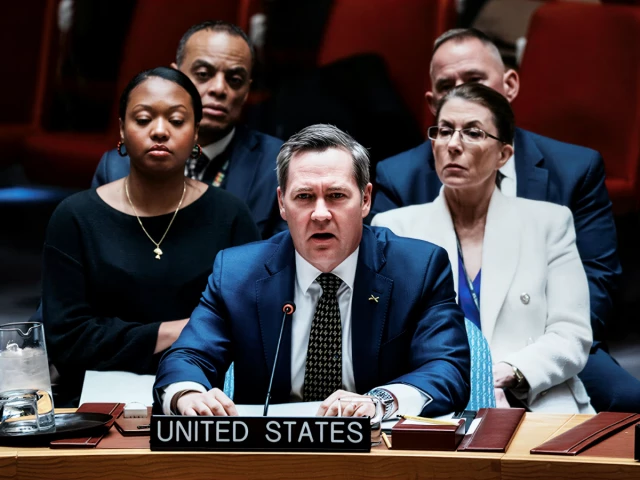
United States Ambassador to the United Nations Mike Waltz speaks during a Security Council meeting to discuss ‘ongoing US aggression’ against Venezuela, at U.N. headquarters in New York City, U.S., December 23, 2025. Reuters
US Ambassador to the UN Mike Waltz said on Sunday that the “door is open” for Iran to return to negotiations to end the conflict in the Middle East.
Speaking at an Al-Monitor Live event in New York on the sidelines of the UN General Assembly, Waltz said the Trump administration believes time is on its side in the conflict with Iran, which began February 28.
“I do believe that to be the case,” Waltz said when asked by Al-Monitor senior adviser Andrew Parasiliti whether Washington believes time is on its side.
He added that the “door is open for Iran to come back to the negotiating table,” while dismissing as “fantastical” reports that Tehran has demanded an end to US sanctions and reparations as conditions for renewed talks.
Waltz also said that Iran “can never [be allowed to] hold the world hostage with a nuclear weapon.”
“The Iranian regime is at its weakest point since 1979, and it’s getting weaker,” Waltz said, citing economic pressure and the collapse of Iran’s currency. “They’re going to come back [to talks], I hope peacefully and diplomatically.”
US military preparing to resume strikes
Iranian military command said on Monday that it received information that the US planned to resume strikes on the country, according to Al Jazeera.
Iran would use new weapons and target locations not previously attacked if the United States launched a new offensive against it, Revolutionary Guards spokesperson Hossein Mohebbi said on Monday, according to the Fars news agency.
“If a new aggression occurs, we will certainly change the weaponry and the geography of the war,” Mohebbi said, adding that Tehran was prepared for a prolonged conflict.
Earlier, Iranian Parliament Speaker Mohammad Bagher Ghalibaf said that Tehran’s “messages and conditions have been conveyed explicitly” to the US through intermediaries. He reiterated that the conditions must be met before negotiations resume.
Iranian Parliament Speaker Mohammad Bagher Ghalibaf said that Tehran’s “messages and conditions have been conveyed explicitly” to the US through intermediaries. He reiterated the conditions must be met before negotiations resume.
🔴 LIVE updates: https://t.co/qJleYbnwN8 pic.twitter.com/VYgZvxBhxB
— Al Jazeera English (@AJEnglish) September 20, 2026
Vessels trickle through Strait of Hormuz as Middle East conflict persists
A dozen commodity vessels transited the Strait of Hormuz on the weekend, down from 35 the prior weekend, shipping data showed on Monday, as tension in the Gulf persisted with the US and Iran in stalemate.
Visible traffic through the strait, the conduit for a fifth of the world’s oil and liquefied natural gas before the war, has dwindled to a trickle. However, Middle Eastern producers continue to export oil on tankers travelling with their transponders off.
Among trackable ships, four vessels — two tankers carrying refined oil products and two empty carriers for bulk goods and gas — exited the strait on Sunday, while another two small-sized oil tankers entered the Gulf, provisional data from analytics firm Kpler showed.
On Saturday, five vessels left the Gulf carrying agricultural products, liquefied petroleum gas and fertiliser while an empty very large gas carrier entered, the data showed.
Before the US-Israeli war with Iran started on February 28, the strait typically handled about 125 large, commercial vessels per day, including tankers, gas carriers, bulkers and container vessels.
Saudi crude exports rising
The attacks by the Houthis on Saudi Aramco’s East-West pipeline have prompted the state energy firm to increase exports through the Strait of Hormuz this month and next after halting some shipments via Yanbu.
That enabled exports from the OPEC kingpin to recover to over 4 million barrels per day (bpd) so far in September after slumping to 2.4 million bpd in August, the lowest since at least 2013, according to provisional data from Kpler.
A total of 18 tankers, mostly very large crude carriers carrying 34 million barrels of crude, exited the strait in the week of September 13, Kpler data showed. Saudi Arabia accounted for half of the exports, while 35% of the volume came from Iraq.
“Middle East oil flows remain surprisingly strong despite the disruption to Saudi Arabia’s East-West pipeline,” JPMorgan analysts said in a note on September 18, adding that the total oil flows averaged 17.1 million bpd in the past 10 days, just 6.1 million bpd below the 2025 average.
“The most notable pivot has come from Saudi Arabia,” the analysts said, as satellite data indicated Saudi oil moving through the Strait of Hormuz averaged 2.9 million bpd over the past six days, up from just 700,000 bpd in August.
Iran says it downed US MQ-1 drone over Strait of Hormuz: report
Iran’s Islamic Revolutionary Guard Corps (IRGC) said on Monday that it intercepted and destroyed a US Army MQ-1 drone over the Strait of Hormuz, according to Iranian media.
The IRGC said the drone was brought down by its new advanced aerospace air defence system, operating as part of Iran’s integrated air defence network, Mehr News Agency reported.
The force claimed Washington had returned the MQ-1 to service after suffering heavy losses among its MQ-9 fleet.
It said the MQ-1, known as the “Beast of Kandahar” after logging about 20,000 flight hours over Afghanistan, had been retired from US military service and replaced by the MQ-9.
After the destruction of a large portion of the MQ-9 fleet, the US has been forced to use this drone, the IRGC said.
Iran and US trade threats after Houthi attacks escalate regional conflict
Iran and the United States exchanged new threats on Sunday, with President Donald Trump warning Iran would fail economically or face its leadership being wiped out if it didn’t make a deal, and the Iranian military saying it would retaliate harshly to any fresh attack.
The conflict has looked stalemated for months, with no sign either side was ready for concessions even as it has deepened a global energy crisis, cratered swathes of Iran’s economy and spilt over into new regional escalations.
In a phone call with a Fox News reporter, Trump said Iran’s leaders should make a deal, rot economically or be wiped out, the reporter said.
However, with Iran’s President Masoud Pezeshkian expected in New York this week for the United Nations General Assembly, Trump said he would be open to meeting him, the Fox reporter added.
Read: Trump warns he has entered ‘deciding mode’ on Iran, says ‘big things’ are in store
Trump has repeatedly made vague threats of major military escalations during the conflict that began with US and Israeli strikes on February 28, without carrying them out.
Earlier, Iran’s military central command said any new attack would trigger sustained retaliation against US bases and interests and that Washington’s regional allies would be considered parties to the conflict.
The Iranian military added that it had information that an attack was being prepared, without elaborating on what that information might be.
Yemen’s Giants Brigades say 5 Houthi military vehicles destroyed near Bab al-Mandab Strait
Yemen’s government-affiliated Giants Brigades said on Sunday that they destroyed five Houthi military vehicles on the Kahbub front overlooking the Bab al-Mandab Strait, killing all those inside.
“The Giants Brigades destroyed five Houthi military vehicles, killing everyone aboard them,” the brigade’s media center said in a Facebook statement, without giving a death toll.
It said one vehicle belonged to an unidentified commander, and another carried a 23mm weapon.
The media centre released video purportedly showing the vehicles engulfed in flames.
The Houthis did not immediately comment.
The Kahbub Mountains in Lahj governorate near the Bab al-Mandab Strait are strategically important because they overlook a major international shipping route connecting the Red Sea and Gulf of Aden.
Qatar says mediation efforts underway to revive US-Iran talks
Qatar said on Sunday that its mediation team has been discussing proposals for nearly two weeks aimed at restarting talks between the United States and Iran.
“We have been exchanging various ideas for nearly two weeks on resuming talks between Washington and Tehran,” said Foreign Ministry spokesman Majed al-Ansari, according to Qatari media.
Qatar, alongside Pakistan, has been mediating between the two sides.
“We are working through our mediation team with Tehran and Washington to see whether talks can resume, and our mediators are currently moving between different capitals in the hope of making progress on this track,” al-Ansari said.
He added that Qatar had heard assurances from officials in the US administration that Washington wanted to reach an agreement.
Al-Ansari said there is a need for “a regional solution that achieves stability and an international understanding that protects waterways such as the Strait of Hormuz.”
“Subjecting waterways to the sovereignty of a single state and using them as a weapon will set a dangerous precedent for all of us,” he added.
The US has recently carried out military attacks on sites in Iran amid a deadlock in negotiations over disagreements concerning navigation in the Strait of Hormuz, one of the world’s most important routes for energy supplies and global trade, despite a memorandum of understanding signed by the two sides in mid-June.
Iran responded with attacks on what it said were US military facilities and equipment in Arab countries, including Saudi Arabia. Some of the attacks caused civilian casualties and damage to civilian infrastructure, drawing condemnation from the affected countries and calls for them to stop.
The US and Israel launched a war against Iran on February 28, leaving more than 3,000 people dead. Iran responded with attacks that it said killed Americans and Israelis.
Houthis target Riyadh
US Gulf allies have already been badly scarred by a war that the US and Israel launched with no warning, bringing their cities under Iranian fire and hammering their economies with the crucial Strait of Hormuz waterway blockaded.
On Saturday, their predicament worsened further, with Yemen’s Iran-backed Houthi group launching missile and drone strikes at the Saudi capital after having made sudden military gains in Yemen’s reignited civil war earlier this month.
Reuters video showed a massive plume of black smoke billowing from the area of Riyadh’s main international airport following booms overnight.
Read more: UN Security Council condemns Houthi attacks on Saudi Arabia
The US State Department issued a security alert citing the Houthi hostilities. It said there was potential for unforeseen escalation in the Middle East, and Americans should exercise more vigilance and be aware of possible flight cancellations and airspace closures.
Saudi Arabia did not comment on the incident, though a Saudi-led coalition fighting the Houthis said it had foiled other attacks on the kingdom.
Recent escalation by the Houthis has forced Riyadh into a painful dilemma: continue airstrikes on the group to stop it seizing more Yemeni territory or step back in the hopes of averting drone strikes on critical infrastructure.
Energy exports blockaded
The Houthi gains along the coast mean the group’s forces now sit on the Bab el-Mandeb Strait, giving them easier control over shipping travelling between the Red Sea and Asia and the ability to blockade the crucial waterway.
With Iran already having blockaded most shipping in the Strait of Hormuz, the oil-rich Gulf’s energy exports are now almost entirely cut off from global markets, adding to pressure on oil prices.
A US blockade of Iranian ports is meanwhile stopping Iran from selling its own oil, contributing to major problems in the Islamic Republic’s economy.
Despite the economic damage, there is little sign of a return to the interim ceasefire agreement that was struck in June but fell apart in July amid disputes over its terms.
Iran reiterated on Sunday that it would not reopen the Strait of Hormuz until the terms of that June agreement, as it interpreted them, were met.
Iranian Parliament Speaker Mohammad Baqer Qalibaf said Iran would have to keep on fighting as well as negotiating, to push back its enemies and to consolidate any gains with diplomacy.