


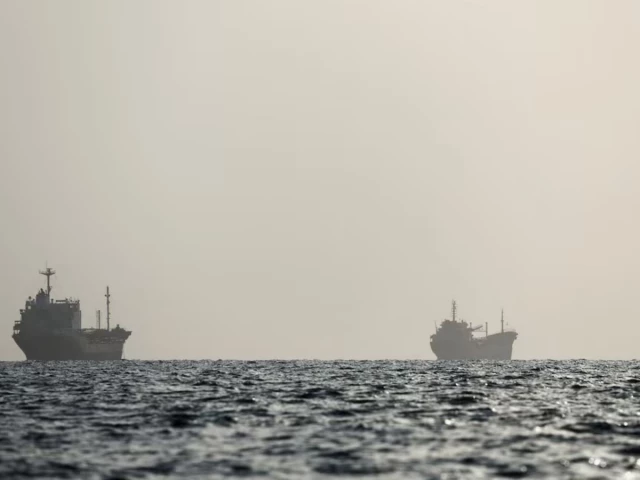
Iran threatened vessels using the strait, cutting traffic and raising oil prices after the war began six months ago
Iranian President Masoud Pezeshkian meets with Qatari Prime Minister and Foreign Minister Mohammed bin Abdulrahman Al Thani, in Tehran, Iran, August 27, 2026.REUTERS
Mediators in the Iran war are stepping up efforts to get the Strait of Hormuz reopened, with Tehran agreeing to draw up a list of conditions to restore normal traffic after a Qatari emissary pressed the Iranians to respect freedom of navigation.
With the US having disengaged from talks in favour of an economic pressure campaign, the prime minister of Qatar, a US ally, met senior Iranian leaders in Tehran on Thursday, stressing the importance of returning to the pre-war status of open shipping through an international waterway.
Qatar and Pakistan helped broker a memorandum of understanding in June that led to a ceasefire but that quickly unravelled due to disagreements between Iran and the US over the strait, which handled 20% of pre-war global oil supplies.
In his mission to Tehran on Thursday, Qatari Prime Minister and Foreign Minister Sheikh Mohammed bin Abdulrahman Al Thani said on X that he underscored to senior Iranian officials “the importance of respecting freedom of navigation in the Strait of Hormuz in accordance with international law”.
Iranian Foreign Minister Abbas Araghchi on Friday described the talks with Al Thani as “creative”, and he renewed his appeal to the US to stop putting military and economic pressure on his country and to resume negotiations.
“Putting diplomacy back on track isn’t impossible. It hinges on US understanding of one simple fact: pressure doesn’t work,” Araghchi said on X.
Had creative discussions with H.E. the PM/FM of Qatar.
Putting diplomacy back on track isn’t impossible. It hinges on U.S. understanding of one simple fact: pressure doesn’t work. The U.S. should build trust, speak respectfully, acknowledge our rights, and uphold commitments. pic.twitter.com/9yQ2pOXe5R
— Seyed Abbas Araghchi (@araghchi) August 28, 2026
Iran’s foreign ministry later issued a statement condemning the United States’ new economic sanctions on the country, announced on Monday, as “state terrorism”. It also urged other countries not to join the sanctions, saying this would amount to “complicity in imposing one state’s unlawful will” on others.
Iran prepares list of conditions for reopening the strait
After the US and Israel launched the war six months ago, Iran threatened to strike any vessel transiting the strait without its authorisation, driving down traffic and sending up the price of oil, providing Tehran with leverage in the bargain.
The US wants the strait to remain an open international waterway.
Mohsen Rezaei, secretary of Iran’s Supreme National Security Council, said on Thursday Iran was preparing a list of conditions for reopening the strait.
Speaking through an interpreter in an Al Manar TV interview, Rezaei said Iran had agreed with Oman on a shipping corridor through the strait, with parts of the route in Omani waters and parts in Iranian waters. Ships would use a designated central channel if the US met Iran’s conditions, he said.
In the past Iran’s conditions have included an end to the US blockade on Iranian ports, compensation and removal of sanctions. It remained unclear whether Iran intended to amend those demands in a way that might be acceptable to Washington.
Tehran and Washington have exchanged little more than bellicose statements in recent weeks, leaving the diplomacy to third parties.
Trump declared the June MOU “over” on July 8 and has cranked up efforts to wreck Iran’s economy.
Clearing sea mines
US military commanders say American forces have cleared sea mines from the strait that had been laid months ago by Iran’s Islamic Revolutionary Guard Corps.
“Bottom line: today, international shipping lanes are open and momentum is building,” Admiral Brad Cooper, commander of the US military’s Central Command, said in a video message posted on social media.
US forces have in recent months helped 1,500 commercial vessels carrying nearly 750 million barrels of crude oil to transit the strait, Cooper said.
Trump has repeatedly said the strait was open, but many vessels have opted against sailing through it because of Iranian threats, and ship tracking services have estimated activity at roughly 5% to 15% of normal volumes.
Preliminary shipping data released on Friday showed that only seven commodity vessels had transited the Strait of Hormuz on Thursday, down from 17 a day earlier and below the 10-day average of 15.
However, Gulf energy exporters have also been seeking to reduce their overreliance on the strait by investing billions of dollars in new infrastructure, from energy pipelines to ports.
Trade is being redirected to Saudi ports on the Red Sea and the United Arab Emirates’ eastern coast ports, though capacity is smaller.
Oil prices held steady on Friday but were on track for a weekly drop, amid what analysts said were signs that more oil was flowing through the strait despite the diplomatic stalemate and that producers were increasingly adapting to the new realities in the Gulf region.
If you want, I can also tighten this further into a more authentic Reuters desk copy, removing repetition and sharpening the lead and transitions.