


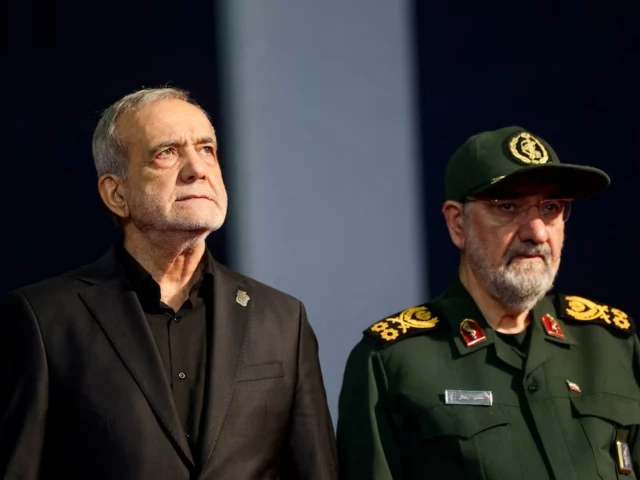
Rezaei has led the IRGC for 16 years and oversaw the expansion of its ground, naval and air capabilities
Iranian President Masoud Pezeshkian and adviser to Iran’s supreme leader Mohsen Rezaei attend a farewell ceremony for Iran’s late Supreme Leader Ayatollah Ali Khamenei, who was killed on February 28 during Israeli and US airstrikes on Iran, for international delegates at the Imam Khomeini Grand Mosalla in Tehran, Iran, July 3, 2026. — REUTERS
Iran on Monday appointed Mohsen Rezaei as secretary of its Supreme National Security Council (SNSC), promoting a prominent hardliner and close ally of Supreme Leader Ayatollah Mojtaba Khamenei to the role more than five months into the conflict with the United States.
Rezaei replaces Mohammad Baqer Zolqadr as second-in-command of the body that coordinates Iran’s security and foreign policy and is chaired by President Masoud Pezeshkian. Zolqadr was appointed as political adviser to Khamenei.
Here’s what you need to know about Rezaei, 71:
Commanded Revolutionary Guards aged 27
Rezaei joined the Islamic Revolutionary Guard Corps (IRGC) shortly after the 1979 Islamic Revolution and became its commander in 1981, aged 27. He led the IRGC for 16 years, including for most of the 1980-88 Iran-Iraq war, and oversaw the expansion of its ground, naval and air capabilities.
He is part of a generation of IRGC commanders who emerged from the revolutionary underground and later became senior figures in Iran’s security apparatus.
A prominent figure in the country’s political and security establishment since leaving his role as IRGC commander, he has been a perennial candidate for president of the Islamic Republic. He served as vice president for economic affairs from 2021 to 2023 under former president Ebrahim Raisi.
He holds a doctorate in economics from the University of Tehran.
Adviser to Mojtaba
Rezaei was appointed military adviser to Khamenei in March after he took over as Iran’s supreme leader, replacing his father, the late Ayatollah Ali Khamenei, who was killed at the start of the US-Israeli war on Iran.
He has made frequent public statements during the war, voicing deep scepticism about negotiations and threatening the United States.
In April, Rezaei said it would be “great” if the US launched a ground invasion of Iran, as “we would take thousands of hostages and then for each hostage we would get a billion dollars”. “I am not in favour of extending the ceasefire at all, and this is a personal view,” he said at the time.
READ: Pakistan, Qatar preparing document for reopening Hormuz amid indirect US-Iran contacts: sources
In June, before Iran signed a memorandum of understanding aimed at ending the war on June 17, Rezaei stated that the agreement had ambiguities that needed clarification. On June 27, he accused Washington of violating the deal by creating tensions in the Strait of Hormuz.
Major General Mohsen Rezaei: Under no conditions will we permit the opening of a second passageway in the Strait of Hormuz. Should any naval vessels or military troops be deployed there with that intent, we will strike them. pic.twitter.com/wpHZ7sRp7o
— IRNA News Agency ☫ (@IrnaEnglish) August 4, 2026
Reflecting his close ties to Mojtaba, the supreme leader issued a decree on Sunday appointing Rezaei as his representative on the SNSC. Khamenei cited Rezaei’s “valuable experience” in the appointment, including his long military career.
Opposed the Shah
Rezaei was active in the opposition to the Pahlavi monarchy, which was overthrown in 1979, while still a teenager, and imprisoned by the Shah’s security service, SAVAK, in 1973.
He helped establish and develop the Mansouroun militant group, which was active against the monarchy in the 1970s. Members of the group who were imprisoned together, including Rezaei, later formed part of the senior leadership of the IRGC.
Controversy over record in Iran-Iraq war
His record during the Iran-Iraq war has been controversial in Iran. Critics have questioned his role in costly offensives that resulted in heavy Iranian casualties, including Operation Karbala-4, a December 1986 assault aimed at breaking through Iraqi defences toward Basra.
In 2018, Rezaei sparked renewed controversy by tweeting that Karbala-4 had been carried out to deceive the enemy ahead of Karbala-5. He later clarified that the operation had originally been intended as a genuine offensive, but that Iran subsequently used its failure as a deception ahead of Karbala-5.
His comments prompted criticism from veterans, bereaved families and senior political figures.