


BANNU:
One of southern Khyber-Pakhtunkhwa’s most prominent historical landmarks has been restored to its former grandeur after decades of neglect, marking a major milestone in the preservation of the region’s architectural and administrative heritage.
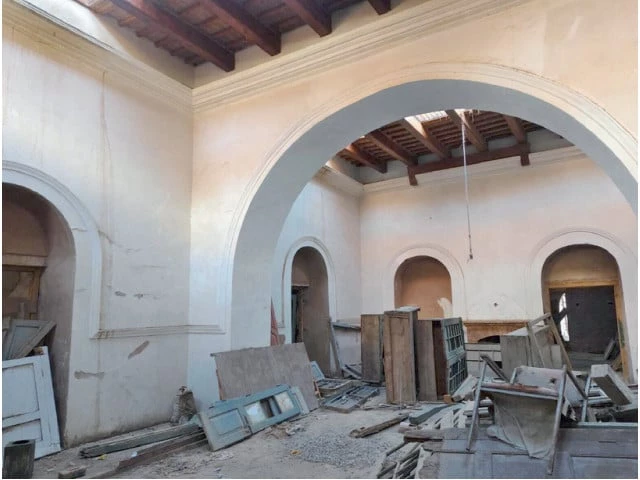
The historic English Room and Deputy Commissioner’s Compound, commonly known as Nicholson House, have undergone an extensive restoration under a provincial government-funded project aimed at conserving an important chapter of the area’s colonial-era history.
Originally constructed in 1852 during the tenure of British military officer John Nicholson, the historic compound served as the principal administrative and judicial headquarters for the southern districts of the province during British rule. For decades, it functioned as the centre of governance where key administrative decisions were made, judicial proceedings were conducted, and tribal disputes were resolved through traditional jirgas.
The sprawling complex comprises several heritage buildings, including the English Room, which served as the colonial courtroom, the courthouse, Jirga Hall, guard house, Commissioner’s House, Deputy Commissioner’s House, Sessions Court, and other government offices that played a pivotal role in the administration of the region nearly two centuries ago.
Speaking to the media at the Commissioner’s House, senior government official Kifayatullah said that during the British era, Bannu was regarded as the administrative headquarters for the entire southern belt of the province, extending from Kohat to Dera Ismail Khan. The historic compound, he said, remained the centre of governance where civil administration, judicial matters and tribal affairs were managed.
However, following Pakistan’s independence, the heritage buildings gradually fell into disrepair due to years of inadequate maintenance and limited conservation efforts. Weathering, ageing infrastructure and prolonged neglect left many of the historic structures in a deteriorated condition, raising concerns among heritage experts and local residents about the possible loss of an important cultural asset.
Recognising the historical significance of the site, the Bannu divisional administration launched a comprehensive restoration initiative a few months ago to rehabilitate the abandoned complex while preserving its original architectural identity. Restoration work focused on repairing damaged structures, strengthening the buildings and reviving their traditional appearance without compromising their historic character.
The restored compound now includes fully renovated heritage buildings that have been made operational once again for official use. Alongside the restoration of the English Room, Nicholson House, Commissioner’s House, Deputy Commissioner’s House, courthouse, Sessions Court and guard house, the project has also introduced modern additions such as the Bacha Khan Conference Hall and a Gymkhana, creating a balance between heritage conservation and contemporary administrative needs.
Commissioner Bannu Division Khalid Mahmood said the restoration project was completed at a cost of Rs138.4 million, funded by the K-P government. He said the initiative was designed not only to preserve a valuable historical landmark but also to ensure that these important public buildings continue serving government institutions while retaining their historical identity.
“The objective of this project was to preserve our historical heritage while bringing these important buildings back into government use,” he said.
He described the Bannu historic compound as far more than a collection of old colonial buildings, calling it a living symbol of the administrative evolution of the region and the subcontinent. According to him, the successful restoration demonstrates that historical preservation and modern development can go hand in hand. Officials believe the renewed heritage site will not only strengthen government infrastructure but also serve as an educational and cultural landmark, allowing future generations to better understand the rich administrative and architectural legacy of southern K-P.