


US-Iran war exposes oil security risks as fuel import dependence renews calls for strategic reserves
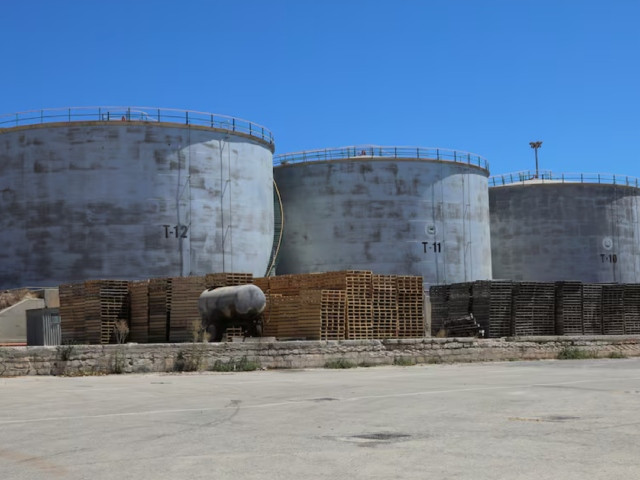
Crude oil storage tanks are seen at Azzawiya oil refinery, in Zawiyah, west of Tripoli, Libya July 23, 2020.PHOTO: REUTERS
LAHORE:
Escalating tensions between Iran and the United States, coupled with uncertainty surrounding the Strait of Hormuz, have once again exposed Pakistan’s vulnerability to external energy shocks, prompting renewed debate over the urgent need for a national strategic petroleum reserve.
Although shipping through the Strait of Hormuz has not been completely disrupted, concerns over potential supply interruptions and volatility in global oil prices have underscored the risks facing Pakistan, which imports the bulk of its petroleum requirements.
An investigative review found that despite its heavy reliance on imported oil, Pakistan still does not have a government-owned strategic petroleum reserve capable of sustaining the country during war, global crises, maritime disruptions or prolonged supply interruptions. Instead, the country depends largely on commercial stocks maintained by oil marketing companies and refineries, which are designed to meet routine market demand rather than national emergencies.
Senior officials in the Ministry of Petroleum said that during the recent Iran-US tensions, the Ministry of Energy’s Petroleum Division monitored petroleum product availability, import cargoes, port inventories and oil company stocks daily to prevent shortages. However, energy experts stressed that emergency monitoring cannot replace a dedicated strategic reserve.
Pakistan’s domestic crude oil production remains far below national demand, requiring imports of crude oil, petrol, high-speed diesel and other petroleum products. Consequently, fluctuations in international oil prices directly affect Pakistan’s import bill, foreign exchange reserves, trade deficit and inflation.
The importance of the Strait of Hormuz is particularly significant because a substantial share of Gulf crude exports passes through the strategic waterway. Any prolonged disruption could force Pakistan to seek alternative supplies at significantly higher freight and import costs.
The concept of strategic petroleum reserves has been discussed in Pakistan for years. Successive governments examined the proposal, while energy experts consistently recommended maintaining reserves for emergency situations. However, financial constraints, policy inconsistency, land acquisition issues, infrastructure costs, and competing priorities repeatedly delayed implementation.
According to sources, the government has accelerated work on the proposal following the latest regional tensions. The Ministry of Petroleum is evaluating options including large storage terminals near ports, underground facilities, modern steel tank farms, public-private partnerships and mandatory minimum storage requirements for oil marketing companies. Officials are also studying international models and seeking technical expertise.
Energy specialists argue that Pakistan should maintain reserves sufficient for at least 60 days of consumption, while many developed countries hold 90 days or more. They estimate that even if work begins immediately, the projectincluding land acquisition, engineering, storage facilities and pipeline infrastructurewould take three to five years to complete.
Legal expert Azhar Siddique said he filed a petition before the Lahore High Court in 2020, during the tenure of former Chief Justice Qasim Khan, seeking the establishment of strategic petroleum reserves. “The court directed the formation of a commission to examine the issue, but its recommendations were not implemented during the PTI government,” claimed Siddique.
Siddique added that the commission recommended maintaining strategic petroleum reserves equivalent to 15 days of national consumption as an initial target. “Recent regional tensions have demonstrated that energy security is not only about importing oil but also about maintaining secure emergency reserves. If Pakistan once again delays this project, any future global crisis or supply disruption could place severe pressure on the economy and disrupt industrial production, transport and electricity generation,” he said.
The investigation concludes that the question is no longer whether Pakistan needs strategic petroleum reserves, but whether the government has the political will to implement the project, secure funding, engage the private sector and finally turn a long-discussed proposal into a national priority.