


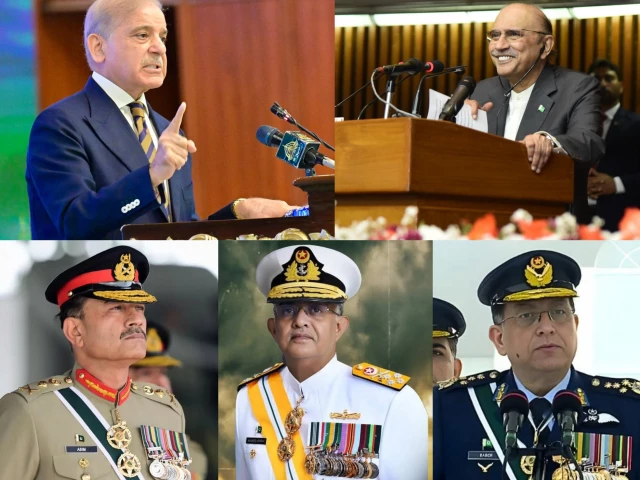
PM, President Zardari, military chiefs hail Marka-e-Haq success, stress unity, resolve and deterrence
Pakistan’s civil and military leadership on Saturday renewed their pledge to defend the country, warning that any aggression aimed at undermining it would be met with an “immediate, befitting and full-spectrum response” as the nation marked the first anniversary of Marka-e-Haq.
The term “Marka-e-Haq” refers to the 2025 conflict with India, which began with the April 22 Pahalgam attack and concluded with a ceasefire on May 10 following Operation Bunyanum Marsoos.
According to a statement issued by the Prime Minister’s Office, the prime minister paid tribute to the martyrs and their families, saying they stood like a steel wall in defence of the homeland.
“Marka-e-Haq is a day to bow in gratitude before Allah Almighty for His countless blessings upon us. Today, we commemorate Pakistan’s valiant stand in adversity and the crushing defeat we inflicted on the enemy,” he said.
Praising the armed forces, he said their well-coordinated and synchronised response across land, sea, air and cyber domains had established Pakistan as an invincible nation. He added that Marka-e-Haq stood as testimony that Pakistanis were a peace-loving, yet courageous, resilient and dignified nation “who can neither be intimidated nor subdued by any aggressor”.
“Marka-e-Haq is etched in history as an epic feat of achieving overwhelming dominance over an enemy, bent on unprovoked aggression. The enemy was administered a heavy dose of reality serum to dispel its illusion of invincibility,” the prime minister said.
As the nation commemorates the glorious success of Marka-e-Haq and Operation Bunyan-un-Marsoos, we thank Allah Almighty and pay tribute to the extraordinary courage, unwavering resolve, and supreme sacrifices of our Armed Forces and the people of Pakistan.
In the face of…
— Shehbaz Sharif (@CMShehbaz) May 9, 2026
Paying tribute to Chief of Defence Forces (CDF) and Chief of the Army Staff Field Marshal Asim Munir, the premier lauded his leadership, alongside the air chief and naval chief, as well as officers and soldiers of the armed forces, who, with the support of the nation, “inscribed a new chapter in the Pakistan-India context”.
“Pakistan clearly manifested its desire for peace, while re-establishing deterrence and safeguarding its security, sovereignty and territorial integrity,” he said.
“Let there be no doubt that any aggression to undermine Pakistan will be met with an immediate, befitting and full-spectrum response,” the prime minister warned.
He reaffirmed Pakistan’s determination to defend the motherland, saying: “We remain steadfast in our efforts to root out” terrorist groups and take the fight against them to its logical conclusion.
The prime minister also reaffirmed Pakistan’s strong commitment to the Kashmir dispute, reiterating Islamabad’s continued support for the Kashmiri people’s fundamental right to freedom and self-determination.
“No story of Pakistan is complete without Kashmir, which remains the unfinished agenda of the subcontinent’s partition. Strategic stability in South Asia, without the resolution of the Kashmir issue, would remain a distant dream which needs to be resolved in accordance with the United Nations resolutions and the aspirations of the Kashmiri people,” he added.
Highlighting Pakistan’s enhanced international image since last year’s victory and its mediation role in the US-Iran conflict, he said the country was now recognised as a responsible state that not only knew how to defend itself but had also emerged as a contributor to global peace and stability.
“Pakistan’s pivotal role as a key mediator during the ongoing US-Iran conflict and our efforts to seek an end to violence have earned worldwide acknowledgement,” he said, adding that Islamabad remained committed to the peaceful resolution of conflicts.
President Asif Ali Zardari also paid tribute to the nation and armed forces on the first anniversary of Marka-e-Haq.
According to a statement issued by the President’s Office, the president said CDF Munir’s leadership, strategy and “courageous decisions” were key to the success of Marka-e-Haq.
He also lauded the air chief and the Pakistan Air Force for their “exceptional skill and professionalism”.
President Zardari praised the naval chief and forces, describing their full operational readiness and defence capabilities as a source of national pride.
“Pakistan is a responsible and peace-loving state. By giving a strong but measured response to enemy aggression, we have conveyed our defensive capability to the world,” the president said.
He said the issue of Jammu and Kashmir must be resolved in accordance with United Nations resolutions.
Also Read: On Marka-e-Haq Day, forces signal firm resolve
“Pakistan will continue its moral, political and diplomatic support for the Kashmiri people,” he said.
Terming India’s attempt to suspend the Indus Waters Treaty as “water aggression”, he said water was a matter of life for millions of Pakistanis.
Turning to cross-border terrorism from Afghanistan, he said Kabul must ensure its territory was not used for terrorism against Pakistan or other countries in the region.
He said terrorism backed by external support must be eliminated for lasting peace in the region.
The president said Pakistan was emerging as a symbol of balance and stability in the region due to the efforts of Prime Minister Shehbaz Sharif and CDF Munir.
He added that Pakistan’s diplomatic efforts for a peaceful resolution of the Iran–US conflict had been widely appreciated at the global level.
“Pakistan’s nation and armed forces are fully prepared to face every challenge and defend the homeland,” President Zardari said.
The military leadership also reaffirmed its commitment to safeguarding Pakistan’s sovereignty, saying the armed forces remained fully prepared to confront all internal and external challenges, calling Marka-e-Haq a defining milestone in the country’s journey.
In a statement issued by the Inter-Services Public Relations (ISPR), CDF Munir, Chief of the Naval Staff Admiral Ashraf and Chief of the Air Staff Air Chief Marshal Sidhu extended “heartfelt congratulations to the nation and all ranks of the armed forces”.
“The day stands as a testament to the enduring spirit of courage, professionalism, and unity,” said the statement, adding that the armed forces stood shoulder to shoulder with the people of Pakistan and reaffirmed their “unbreakable bond with the nation they proudly serve”.
The ISPR said ceremonies were being held across the country to commemorate the occasion and honour the sacrifices of martyrs and veterans, with floral wreaths being laid at memorials and prayers offered for the departed.
“Marka-e-Haq has become a defining landmark in the nation’s journey, reflecting national resolve, military excellence, and strategic maturity,” the statement said.
“This success not only bolstered national confidence but also established Pakistan as a responsible regional stabiliser, possessing formidable military capabilities,” it added.
The military’s media wing said Pakistan’s “measured and resolute response” during Marka-e-Haq had exposed “adversarial conspiracies, false flag narratives and disinformation campaigns”.
“Marka-e-Haq has become a defining landmark in the nation’s journey, reflecting national resolve, military excellence, and strategic maturity,” the statement said, adding that the success not only bolstered national confidence but also established Pakistan as a responsible regional stabiliser possessing formidable military capabilities.
“Despite facing conventional and hybrid challenges, including proxy terrorism, the armed forces demonstrated superior operational competence across land, air, sea, cyber, and information domains,” the statement said.
It added that Pakistan had further enhanced its defensive capabilities and reinforced “full-spectrum deterrence despite resource asymmetries”.
“With the unwavering support of a resilient and united nation, the armed forces remain capable, vigilant, and fully prepared to confront all internal and external challenges, ensuring the security, stability and territorial integrity of Pakistan,” the statement concluded.
Pahalgam attack and Marka-e-Haq
On April 22, 2025, escalation between Pakistan and India began when an attack in Pahalgam killed 26 people. India immediately blamed Pakistan for the incident. However, Pakistan categorically rejected the Indian blame.
In response, India undertook a series of hostile actions the next day, on April 23, 2025, including suspending the 65-year-old Indus Waters Treaty (IWT), cancelling visas for Pakistani citizens, closing the Wagah-Attari border crossing, ordering the shutdown of the Pakistan High Commission in New Delhi, and reducing diplomatic staff at each other’s embassies.
Tensions further escalated in the early hours of May 7, 2025, when missile strikes hit six cities in Punjab and Azad Jammu and Kashmir (AJK), destroying a mosque and killing dozens of civilians, including women, children, and the elderly.
In a swift military response, Pakistan’s armed forces shot down Indian warplanes, including three Rafale jets. The confrontation intensified again in the early hours of May 10, 2025, when India targeted several Pakistani airbases with missile strikes. In retaliation, Pakistan launched Operation Bunyanum Marsoos, damaging Indian military installations, including missile storage sites, airbases, and other strategic targets.
On May 10, 2025, US President Donald Trump announced that a ceasefire had been reached following intense overnight diplomatic efforts. Minutes later, the agreement was confirmed separately by Pakistan’s Foreign Minister Ishaq Dar and the Indian foreign secretary.