


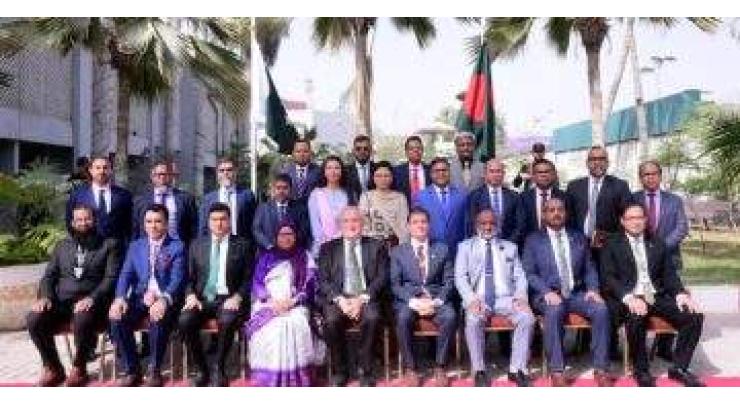
A significant step towards strengthening bilateral relations, a 12-member delegation of the Bangladeshi civil service paid its first historic visit to the National Institute of Public Administration (NIPA), Karachi on Monday, attending a special training program under the theme of Strategic Leadership, Governance Systems, and Policy Innovation
KARACHI, (APP – UrduPoint / Pakistan Point News – 4th May, 2026) A significant step towards strengthening bilateral relations, a 12-member delegation of the Bangladeshi civil service paid its first historic visit to the National Institute of Public Administration (NIPA), Karachi on Monday, attending a special training program under the theme of Strategic Leadership, Governance Systems, and Policy Innovation.
The two-day visit of the delegation- led by Md.Raihan Akhtar, Joint Secretary of the Ministry of Public Administration, and comprised of senior officers from various key ministries including Salma Siddiqua Mehtab, Muhammad Mustafa Jamal Haider, Abu Rehan Mian, and others- is part of the Executive Development Program organized by the Civil Services Academy (CSA), Lahore.
Rector of the National School of Public Policy, Farhan Aziz Khawaja, Director General National Institute of Public Administration Dr. Syed Saifur Rehman, Deputy High Commissioner of Bangladesh in Karachi, senior Pakistani Officers were present in the program that featured keynote addresses by former federal minister Senator Javed Jabbar and former State Bank Governor Dr. Ishrat Hussain.
The purpose of this visit is to understand policies, exchange experiences, and strengthen ties between the two countries, the leader of the Bangladeshi delegation stated, adding that the visit will build a strong connection between the people, policymakers, and institutions. Pakistan and Bangladesh share a common vision of peace, development, and regional stability, and through mutual trust, the foundation for a better future can be laid, he underlined and lauded NIPA Karachi’s efforts in this regard as well as its facilities and training system, noting that to understand any country, one must observe its institutions and culture.
Rector of the National School of Public Policy, Farhan Ali Khawaja, said that bureaucrats serve as bridges between societies, and this platform offers extensive opportunities for learning and capacity building for the officers of both countries.
Shedding light on training institutions operating under the National School of Public Policy, he said that these institutions foster professional training and policy-making capabilities of civil servants belonging to all service groups in Pakistan and lay their professional foundations. These institutions form the central pillar of Pakistan’s administrative structure and play a key role in strengthening the country. Bureaucrats are not merely degree holders; they are molded into professional leadership through knowledge, experience, and practical skills, he stated.
Addressing the ceremony, DG NIPA stated that Pakistan is taking practical steps to promote effective and modern governance in the region. Programs of this nature play a key role in improving the professional capacities of civil servants which will lead to better public service delivery, he added.
This visit is not limited to speeches or formal meetings; it is a practical opportunity for mutual learning and exchange of experiences, Dr. Saifur Rehman added governance is not merely about administrative structures, it is deeply intertwined with humanity, policy, and public welfare. Development is not just about increasing GDP; it also includes strengthening national identity, collective memory, and social values, he emphasized.
Addressing the ceremony, Senator Javed Jabbar, overviewed the historical geographical developments taking place in South Asia, from creation of a new Nation Pakistan on the basis of Muslim Nationalism, its unique characteristics, challenges and following historical events that further reshaped the geography of the subcontinent.
Highlighting the over the past 54 years progress, he emphasized that Bangladesh has commendably strengthened its identity through nationalism and pluralism and attained remarkable economic achievements.
Javed Jabbar presenting a strategic overview of Pakistan spoke on the measures for fostering national cohesion within ethnic, linguistic and political diversities as well on the external and internal challenges faced by the country.
He also stressed the need of fostering people to people contacts, enhancing exchanges in the fields of parliament, bureaucracy, academia, trade, commerce, sports, tourism, digital technologies and learning more about each other’s culture, languages, arts, and other sectors of life.
The ceremony also featured a detailed session on the book by former State Bank Governor Dr. Ishrat Hussain, Development Pathways: India-Pakistan-Bangladesh (1947–2022)’, discussing important aspects of economic reforms, governance, and institutional improvement.
The eminent economist Dr. Ishrat Hussain, addressing the event as a special guest, underscored the key role of women empowerment in Bangladesh’s success, and said that Bangladesh’s economic policies remained consistent amid political changes.
Continuity of policies, ideology, a realistic and strong state system,competitiveness and global economic integration are powerful drivers of economic growth and development, he maintained and added that China did not rely solely on domestic output but invited foreign investors and ensured technology transfer to achieve growth.
At arrival at NIPA, the senior Bangladeshi civil servants received a warm welcome, DG NIPA gave the Bangladeshi officers a detailed tour of NIPA Karachi, and a tree-planting ceremony was also held. The purpose of the plantation drive was to promote a greener environment, enhance environmental protection, and convey the message of establishing a clean and healthy ecosystem.
At the conclusion of the ceremony, DG NIPA Dr. Syed Saifur Rehman distributed shields and presented gifts to the Bangladeshi officers.