


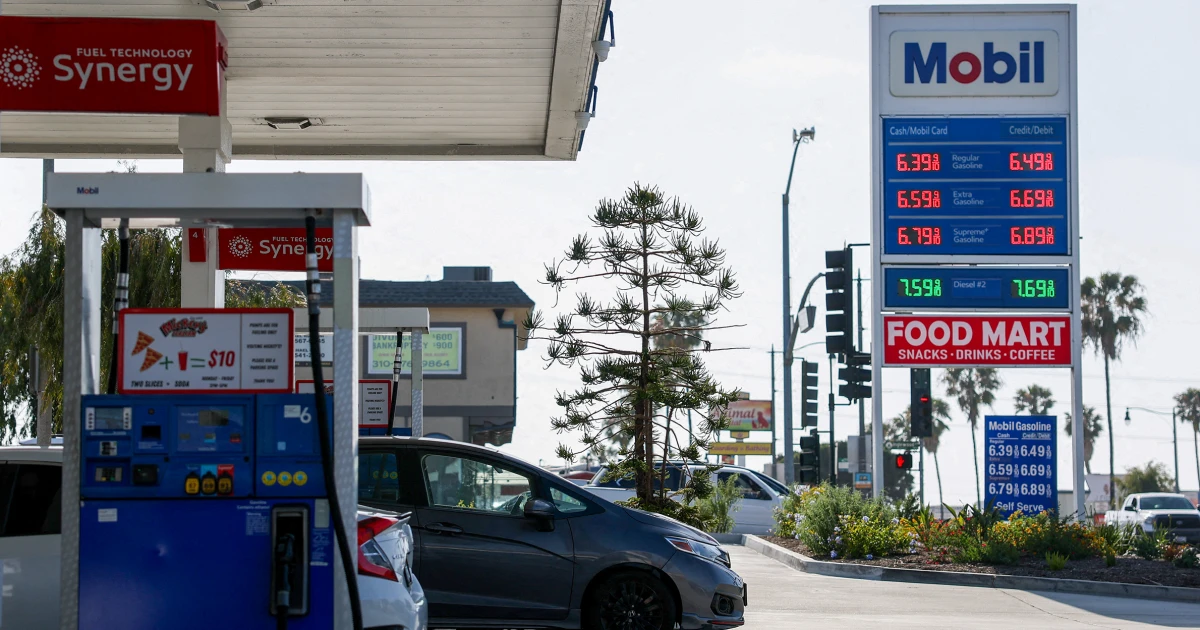
The national average gas price rose to a fresh wartime high of $4.39 per gallon in its biggest one-day jump since a ceasefire with Iran was announced on April 7. It was also the biggest one day jump since early March.
Subscribe to read this story ad-free
Get unlimited access to ad-free articles and exclusive content.

On Thursday, gas prices jumped seven cents to $4.30, but overnight jumped an additional nine cents. Since the war started, the average price of gas has risen more than 47%.
The steady rise for gas prices comes as crude oil extends its gain for the year to more than 80%. In early trading on Friday, U.S. crude oil traded around $103 per barrel and international benchmark Brent traded around $110 per barrel.
This week, price pressures worsened as President Donald Trump said that he wants to maintain the blockade on Iranian ports, which the U.S. Navy has been enforcing since April 13.
“Iran can’t let Iran have a nuclear weapon, and their economy is crashing,” Trump said in the Oval Office on Thursday afternoon. “The power of the blockade is incredible.”
Casting fresh doubt on how fast the war can be ended, Trump added, “They’re not getting any money from oil, and hopefully it can be worked out very soon.”
“The gas will go down,” Trump remarked, adding. “as soon as the war is over, it’ll drop like a rock.”
But experts do not believe that to be the case, and most believe that the price of oil will remain elevated for an extended period of time after the war ends given that Iran has showed that it can effectively halt ship traffic through the critical Strait of Hormuz.
In parts of the Trump administration, however, the war has already ended.
On Capitol Hill, members of Congress have been calling for a vote on a War Powers Resolution, as the Iran war crosses a 60 day threshold. The 1973 War Powers Resolution requires the president to get authorization from Congress in order to maintain military forces in a conflict for more than 60 days.
In its 50 years, however, Congress has not actually used the law to require the removal of U.S. forces from a foreign conflict.
“For War Powers Resolution purposes, the hostilities that began on Saturday, February 28 have terminated,” a senior administration official told NBC News on Thursday.
House Speaker Mike Johnson, R-La., also said Thursday that it was not necessary for Congress to weigh in on the Trump administration’s military action in Iran because the United States is currently “not at war.”
Markets disagree, and as of early Friday, U.S. crude oil was set to post a more than 8% jump for the week.
As gas prices move higher, consumers in online communities are voicing more and more frustration.
On Reddit’s r/Indiana, which represents a state that has seen nearly a $2 per gallon jump since the war began, more than 500 comments detail dissatisfaction of residents in the Hoosier state. Similar conversations is taking place this week in r/Pennsylvania, r/Iowa, and more locally, r/kzoo, which represents Kalamazoo, a city of about 80,000 in Western Michigan.
Commodities analysts at Citigroup said on Friday that the price of international Brent could rise as high as $150 per barrel “if the Strait remains closed through the end of June.”
“Even if all output is eventually curtailed, it is plausible that the regime can survive for many months, even years, through money printing and other wartime measures,” they wrote.
Trump has claimed the war will end in short order and Iran will accept U.S. demands because its economy is unable to sustain the loss of oil revenues.
“Iran’s economy is crashing. Their money is valueless. They’ve got inflation that nobody’s ever seen before, Trump told reporters Thursday at the White House.
“The blockade doesn’t impact Iran’s immediate revenues,” said Kpler analysts in a note on Monday. They noted that it typically “takes around two months for an oil cargo to reach northeastern China from Kharg Island,” where Iran exports the bulk of its crude from. The buyer then has a two month period to pay the Iranians.
“As a result, the blockade would only impact Iran’s oil revenues 3-4 months from now, limiting its effectiveness,” Kpler’s head of crude oil analysis Homayoun Falakshahi said.
“In this way the decision to deal or not to deal looks to be in the Iranian regime’s hands (absent any military escalation),” Citi’s analysts wrote.
The leaders of two of the world’s biggest oil and gas companies warned Friday that energy supplies and markets are under intense pressure.
“If we don’t get supply reestablished, demand will have to come down across different sectors of the economy,” Chevron CEO Mike Wirth said.
“The global energy system continues to be under extreme stress,” Wirth added in an interview on CNBC.
Exxon Mobil CEO Darren Woods, in a separate interview on CNBC, said that about 15% of Exxon’s oil production is “impacted” by the war.
If and when the strait reopens, Woods said that it will take up to two months for oil flows to get back to normal levels and another month or so for that oil to reach customers.
“We’re heading towards another weekend of potential uncertainty,” said analysts at the financial firm ING. Global oil markets don’t trade over the weekend.
Friday is “seen in the minds of many as something of a key day by which some move needs to happen between the U.S. and Iran with respect to a deal of sorts,” they wrote.
But they cautioned, “Hope is fading on this, which risks seeing the pendulum swinging back in the direction” of resumed fighting.
That would not be great for markets, which would prefer a quick reopening of the Strait, even on a bad deal.”