


Araghchi says US push reflects ‘unmet war aims’ Washington reviews Iranian phased
de-escalation proposal
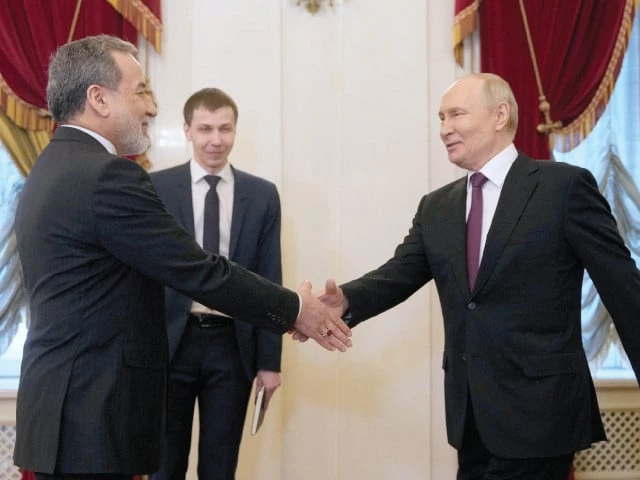
Russian President Vladimir Putin shakes hands with Iranian Foreign Minister Abbas Araghchi during a meeting at the Boris Yeltsin Presidential Library in Saint Petersburg. PHOTO: REUTERS
MOSCOW/WASHINGTON:
Russian President Vladimir Putin on Monday assured Tehran that Moscow would do “everything” to help secure regional peace, as US President Donald Trump simultaneously reviewed a fresh Iranian proposal while Tehran “assessed Washington’s request” for negotiations.
Putin met Iranian Foreign Minister Abbas Araghchi in St Petersburg, Iran’s Press TV reported. It said that he received a message from Supreme Leader Mojtaba Khamenei. It said that Putin told the foreign minister that his country would “do what it can” to achieve regional peace.
“Russia will do what it can to support the interests of Iran and other regional countries and help bring peace to West Asia as soon as possible. I hope Iranian people overcome this difficult period and that peace is restored,” the outlet quoted him as saying.
Speaking in St Petersburg after talks with Putin, Foreign Minister Araghchi confirmed that Tehran was “considering” Trump’s call for negotiations, signalling a cautious but deliberate reassessment of diplomacy following weeks of conflict and stalled engagement.
He argued that the US push for talks reflected unmet war aims, adding that Tehran would decide its next steps based on evolving conditions. Despite being a superpower, US leaders “have achieved none of their goals that’s why they ask for negotiation,” he said, adding, “We are now considering it.”
The St Petersburg meeting underscored Moscow’s continued alignment with Tehran, with Putin pledging support for Iran’s interests and expressing hope for a swift restoration of peace. Russian officials present at the talks described the engagement as critical amid rapidly shifting regional dynamics.
Araghchi reiterated that Iran remained “stable” and committed to its strategic partnership with Russia. “Iran and Russia are strategic partners the two countries have always supported each other,” he said, adding that cooperation would continue.
Even as Moscow positioned itself as a diplomatic backer, the focus shifted to Washington, where Trump convened senior aides to examine a new Iranian proposal aimed at breaking the deadlock.
According to US officials, the plan envisages a phased process that prioritises ending the war before addressing more contentious issues, including Iran’s nuclear programme. The White House confirmed discussions were under way but stopped short of endorsing the proposal.
Officials maintained that Trump’s core demands remain unchanged, including guarantees related to Iran’s nuclear activities, which Washington insists must be addressed from the outset rather than deferred.
Secretary of State Marco Rubio described Iran as “serious” about reaching a deal but stressed that any agreement must decisively prevent Tehran from advancing towards a nuclear weapon, reflecting Washington’s consistent position that diplomacy requires firm safeguards.
The latest Iranian proposal, conveyed through indirect channels, outlines a sequenced framework in which hostilities would first be halted, followed by confidence-building measures and only then broader negotiations, according to a US media report citing sources.
Iranian sources, meanwhile, said the approach was designed to achieve immediate de-escalation while preserving leverage over longer-term disputes. However, the proposal has met scepticism in Washington, where officials argue that postponing nuclear discussions risks weakening the central objective of talks.
The divergence highlights a familiar impasse: Tehran seeks phased relief and recognition of its position, while Washington demands comprehensive commitments upfront. Against this backdrop, Araghchi’s diplomatic push has extended beyond Moscow as part of an intense round of shuttle diplomacy.
He travelled to Pakistan and Oman in quick succession, engaging with mediators and conveying Iran’s position, including a set of “red lines” for US consideration. In Islamabad, which has emerged as a key intermediary, Iranian officials outlined parameters for a potential deal.
Pakistani officials confirmed that while direct negotiations remain stalled, indirect exchanges are continuing, with efforts focused on narrowing differences before any formal meeting. Araghchi acknowledged Pakistan’s role, describing its mediation as “valuable”.
The Iranian foreign minister indicated that Tehran remains open to diplomatic solutions, provided its core concerns are addressed. His remarks suggest a willingness to continue engagement, albeit on terms shaped by Iran’s assessment of the conflict.
He also pointed to what he described as Washington’s “destructive habits” in negotiations, including shifting demands and the use of pressure tactics, saying Tehran’s decision would depend on whether the US demonstrates seriousness and consistency.
For the Trump administration, domestic and strategic considerations are shaping the response. Officials familiar with the discussions said Trump’s team is carefully evaluating the Iranian proposal but sees significant gaps that must be bridged before any breakthrough.
As Araghchi’s consultations in Moscow concluded, the diplomatic landscape appeared defined less by immediate progress than by cautious positioning on all sides. Russia’s assurances offered Tehran political backing, but the decisive engagement remains between Iran and the US amid persistent mistrust.