


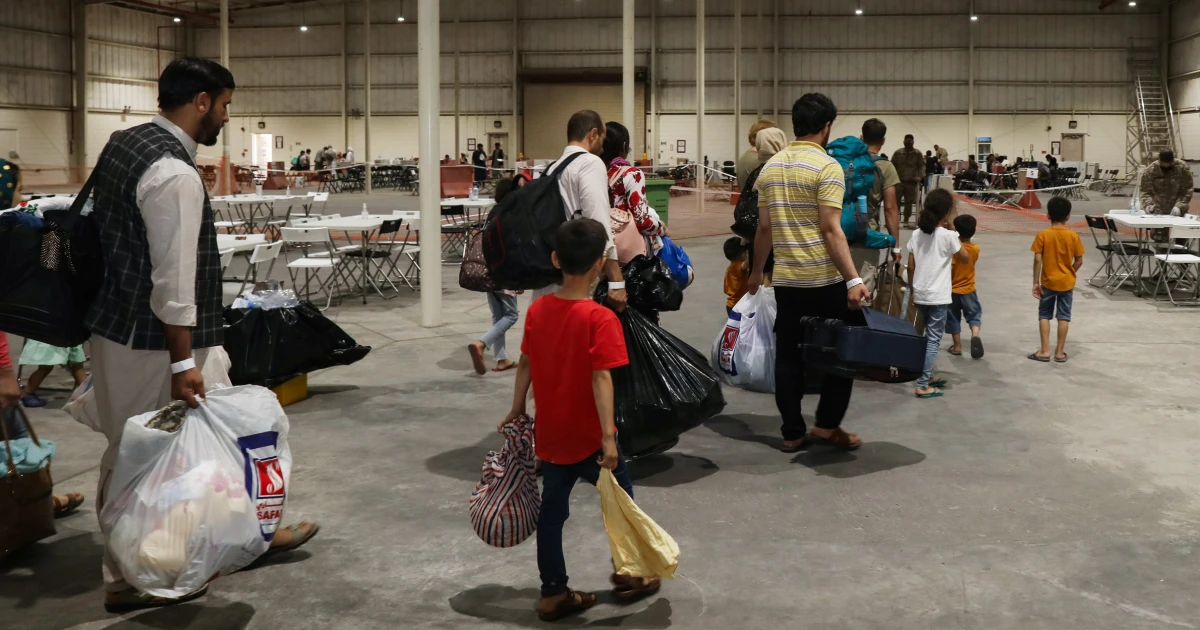
Hundreds of Afghan refugees who helped the United States fight the Taliban may be sent to the Democratic Republic of Congo after the Trump administration halted their U.S. resettlement, an advocacy group said.
Subscribe to read this story ad-free
Get unlimited access to ad-free articles and exclusive content.

Shawn VanDiver, president of San Diego-based advocacy group AfghanEvac, said he had been briefed on the DRC plan by multiple officials with direct knowledge of it who work either at the State Department or in close coordination with it.
The Trump administration plan was first reported by The New York Times.
The Democratic Republic of Congo, a Central African country where the Afghans have no ties, is experiencing one of the world’s worst humanitarian crises, with more than 600,000 refugees there already after decades of armed conflict.
VanDiver accused the Trump administration of intentionally offering the Afghan refugees an alternative so bad that they would choose to return to Afghanistan even if it means risking their lives.
“This is insane,” he told NBC News in an interview, noting in a separate statement that “you do not solve the world’s number one refugee crisis by dumping it into the world’s number two.”
The Democratic Republic of Congo government and its U.S. embassy did not immediately respond to requests for comment overnight.
The State Department did not respond to a request for comment Tuesday. A spokesperson previously said that the Trump administration has no plans to force anyone back to Afghanistan and that moving refugees from Camp As Sayliyah in Qatar to third countries was “a positive resolution.”
The spokesperson said that Afghan refugees were not properly vetted under the Biden administration, which AfghanEvac and other advocacy groups dispute.
“The American people have had to pay the price for the irresponsible way hundreds of thousands of Afghans were brought into the United States,” Tommy Pigott, a State Department spokesman, told The New York Times on Tuesday. “Our focus now is on restoring accountability by advancing responsible, voluntary resettlement options.”
Advocates for Afghan refugees at the camp, which is slated for closure, say the Trump administration is trying to pressure them into returning to Taliban-ruled Afghanistan, where they potentially face persecution, imprisonment or death under the Islamic fundamentalist regime.
There are about 1,100 Afghans at Camp As Sayliyah, a former U.S. military base outside Doha, where they were evacuated to await U.S. resettlement after U.S.-led troops withdrew from Afghanistan in 2021. They include former members of the Afghan special forces, interpreters who worked with the U.S. military and others whose work puts at them risk of persecution by the Taliban.
Most of the people at the camp have been approved for U.S. settlement after extensive security screening, and more than 400 of them are children. Many have been waiting for months or years to be reunited with family in the U.S., including relatives of U.S. service members and veterans.
The State Department said earlier this year that it planned to empty the camp by March 31, a deadline that came and went with no updates.
The DRC is unable to support the refugees it already has, most of whom are from neighboring Rwanda and the Central African Republic, VanDiver said. It’s also unclear what protections if any the Afghans would have against repatriation.
“There’s no jobs. They’re in the middle of a civil war. It’s not a place for Afghans,” he said. “They’re just going to end up getting deported back to Afghanistan by the DRC government.”
00:39
Afghan refugees in Qatar protest over travel suspension
00:0000:00
As part of his immigration crackdown, Trump has blocked virtually all paths to the U.S. for Afghan allies, more than 190,000 of whom were resettled in the U.S. from August 2021 until mid-2025. Afghan allies and their family members have been detained by U.S. immigration officials, with one of them dying last month after less than 24 hours in custody. (Immigration and Customs Enforcement said the death of Mohommad Nazeer Paktyawal, 41, was being investigated.)
Restrictions were further tightened after a November shooting in Washington killed one National Guard member and seriously injured another.
The suspect, identified as Rahmanullah Lakanwal, 29, is an Afghan national who served alongside U.S. troops as part of an elite CIA-backed unit in Afghanistan. He was granted asylum by the Trump administration last year after having arrived in the U.S. during the Biden administration.
Retribution from the Taliban is not the only challenge facing refugees who return to Afghanistan, where the U.S. war began in 2001.
Women’s rights have been severely curtailed since the Taliban’s return to power, and the country is facing a number of humanitarian crises, including widespread malnutrition.
Afghanistan has also been engaged in a deadly conflict with neighboring Pakistan, with Pakistani airstrikes killing civilians in Kabul and elsewhere.
VanDiver said the Trump administration has been in negotiations with dozens of countries, many of them in Africa, to accept the Afghans currently in Qatar. He said the talks were likely to have been complicated by other actions by the administration, which has included many of the same countries in travel bans or required their citizens to pay thousands of dollars in visa bonds before traveling to the U.S.
Those negotiations are separate from the ones the Trump administration has been holding with various countries, including the Democratic Republic of Congo, to accept migrants from other countries who face deportation from the U.S. In exchange, the U.S. is paying millions of dollars to their governments, some of which have records of human rights abuses.
Critics of the Trump administration’s treatment of Afghan allies say it could harm U.S. national security by making local populations less willing to work with U.S. forces in future conflicts.
VanDiver noted that there is nothing stopping the Trump administration from bringing the hundreds of Afghans at the camp who have passed security screening to the U.S. as promised.
In the meantime, he said, the continuing uncertainty of the situation has taken a severe toll on their mental well-being.
“They’re reaching their breaking point,” he said.