


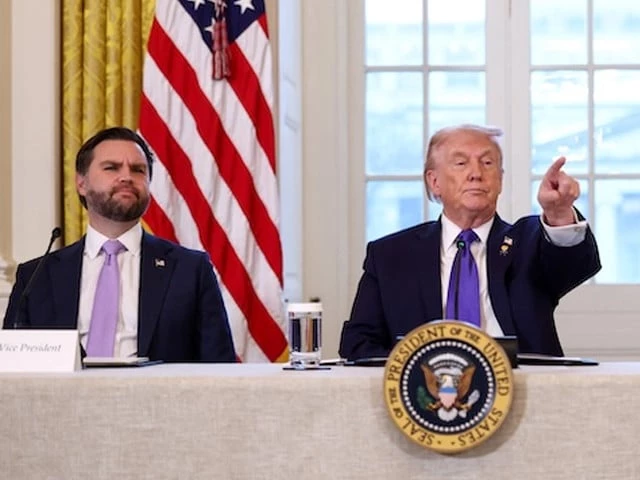
US delegation led by JD Vance set to arrive
Official confirmation from Iran still awaited
Efforts afoot to ensure
ISLAMABAD:
Islamabad is set to host the second round of high-stakes talks between Iran and the United States after the White House on Sunday announced that an American delegation led by Vice President JD Vance will travel to Pakistan this week.
Vance will be accompanied by President Donald Trump’s Middle East envoy Steve Witkoff and senior adviser Jared Kushner.
A week ago, Iranian and US officials held marathon 21-hour negotiations that ended without a breakthrough. However, between the last round and the upcoming session, significant behind-the-scenes work appears to have taken place, raising cautious hopes for progress.
The development has once again placed Pakistan at the centre of a sensitive diplomatic effort aimed at defusing tensions in the Gulf, though uncertainty persists over Iran’s participation and the fate of a temporary ceasefire set to expire on Wednesday.
While Washington has confirmed its delegation, Tehran has yet to officially endorse the process. Iran’s state-run IRNA news agency dismissed reports about its participation, terming them “not correct” and accusing the United States of making “unnecessary and excessive demands” while frequently shifting its stance.
The Iranian side has also cited continued US sanctions, the naval blockade of Iranian ports, and what it described as “threatening rhetoric” as major obstacles to meaningful negotiations.
In a statement shared on Telegram, IRNA said that under such circumstances, prospects for constructive dialogue did not appear promising.
Adding to the ambiguity, media outlets affiliated with Iran’s Revolutionary Guards have also expressed doubts about Tehran dispatching a delegation, although sources suggest Iranian officials could still arrive in Islamabad as early as Tuesday.
The diplomatic uncertainty comes against the backdrop of a fresh escalation at sea.
President Trump claimed that US naval forces had fired upon and seized an Iranian-flagged cargo vessel attempting to bypass a US-imposed blockade in the Gulf of Oman, marking a significant spike in tensions linked to the strategic Strait of Hormuz, a critical global waterway.
Despite the rising tensions, Washington has signalled that talks will proceed. In a statement on Sunday, Trump confirmed the visit of his representatives to Islamabad.
“My representatives are going to Islamabad, Pakistan, they will be there tomorrow evening, for negotiations,” he said.
Referring to recent incidents in the Strait of Hormuz, Trump alleged that Iran had violated the ceasefire by opening fire, claiming that some shots were directed at a French vessel and a British freighter.
He also criticised Iran’s reported move to close the Strait, terming it “strange” and arguing that an existing blockade had already rendered the route effectively shut.
“They’re helping us without knowing, and they are the ones that lose with the closed passage, $500 million a day. The United States loses nothing,” Trump said, adding that several ships were now being redirected to US ports.
In a stark warning, the US president said Washington was offering Tehran a “very fair and reasonable deal,” but cautioned that failure to accept it could trigger severe consequences.
“We’re offering a very fair and reasonable deal, and I hope they take it because, if they don’t, the United States is going to knock out every single power plant, and every single bridge, in Iran,” he said.
He added that it would be his “honour to do what has to be done,” concluding, “It’s time for the Iran killing machine to end.”
Diplomatic sources say Pakistan has intensified backchannel efforts to ensure both sides remain engaged, positioning itself as an “honest broker” and a trusted intermediary.
People familiar with the process suggest that while public rhetoric from both Washington and Tehran has hardened, much of it is aimed at domestic audiences rather than reflecting the actual state of negotiations.
“The process is ongoing and, by most accounts, moving in a positive direction,” a source said, cautioning, however, that key contentious issues remain unresolved and will require further deliberation.
Meanwhile, Islamabad and Rawalpindi have been placed on high alert ahead of the expected arrival of foreign delegations. Advance teams have already begun landing, triggering an extensive security operation across the twin cities.
Authorities have deployed over 18,000 security personnel in Islamabad, with an additional 7,000 reinforcements brought in from Punjab. Police, Rangers and Frontier Corps units have been mobilised, while the Red Zone has been sealed off and multiple security checkpoints established around key areas, including hotels designated for VVIP guests.
Despite the heightened security and mixed signals from Tehran, diplomatic insiders remain cautiously optimistic. They believe that both sides retain a genuine intent to reach a negotiated settlement, even as spoilers attempt to derail the process.
As Islamabad prepares to host what could prove to be a decisive round, expectations remain measured as a final agreement will depend on whether Washington and Tehran can bridge their differences.