


A Spanish woman who was on the same flight as a passenger who later died of hantavirus is being treated at a hospital for a suspected infection, local officials said Friday.
Subscribe to read this story ad-free
Get unlimited access to ad-free articles and exclusive content.

The Spanish Health Ministry said in a Friday briefing that a 32-year-old woman was being treated in her home city of Alicante, after the regional Valencian health authority contacted her through a Europe-wide health alert system.
The woman was “sitting two rows behind the person who died from hantavirus, a person who tested positive, having had only brief contact as they were on board the plane for a short time,” Secretary of State for Health Javier Padilla told a news conference.
Padilla said that others had been on the flight and developed potential symptoms of the virus but later tested negative —including a Dutch flight attendant.
“This is what happened with the flight attendant on the KLM flight, and we are confident that the same will happen here,” he said.
The results from the Spanish patient’s tests should be ready in 24 to 48 hours, Padilla said.
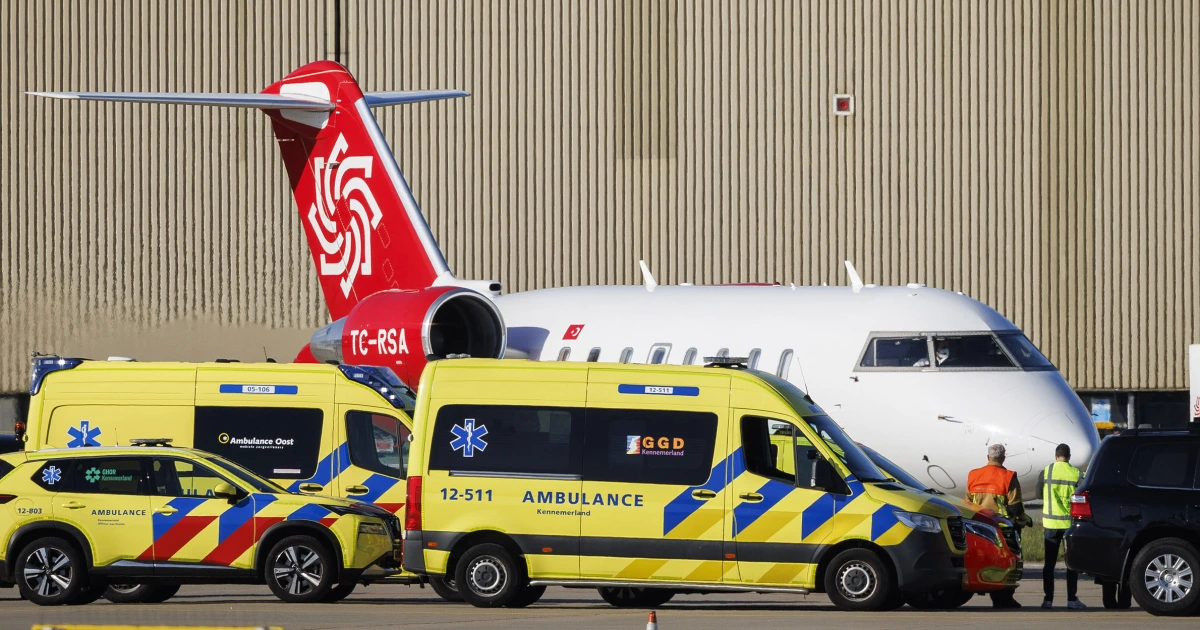
The unidentified Dutch woman who later died — whose husband died at sea aboard the Hondius cruise ship, the center of a deadly hantavirus outbreak — was removed from a flight from Johannesburg to Amsterdam because staff were so concerned about her condition.
Earlier on Friday, the World Health Organization confirmed that the flight attendant who was not on the ship tested negative for the virus following testing at a hospital in the Netherlands.
Public health officials will be hoping for a similar result from the patient in Spain, which would help dampen fears that the virus has already spread beyond the passengers on the Hondius cruise ship.
A German national has also died in the outbreak. On Thursday, the World Health Organization said there have been five confirmed cases of the virus and three suspected cases, as countries around the world seek to trace and monitor passengers who left the Hondius at points along its voyage.
On Friday, British authorities confirmed a new suspected case on the tiny Atlantic island of Tristan da Cunha, one of the most remote inhabited places on Earth, with about 220 permanent residents, where the Hondius made its first scheduled stop on April 15.
Stephen Doughty, the U.K. minister for overseas tourism, wrote in a letter to the Tristan da Cunha administration that the patient was “an islander” and that their spouse was isolating.
Doughty added that four islanders hitched a lift with the Hondius to nearby St Helena.
The U.K. Health Security Agency confirmed that this patient was on board the Hondius and added that two additional British nationals have now been confirmed to have the virus, which is typically contracted through contact with rodents. Person-to-person transmission is rare, though officials say it is possible through close personal contact.
At least seven Americans who were on the vessel are isolating at home across five states, and none show any symptoms of the virus, according to local health officials.
The Spanish Health Ministry also released its protocol plan on Friday for those disembarking from the MV Hondius. The plan will require passengers and staff who were aboard the ship between April 1 and May 10 — or who had close contact with a confirmed case — to quarantine at a Madrid military hospital in Madrid under active monitoring.
“Passengers will remain in single rooms without visitors,” the health ministry said in a Friday press release. “During this period, they will undergo a PCR test upon arrival and another seven days later. Active surveillance will also be conducted, including twice-daily temperature checks to detect any compatible symptoms early.”
If a patient develops a fever, shortness of breath, or other relevant symptoms, they will be transferred to a negative-pressure isolation room, the health ministry said. If they test positive, the patient “will be admitted to a High-Level Isolation and Treatment Unit (UATAN) until clinical recovery.”
The cruise operator, Oceanwide Expeditions, said Friday that one of the people evacuated from the ship, who had shown potential signs of hantavirus, was the ship’s doctor.
A WHO investigation is underway to identify the source of the hantavirus outbreak, which is rare but endemic in parts of Argentina where the Hondius began its voyage.
Meanwhile, the Hondius is on a three-to-four-day journey north from Cape Verde in western Africa to the Canary Islands ahead of its planned docking on the island of Tenerife on Sunday, when the WHO, alongside Dutch, British, and Spanish officials, will collaborate in the evacuation and testing of the remaining passengers.
The U.K. health agency said all British passengers will be asked to isolate for 45 days upon returning to the U.K., noting that the disease’s incubation period can be up to 6 weeks.
The WHO and health officials in numerous countries have stressed that the risk of the outbreak spreading to wider populations is low and that hantavirus is only transmitted through close contact, unlike airborne diseases such as Covid-19.