


Iran submits ‘revised proposals’ through Pakistan
US president says he’s not satisfied with latest plans
T
WASHINGTON/ISLAMABAD/CAIRO:
US President Donald Trump said on Friday he was not satisfied with the latest Iranian proposal for talks on the Iran war, while Iran’s foreign minister said Tehran was ready for diplomacy if the United States changes its approach.
Trump’s comments came after Iranian state media and a Pakistani official said Iran had submitted its latest proposal for negotiations, raising some hope that a deadlock in efforts to end the war might be broken.
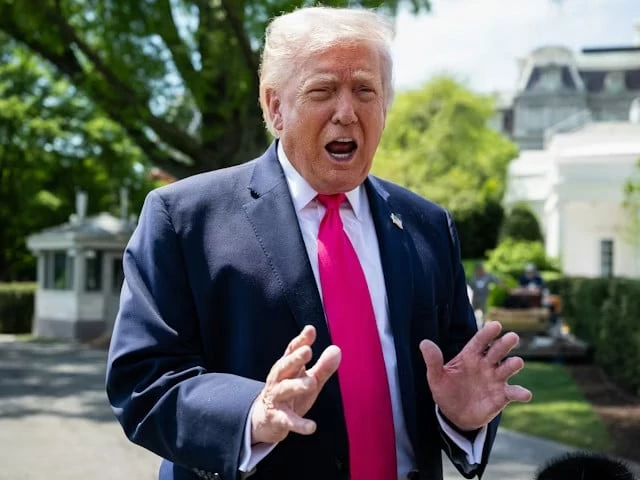
“They want to make a deal, but … I’m not satisfied with it,” Trump told reporters as he left the White House on a trip to Florida, adding that the Iranian leadership was “very disjointed” and split into two or three groups.
Trump praised Pakistan’s mediation efforts, saying negotiations by phone were continuing. “They’ve made strides, but I’m not sure if they ever get there,” Trump said. “They’re asking for things that I can’t agree to.”
Global oil prices, which remain well above $100 a barrel, had eased following news of the Iranian proposal.
Iran’s Foreign Minister Abbas Araqchi said his country was ready to pursue diplomacy if the United States changes what he called its “excessive approach, threatening rhetoric and provocative actions.”
However, Araqchi added in a post on his Telegram channel that “Iran’s armed forces remained ready to defend the country against any threat.”
Iran has activated air defences and plans a wide response if attacked, having assessed that there will be a short, intensive US strike, possibly followed by an Israeli attack, two senior Iranian sources told Reuters on condition of anonymity.
Trump’s administration argued that the ceasefire with Iran had “terminated” hostilities as a legal deadline arrived on Friday for making the case to Congress about the war.
In a letter to congressional leaders on Friday, the deadline to come to Congress about the war, Trump said there has been no exchange of fire with Iran since the ceasefire. “The hostilities that began on February 28, 2026, have terminated,” he said.
Under the 1973 War Powers Resolution, a U.S. president can wage military action for only 60 days before ending it, asking Congress for authorization or seeking a 30-day extension due to “unavoidable military necessity regarding the safety of United States Armed Forces” while withdrawing forces.
The president formally notified Congress of the conflict 48 hours after the first airstrikes two months ago, starting the 60-day clock that ends May 1.
As the date approached, congressional aides and analysts said they expected the Republican president to sidestep the deadline. A senior Trump administration official had said on Thursday the administration’s view was that the war powers law deadline did not apply.
Trump said he considered the war powers law unconstitutional. Both Republican and Democratic presidents have contended the measure violated the Constitution because it sets limits on the president’s powers as commander-in-chief. Legal experts say the matter has not been decided by the courts.
“We had a ceasefire, so that gives you additional time,” Trump said before leaving Washington for Florida.
Trump has repeated that Iran will not be allowed to have a nuclear weapon, and that the price of gasoline – an important concern for his Republican Party before midterm elections in November – would drop sharply as soon as the war ended.
Iran has long demanded that the United States acknowledge its right to enrich uranium, which Tehran says it seeks only for peaceful purposes but which Western powers say is aimed at building nuclear weapons.
Asked about his options, Trump said on Friday: “Do we want to go and just blast the hell out of them and finish them forever? Or do we want to try and make a deal?”
Asked if he wanted to blast the hell out of them, Trump said: “On a human basis, I prefer not.”
China’s UN ambassador, Fu Cong, said on Friday it was an urgent necessity to maintain the ceasefire and that the Strait of Hormuz needed to be reopened as quickly as possible. He said he was sure the Strait would be high on the agenda if it is still closed when Trump travels to China this month.
Earlier, Iran delivered the new set of proposals to the United States via Pakistan in a move that rekindled dwindling hopes for finding a diplomatic solution to the catastrophic war.
Officials in Islamabad offered no details or reacted to the latest development.
Nevertheless, at the weekly briefing on Thursday, Foreign Office spokesperson Tahir Andrabi had said that the clock of diplomacy had not closed yet and that Islamabad remained committed to seeking an end to the war through dialogue and diplomacy.
The latest development immediately sent a positive signal to international oil markets, where crude oil prices saw a 4 percent dip soon after reports emerged of the new diplomatic push.
Iran earlier, through Pakistan, had submitted proposals to end the war. The plan, however, only envisaged addressing the issue of the Strait of Hormuz in the first phase before dealing with more intricate issues such as Iran’s nuclear program.
Meanwhile, Pakistan has kept the diplomatic channels open between the two warring sides, pushing and prodding them to give diplomacy a chance.
Tehran had then agreed to send a revised plan after consulting with the Iranian leadership, including Supreme Leader Mujtaba Khamenei.
It is not clear what was incorporated in the revised proposals, but the US side wanted Iran’s nuclear issue to be part of the broader deal.
American media reported that Steve Witkoff, Trump’s Middle East envoy, objected to the initial proposals and sent back the plan, highlighting certain amendments.
During the first round of talks in Islamabad, both sides at one point were close to signing an MoU, but differences on the nuclear issue could not produce the desired results.
At the time, the US wanted a 20-year moratorium on Iran’s enrichment of uranium while giving up the 60% uranium stockpile.
Tehran has insisted that it is not shying away from talks, but Washington’s maximalist demands and threats are the real cause of concern.
On the day Tehran submitted a revised plan, Iran’s Foreign Ministry spokesperson struck a conciliatory tone, saying the Islamic Republic wanted to seek an end to the war through diplomacy.
While the new exchange of proposals may have generated some hope, the huge differences between the two sides on several issues may prevent a final deal.
Iran’s Parliament Speaker Muhammad Baqer Ghalibaf on Friday insisted that the Strait of Hormuz would never return to pre-war protocols, signalling a hardening of the stance.
Observers believe that the next two weeks may provide a window for a diplomatic solution.
President Trump is set to travel to Beijing in the second week of May, and he certainly wants to wind down the Iran war before that, according to observers.
(With additional input from Kamran Yousaf)