


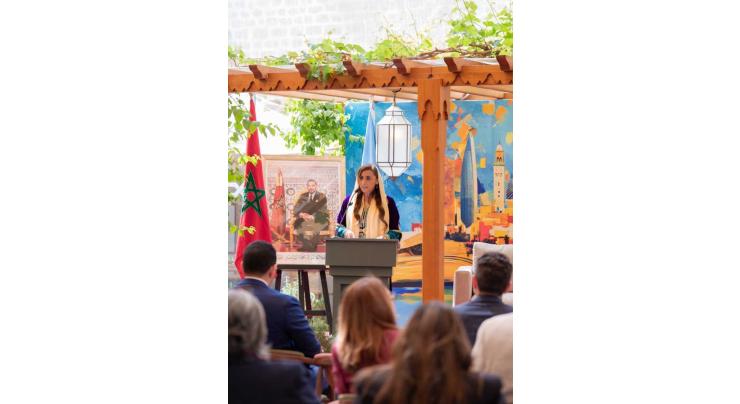
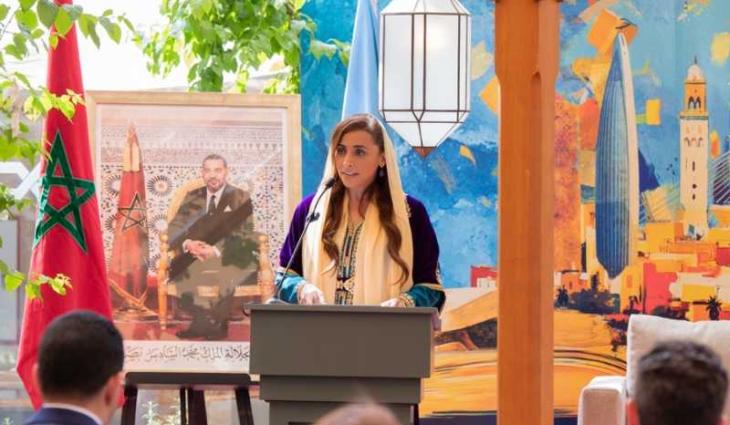
RABAT, (UrduPoint / Pakistan Point News / WAM – 26th Apr, 2026) Sheikha Bodour bint Sultan Al Qasimi, UNESCO Goodwill Ambassador for Education and Book Culture, has launched in cooperation with UNESCO, the global ‘Reading for the Future’ campaign during ongoing celebrations to mark Rabat as World Book Capital 2026.
The campaign aims to advance youth literacy and reinforce the role of reading as a foundation for inclusive knowledge societies.
She also launched the global cultural initiative ‘Young Voices of World Book Capitals’ to be implemented with UNESCO, aimed at supporting emerging writers by empowering them to express their perspectives and help shape the future through the written word.
The announcements were made during a ceremony in Rabat attended by Mohamed Mehdi Bensaid, Minister of Youth, Culture and Communication of Morocco; Charaf Ahmimed, Director of UNESCO Regional Office for the Maghreb, as well as senior officials and representatives from the cultural and education sectors.
In her address, Sheikha Bodour Al Qasimi said UNESCO views reading as closely linked to the quality of education and the stability of societies, stressing that investing in reading is an investment in people’s awareness and ability to participate in shaping their future.
Sheikha Bodour launched the Reading for the Future campaign, which seeks to mobilise international efforts to address literacy challenges affecting children and young people. Global indicators show that around 244 million children remain out of school, while nearly 70% of children in low-income countries cannot read a basic text by the age of ten.
She also stressed that the Young Voices of World Book Capitals initiative will serve as an international platform to support emerging writers and amplify their literary and intellectual voices.
She reaffirmed that the future of societies is shaped not by knowledge alone, but by the ability to read it, interpret it, and turn it into living awareness. This is not a theoretical idea, but a truth history has repeatedly confirmed. Reading has always stood at the heart of every human renaissance, and civilisations were built not by wealth alone, but by libraries.”
Sheikha Bodour further stated that reading is not the final destination, stressing the importance of empowering young people to become active partners in shaping the future rather than mere witnesses to it.
She noted that reading gives them awareness, while writing grants them the power of expression, creativity and influence.
On this occasion, Charaf Ahmimed said, “Books and literature are not relics of the past — they are tools for building the future. This event, bringing together established voices and young writers in the heart of this modern capital and historic city, shows that storytelling remains one of our most powerful responses to the challenges of our time. Through initiatives like the Young Voices of the World Book Capital, UNESCO is committed to ensuring that the next generations do not just read the future — they write it.”
As part of the programme, the panel “Imagining Better Futures: How Literature Helps Us Navigate Uncertainty and Find Hope,” moderated by Oussama Benjelloun, brought together education policy expert Farid Chafiki, alongside authors Racha Belokda and Kawtar El Qorchi to examine how reading and creativity shape perspectives on the future amid cultural change.
The campaign aims to reaffirm reading as a cornerstone of education, creativity and participation in the knowledge economy through partnerships that bring together educational and cultural institutions, publishers and policymakers. It also supports the achievement of the UN Sustainable Development Goal 4 to expand equitable access to knowledge.
The Young Voices of World Book Capitals initiative will invite young people aged 18 to 30 from around the world to submit short stories, essays, poetry and reflections on reading and society.
Five young voices will be selected annually, with their work published in a UNESCO-supported anthology and presented during future World Book Capital events.
The initiative aims to strengthen the presence of a new generation in the global cultural landscape and connect World Book Capitals through a sustainable network of collaboration, starting in Rabat.
In 2001, UNESCO launched the ‘World Book Capital’ initiative, which designates cities around the world in an effort to foster literacy, lifelong learning, copyright protection as well as freedom of expression. Medellín, in Colombia, has been designated the World Book Capital for 2027.