


Meets financial institutions, US officials, business representatives on sidelines of World Bank–IMF Spring Meetings
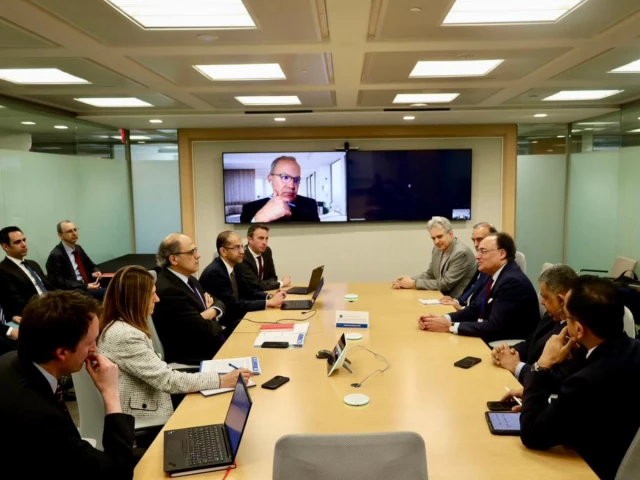
Finance Minister Muhammad Aurangzeb, held a productive meeting with, Director of the Middle East and Central Asia Department at the International Monetary Fund (IMF) Jihad Azour, along with the IMF mission team to Pakistan, on the sidelines of the World Bank–IMF Spring Meetings 2026. PHOTO: X
Federal Minister for Finance Muhammad Aurangzeb, on Tuesday expressed hope for early approval by the IMF Executive Board of the Staff-Level Agreement (SLA), as he met Director of the Middle East and Central Asia Department at the International Monetary Fund (IMF) Jihad Azour on the sidelines of the World Bank–IMF Spring Meetings 2026, according to a post on X by the finance ministry.
FinMin held a series of high-level meetings with international financial institutions, US officials, and global business representatives on the sidelines of the World Bank–IMF Spring Meetings 2026 scheduled from April 13 to 18, focusing on economic reforms, investment and external sector stability on Tuesday.
During the meeting with the IMF official and the IMF mission to Pakistan, the finance minister “expressed appreciation for the successful Staff-Level Agreement (SLA)” and said he expected early approval “to sustain the momentum of Pakistan’s reform programme”.
Finance Minister Meets IMF Director Jihad Azour to Discuss Reform Progress and Economic Outlook
Federal Minister for Finance and Revenue, Senator Muhammad Aurangzeb, held a productive meeting with Mr. Jihad Azour, Director of the Middle East and Central Asia Department at the… pic.twitter.com/LyTh09iHd0
— Ministry of Finance, Government of Pakistan (@Financegovpk) April 14, 2026
Aurangzeb also briefed Mr Azour on the economic impact of the ongoing conflict in the Middle East, describing it as “one of the most significant supply shocks in recent times”. He said the government was “actively managing the second and third-order effects of the crisis, particularly in relation to economic growth and inflation”.
The finance minister “underscored Pakistan’s successful Eurobond repayment” and reaffirmed the government’s commitment to meeting “all other bilateral and multilateral external obligations in a timely manner”.
Both sides discussed progress on fiscal and structural reforms, as well as efforts to enhance revenue mobilisation, and agreed on “the importance of maintaining macroeconomic stability as a foundation for sustainable and inclusive economic growth”, according to the statement.
The finance minister also held talks with the Chief Executive Officer of the Saudi Fund for Development (SFD), Sultan bin Abdulrahman Al-Marshad, on the same day and thanked the fund for its “continued support and its ongoing and future development cooperation” with Pakistan, a separate post on X by the ministry stated.
Finance Minister Meets CEO of Saudi Fund for Development
Federal Minister for Finance and Revenue, Senator Muhammad Aurangzeb, held a meeting with Mr. Sultan bin Abdulrahman Al-Marshad, Chief Executive Officer of the Saudi Fund for Development (SFD), on the sidelines of the… pic.twitter.com/M3FINvKBpb
— Ministry of Finance, Government of Pakistan (@Financegovpk) April 14, 2026
The two sides discussed “the implications of the ongoing conflict in the Middle East on global energy security and its potential economic impact”, with Aurangzeb expressing hope for “an early resolution of the conflict” and stressing “the importance of continued cooperation between Pakistan and Saudi Arabia”. They reaffirmed their “strong and longstanding partnership” and commitment to strengthening economic cooperation.
Meeting the United States Trade Representative Jamieson Greer, the minister “underscored the importance of strengthening Pakistan-United States economic relations, particularly through enhanced trade and investment flows”, the finance ministry stated in a post on X.
Finance Minister Meets U.S. Trade Representative to Discuss Trade and Investment Cooperation
Federal Minister for Finance and Revenue, Senator Muhammad Aurangzeb, held a meeting with the United States Trade Representative (USTR), Ambassador Jamieson Greer, on the sidelines of… pic.twitter.com/LKUoNXOVbm
— Ministry of Finance, Government of Pakistan (@Financegovpk) April 14, 2026
He emphasised Pakistan’s commitment to “fostering a conducive business environment and improving market access to support sustainable economic partnerships”. Both sides held “constructive discussions on advancing bilateral trade and investment”, including “opportunities to expand market access for exports, facilitate greater investment flows, and deepen commercial linkages”.
They also “expressed satisfaction over the steady progress in ongoing trade negotiations” and reaffirmed their commitment to “achieving mutually beneficial outcomes and supporting long-term economic growth”.
In a separate meeting with Tsutomu Yamamoto of the Multilateral Investment Guarantee Agency (MIGA), Aurangzeb welcomed a proposed short-term trade finance facility of “up to $500 million”, calling it important for “financing of critical imports, including food, fertiliser, energy, and essential machinery”.
Finance Minister Meets Tsutomu Yamamoto, Managing Director MIGA, to Discuss Trade Finance and Investment Facilitation
Federal Minister for Finance and Revenue, Senator Muhammad Aurangzeb, held a meeting with Mr. Tsutomu Yamamoto, Managing Director of the Multilateral Investment… pic.twitter.com/rRetyZNQVh
— Ministry of Finance, Government of Pakistan (@Financegovpk) April 14, 2026
According to the post by the ministry, Aurangzeb stressed “the need for expediting progress on the facility to ensure timely support for Pakistan’s external financing requirements”. Referring to arbitration cases, he said MIGA’s “neutral facilitation would contribute towards achieving amicable resolutions, while safeguarding investor confidence and protecting national interests”.
The minister reaffirmed the government’s commitment to “fostering sustainable investment and maintaining economic stability” and to continuing close cooperation with MIGA.
Aurangzeb also met Vice President and Global Head of Government Affairs and Public Policy at Google, Karan Bhatia, where he “appreciated Google’s ongoing initiatives in Pakistan, particularly its training and capacity-building programmes in the field of artificial intelligence”.
Finance Minister Meets Google Vice President to Discuss AI Development and Digital Transformation
Federal Minister for Finance and Revenue, Senator Muhammad Aurangzeb, held a productive meeting with Ambassador Karan Bhatia, Vice President and Global Head of Government Affairs… pic.twitter.com/qiSN5g7062
— Ministry of Finance, Government of Pakistan (@Financegovpk) April 14, 2026
He “commended the company on the landmark development of local assembly of Google Chromebooks in Pakistan” and its decision to open an office in the country in July 2026. Both sides discussed initiatives to promote AI development “across key sectors of the economy, including agriculture and manufacturing”, and reaffirmed their commitment to supporting Pakistan’s “broader digital transformation agenda”.
Along with meeting counterparts and financial leaders from China, Saudi Arabia, the United Arab Emirates, Turkiye, and the United Kingdom, the finance minister is also expected to meet senior officials of the United States’ State Department and the Department of the Treasury. He will also engage with senior representatives of global financial institutions and corporations, including the leadership of major investment institutions and banks such as Franklin Templeton, Rothschild & Co, Citibank, and JPMorgan Chase.
The spring meetings will commence under the shadow of the war in the Middle East, which has delivered a major shock to the global economy; a concern also raised at the Pakistan Conference, where participants acknowledged that the regional conflict has created a difficult economic environment for most countries.
IMF and World Bank officials have stated they would downgrade their forecasts for global growth while raising inflation forecasts, warning that emerging markets and developing countries will be hit the hardest by higher energy prices and disruptions in supply chains.