


At WEF 2026, Canadian PM says great power rivalry reshaping the world and economic integration now used coercively
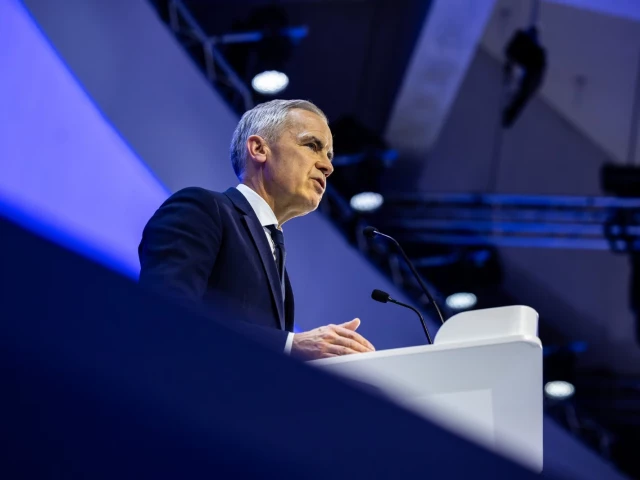
Canadian Prime Minister Mark Carney praised the strengths of the middle powers in his special address at the World Economic Forum 2026 in Davos. PHOTO: World Economic Forum
Canadian Prime Minister Mark Carney on Tuesday warned that the rules-based international order is under unprecedented strain and called on middle powers to act strategically and with integrity to safeguard their sovereignty, values, and global influence.
Delivering a special address at the World Economic Forum Annual Meeting 2026 in Davos, Carney described a world in which “great power rivalry is reshaping the international system” and economic integration, once a source of mutual benefit, is increasingly being used as a tool of coercion.
Tariffs, supply-chain vulnerabilities, and financial leverage, he said, are now employed by dominant states to assert their interests, leaving other nations vulnerable. “Countries that only negotiate bilaterally with hegemons negotiate from weakness,” Carney said. “Middle powers must combine to create a third path with real impact.”
Citing Czech dissident Václav Havel’s 1978 essay The Power of the Powerless, he warned that nations and companies that continue “living within the lie” of a rules-based order risk perpetuating a system that no longer protects them.
Carney stressed that middle powers, lacking the leverage of global hegemons, cannot afford to negotiate solely from weakness. Instead, he argued, they must act collectively to amplify their influence, reduce dependence on coercive powers, and promote stability through shared standards, complementary capacities, and coalitions built around common interests.
“A world of fortresses will be poorer, more fragile, and less sustainable,” he said. “The gains from transactionalism are harder to replicate when the strongest pursue power without restraint. Middle powers have the capacity to stop pretending, to name reality, and to act together.”
Building coalitions for shared challenges
Carney outlined Canada’s approach to international engagement, emphasising “value-based realism”, a strategy that blends principled commitment to human rights, sovereignty, and the prohibition of force with pragmatic recognition that interests often diverge.
He detailed Canada’s expanding global partnerships, including strategic agreements with the European Union, China, and Qatar, as well as ongoing trade negotiations with India, ASEAN countries, Thailand, the Philippines, and Mercosur nations. Plurilateral trade initiatives, he said, aim to bridge the Trans-Pacific Partnership and the EU, potentially creating a bloc representing 1.5 billion people.
In security, Carney reaffirmed Canada’s commitment to NATO’s Article 5 and highlighted investments in Arctic and northern defence infrastructure, including over-the-horizon radar, submarines, and aircraft, while supporting Greenland and Denmark in determining Arctic sovereignty.
Strengthening domestic foundations
Carney stressed that the foundation of principled foreign policy begins at home.
He said since taking office, his government has pursued measures to bolster Canada’s economic and strategic resilience, including cutting taxes on incomes, capital gains, and business investment, removing federal barriers to interprovincial trade, and fast-tracking trillion-dollar investments in energy, AI, critical minerals, and trade infrastructure. Defence spending is set to double by the end of the decade, with an emphasis on building domestic industries.
“These steps are not just investments in growth,” Carney said. “They are investments in sovereignty, resilience, and our capacity to act according to our values.”
Carney highlighted Canada’s abundant resources and human capital as key assets for this strategy. With vast energy reserves, critical minerals, an educated workforce, sophisticated pension funds, and strong fiscal capacity, Canada is positioned to contribute meaningfully to global cooperation.
He also emphasised Canada’s commitment to innovation and sustainability, noting the country’s investments in AI governance, green energy, and industrial collaboration. By expanding domestic demand and fostering international partnerships, Canada aims to create opportunities for both domestic growth and global prosperity.
A call for honesty and collaboration
Carney concluded by urging middle powers to “take the sign out of the window” — a metaphor for abandoning illusions about the old rules-based order and confronting global realities honestly.
He framed Canada’s approach as a model for other nations: building domestic strength, diversifying international partnerships, and acting collectively to uphold shared values and sustainable development.
“From the fracture, we can build something bigger, better, stronger, more just,” he said. “The powerful have their power, but middle powers have the capacity to act with integrity, to name reality, and to work together. That is Canada’s path.”