



Former South Korean President Yoon Suk Yeol has received a five-year jail sentence after being found guilty of multiple charges, including attempts to block his arrest after his failed move to impose martial law on the country in December 2024.
Yoon was sentenced at the Seoul Central District Court on Friday in televised proceedings of one of the country’s most sensitive political trials in recent history.
Recommended Stories
list of 4 itemsend of list
But this is only the first sentencing in several court cases the controversial ex-leader is facing since he was impeached and detained following widespread demonstrations against his government from late 2024. In another case, he could be facing a death sentence if he is found guilty of charges of insurrection.
Yoon was the first sitting president in South Korean history to be arrested and indicted. His short-lived administration was plagued by criticism and poor ratings. However, his surprise martial law announcement sent shockwaves through the democratic country, and around the world, triggering a dramatic political saga.
Yoon’s lawyers say the former president will appeal the court’s ruling.
Here’s what we know about Yoon’s government and the latest sentence:
What has the court ruled?
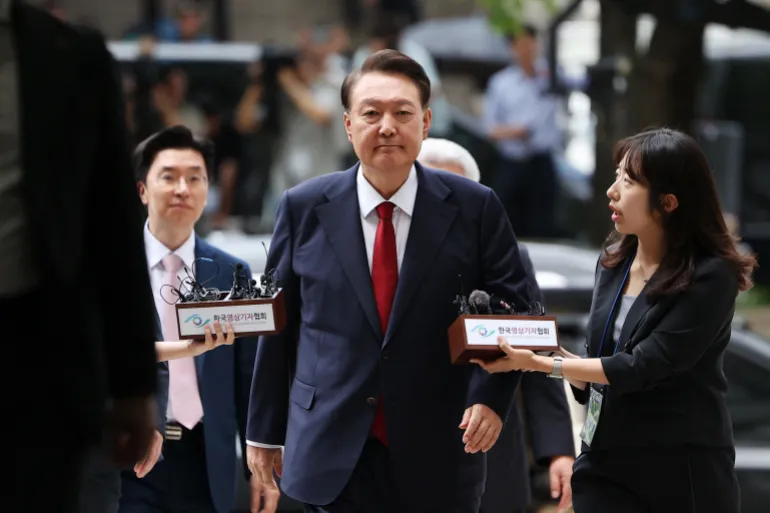
A three-justice panel at Seoul Central District Court sentenced Yoon to five years after finding him guilty of several charges on Friday.
These were: infringing on investigators’ rights to deliberate on his martial law imposition; obstructing justice by evading his arrest in January 2025; and fabricating official documents relating to his December 2024 martial law declaration.
In the ruling, Presiding Judge Baek Dee-hyun said martial law could only be imposed in exceptional circumstances and that the president was required to consult with his cabinet before making a pronouncement.
“But Yoon, in an unprecedented manner, notified only some Cabinet members of the meeting on the proclamation of martial law, thereby directly violating the Constitution and infringing the deliberation rights of Cabinet members who were not notified,” the judge said, according to reporting by the national newspaper, Korea Times.
Yoon also mobilised security forces of the Presidential Security Service to block his arrest, which had been ordered by the Corruption Investigation Office (CIO) on January 3, 2025, after parliament voted to impeach him, the court ruled.
“The defendant abused his enormous influence as president to prevent the execution of legitimate warrants through officials from the Security Service, which effectively privatised officials … for personal safety and personal gain,” Judge Baek said.
To make it appear as though procedural requirements had been met when he declared martial law on December 3, Yoon tampered with the date and signatures on an important document, which had actually been created later, on December 7, the court found.
Outside the court, Yoo Jung-Hwa, a lawyer representing Yoon, told reporters the ruling was “politicised” and that the ex-president would appeal.
Who is Yoon Suk Yeol?
By profession, Yoon, 65, is a lawyer. He served as the country’s president from May 2022 until his official removal in April 2025.
He was an instrumental prosecutor in the trials of former Presidents Park Geun-hye and Lee Myung-bak. Their convictions brought him to the notice of left-wing political parties, and saw him appointed as prosecutor general from 2019 to 2021 by the left-leaning Moon Jae-in administration.
However, when he launched investigations into that government, which prompted at least one minister to resign, Yoon also gained recognition with conservatives. Generally, he had widespread appeal and was viewed as a no-nonsense, principled lawyer loyal only to the law.
In the 2022 presidential elections, Yoon ran as the candidate for the conservative People Power Party, promising economic deregulation and, controversially, anti-feminist policies, such as scrapping the gender ministry. He narrowly won against the opposition Democratic Party of Korea, but his administration was expected to unite both sides. Instead, Yoon’s government leaned further to the right, clashing with the opposition left, which controlled parliament.
In particular, he was criticised for his government’s handling of the Seoul Halloween crowd crush tragedy in October 2022, which killed more than 150 people in the capital and plunged the country into mourning, and for its clashes with the Korean Medical Association, which blamed the authorities for raising quotas for medical students rather than reforming the health sector to benefit practising professionals.
Yoon’s approval ratings dropped during his term. Varying polls showed an approval rate of about 52 percent when he was first elected in May 2022, compared with approximately 36 percent by December 2024.
Parliamentary elections two years into his administration saw his NPP party further lose ground, hindering the progress of Yoon’s budget policies.
What was the martial law crisis?
On the night of December 3, 2024, Yoon shocked South Korea and the world when he imposed martial law, citing the need “to protect the country from North Korea communists and eliminate anti-state elements”.
Yoon further accused opposition politicians of being an “anti-state … den of criminals” who were “trying to overthrow the free democracy” by blocking his budget plans. He asserted a need to “rebuild and protect the country from falling into ruin”.
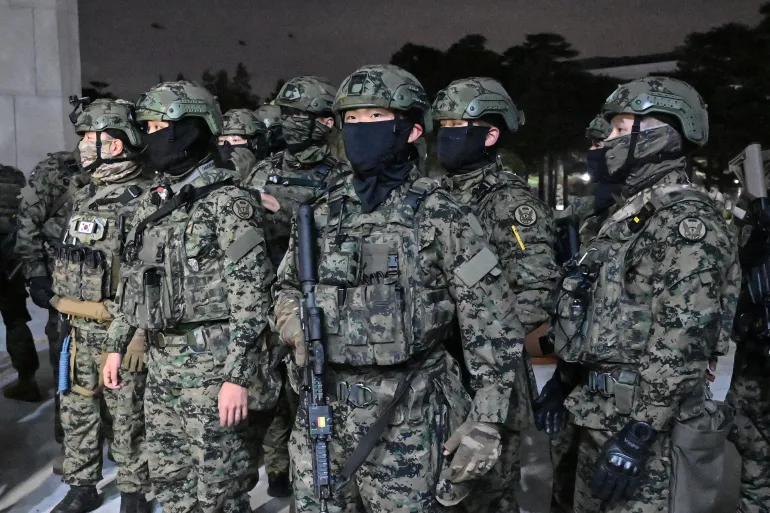
When parliamentarians attempted to convene, Yoon ordered troops to blockade the National Assembly and arrest opposition leaders.
Legislators managed, however, to enter the building and voted to lift the martial law after midnight on December 4, just hours after it was declared.
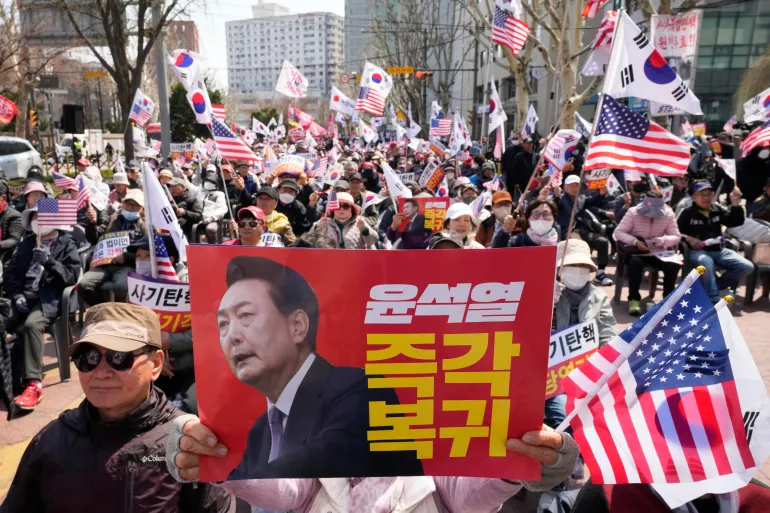
Hundreds of protesters took to the streets in protest, calling for Yoon to step down.
On December 7, Yoon apologised to the nation for the martial law, calling it “an act of governance”. Parliament voted to impeach him on December 14, suspending his powers as president.
He then holed himself up in the presidential palace and refused to respond to a summons by the CIO, an agency investigating crimes committed by senior government officials.
Security forces from the CIO attempted to enter the premises on January 3, but were blocked by security units still loyal to Yoon. On a second attempt on January 15, after more than 3,000 troops were deployed for the mission, Yoon was arrested and is still in detention.
Yoon’s term was formally terminated on April 4 when the Constitutional Court upheld his impeachment.
South Korea, which prides itself on being a stable democracy, last experienced martial law in 1979, after military leader Chun Doo-hwan seized power in a coup.
What other trials does Yoon face?
In all, Yoon has been indicted in four criminal cases, ranging from the more serious charge of leading an insurrection to violating campaign laws during his political election.
Insurrection
Yoon was indicted for insurrection in January 2025, after parliament had voted to impeach him, but before the Constitutional Court approved the move.
The insurrection charge is in connection with the actions Yoon took on December 3, 2024, to seal off the National Assembly and prevent lawmakers who wanted to block his martial law decree from entering. The charge also relates to his orders that the speaker and opposition leaders be arrested.
Yoon has repeatedly claimed that he did not intend to impose military rule. He says did so to sound the alarm about wrongdoing by opposition parties and to protect democracy from “anti-state” elements.
His defence team also argues that the CIO has no authority to investigate him and that, as president, he was within his rights to declare martial law because there was an emergency.
Yoon’s lawyers used the same defence during Friday’s trial, but that was dismissed by the court – potentially setting a line for the insurrection case.
The insurrection trial began on January 9, and the court is scheduled to rule on it on February 19.
On Tuesday, prosecutors at a closed hearing sought the death sentence for Yoon. While the death penalty is legal in South Korea, there have been no executions since 1997.
Former military leader Chun Doo-hwan, who seized power in a 1979 coup and ruled until 1988, was convicted in 1996 on several charges, including insurrection for orchestrating a coup and declaring martial law to suppress pro-democracy protests.
He was handed a death sentence, which was commuted to life imprisonment. But two years later, Chun was pardoned.
Espionage
Separately, Yoon will also answer to charges of treason in an ongoing trial which began on Monday.
In that case, he is accused of aiding an enemy state and was indicted on the charge of treason in November.
Former Defence Minister Kim Yong-hyun and the former intelligence chief, Yeo In-hyung, have also been indicted on the same charge.
Prosecutors accuse Yoon and his aides of trying to instigate a military crisis with North Korea by ordering a drone incursion into Pyongyang in October 2024.
The plan, prosecutors allege, was to goad North Korea into retaliating so that Yoon could impose and justify martial law.
The drone dispatch leaked military secrets to North Korea when it crashed near Pyongyang, prosecutors say. The crash itself constituted a violation of national security laws, they submitted.
Prosecutors also presented a memo found on former intelligence chief Yeo’s phone as key evidence of intent to commit espionage.
In a note to himself, they allege that Yeo wrote: “… we must either create instability or exploit instability when it arises.”
Yoon and his aides face a maximum life imprisonment under Korean law, or a minimum of three years, if found guilty of this charge.