


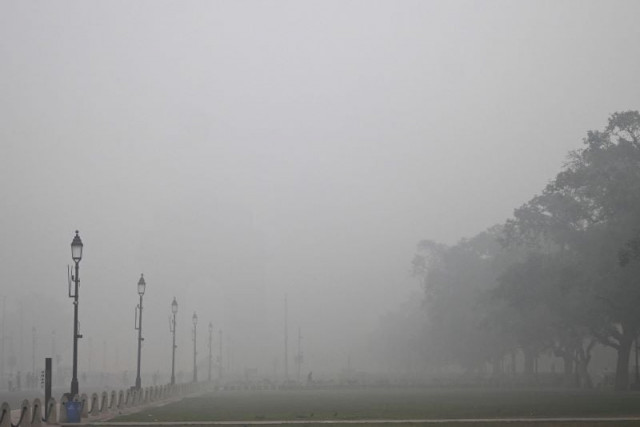
Punjab's air pollution situation is showing renewed signs of deterioration as the province moves into October with Lahore experiencing repeated unhealthy air episodes and its weekly Air Quality Index (AQI) touching 295, raising concerns that the current pre-smog phase could develop into a severe pollution crisis as temperatures fall.
According to the latest Punjab Environmental Protection Agency (EPA) real-time monitoring data, Lahore's overall AQI stood at 154 at noon on Sunday, placing the city in the "unhealthy for sensitive groups" category.
The reading was lower than the 172 recorded at the same hour a day earlier but remained above the level considered safe for vulnerable residents.
Pollution levels remained uneven across the provincial capital. At noon, Safari Park recorded an AQI of 180, followed by Shahdara at 171, Multan Road 164, Barki Road 160, Punjab University 152 and GT Road 151. DHA Phase 6 recorded 149 while Kahna Nau, Wagha Border and Egerton Road recorded 145, 140 and 133, respectively.
EPA data shows that Lahore's AQI reached a weekly maximum of 295 at 9am on October 3, placing the city at the upper end of the unhealthy category and close to the "very unhealthy" threshold.
The record shows pollution repeatedly crossing 200 during October 13, indicating that high pollution episodes are already occurring before the traditional winter peak.
The situation is not limited to Lahore as provincial assessments have shown unhealthy and very unhealthy air in several cities.
Lahore's position in international pollution rankings has also fluctuated in recent days. On October 3, IQAir data placed it at the top of its live global major city ranking at one point with AQI reported at 204. However, provincial authorities recorded a substantially different local reading.
The latest international snapshot available on October 4 showed Kolkata first, Delhi third and Lahore fifth with IQAir reading of around 157. The global rankings change in hours.
The more important concern is that air pollution is repeatedly reaching unhealthy levels even before the coldest part of the season.
"The real danger may still be ahead.
October marks the beginning of the period in which Punjab's air quality can deteriorate rapidly," said a former chairman of Punjab University Geography Department, Dr Munawar Sabir. As temperatures decline, wind movement may weaken and atmospheric inversion can increasingly trap pollutants close to the ground. The combination of vehicle emissions, industrial activity, brick kilns, construction dust, waste burning and agricultural residue burning can therefore produce increasingly persistent pollution episodes, he added.
IQAir has identified dust, vehicle emissions, brick kilns, construction and industrial pollution among important contributors to Lahore's poor air quality. Its recent assessment noted that weak winds can restrict the dispersion of pollutants.
During winter, high humidity, fog and stagnant atmospheric conditions can occur alongside pollution, worsening visibility and increasing the health risk.
A pre-smog crackdown has targeted crop residue and waste burning, vehicle emissions, construction dust and brick kilns.
The EPA has also directed authorities to reduce dust generating practices, including dry sweeping.
The government also recently introduced smart field enforcement, monitoring and digital drone surveillance to identify pollution sources and violations. Authorities said more than Rs300 million in environmental fines had been imposed during the ongoing year, while measures against paddy residue burning had been intensified.
The EPA has deployed night squads and drones to monitor stubble burning and other pollution sources, particularly along motorways. The strategy combines night surveillance, drone monitoring and ground enforcement so that field teams can respond after suspected violations are identified.
The Punjab government is also expanding its air quality monitoring capacity with plans for 26 additional monitoring stations, 20 smoke opacity meters for vehicle emissions and mobile fuel testing laboratories.
If pollution levels rise substantially during the coming weeks, schools may face restrictions on outdoor activities. Authorities may also have to alter business timings.
Children, senior citizens and patients with respiratory or cardiovascular vulnerabilities face greater risks amid unhealthy air.
The evidence indicates that Punjab has entered the pre-smog deterioration phase.
Source link