



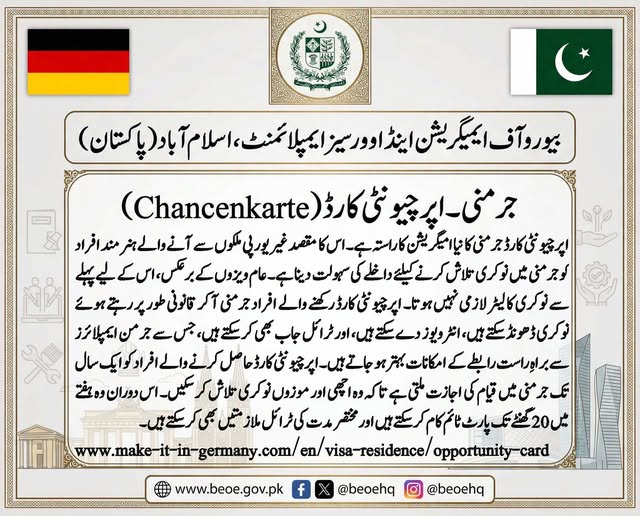
BERLIN: Germany’s Opportunity Card, known in German as the Chancenkarte, allows qualified and skilled professionals from non-EU countries to enter Germany and look for employment without having a confirmed job offer in advance.
The Opportunity Card is a formal residence title under Section 20a of Germany’s Residence Act. It is initially issued for a maximum period of one year, but obtaining the card does not guarantee employment. Applicants are responsible for covering their own living, accommodation and job-search expenses while in Germany.
Who can apply?
Applicants generally need to hold a valid passport or recognised travel document, demonstrate sufficient financial resources for their stay and meet Germany’s immigration requirements.
There are two main routes to qualify for the Opportunity Card.
Route one: Fully recognised qualification
Applicants who hold a university degree or vocational qualification obtained in Germany, or a foreign academic or professional qualification that is fully recognised or considered equivalent to German standards, may qualify as skilled workers.
Applicants using this route do not need to meet the six-point requirement or provide formal proof of language proficiency. However, knowledge of German can significantly improve employment prospects.
Route two: Points-based system
Applicants whose foreign qualifications are not fully recognised in Germany may qualify through the points-based system.
They generally need a university degree recognised in the country where it was obtained, or at least two years of full-time, officially recognised vocational training.
Applicants must also demonstrate German language skills at least at A1 level or English at B2 level, obtain a minimum of six points under the system and demonstrate sufficient financial resources to support themselves in Germany.
For foreign university degrees, a positive record in the ANABIN database or a Statement of Comparability from the Central Office for Foreign Education (ZAB) may be required.
For vocational qualifications, applicants may need to obtain a Digital Statement on Professional Qualification. Under certain legal conditions, a Category A certificate issued by a German Chamber of Commerce Abroad (AHK) may also be accepted. Applicants should confirm the requirements with the relevant AHK in advance.
How are the points calculated?
Applicants can earn points based on qualifications, professional experience, age, language skills and previous legal residence in Germany.
The points include:
- Partially recognised qualification: 4 points
- Qualification in a shortage occupation: 1 point
- At least two years of relevant professional experience during the previous five years: 2 points
- At least five years of relevant professional experience during the previous seven years: 3 points
- German language at A2 level: 1 point
- German language at B1 level: 2 points
- German language at B2 level or above: 3 points
- English at C1 level or being a native English speaker: additional 1 point
- Under 35 years of age: 2 points
- Between 35 and 40 years of age: 1 point
- At least six months of continuous legal residence in Germany during the previous five years: 1 point
- Certain applications involving an eligible spouse or life partner: 1 point
Applicants must provide appropriate documentation and certificates to substantiate each claimed point.
Short tourist or other brief visits to Germany do not count toward the previous-residence points.
Financial requirements
In 2026, applicants are required to demonstrate minimum net financial resources of €1,091 per month.
This requirement can generally be met through a blocked account in Germany, a formal Declaration of Commitment from an eligible sponsor residing in Germany, or, in certain circumstances, a confirmed part-time job of up to 20 hours per week if the income meets the required financial threshold.
For a one-year stay, the total amount required in a blocked account depends on the application period and the instructions of the relevant German mission. Applicants should verify the latest official financial requirement before opening an account or transferring funds.
How to apply
Prospective applicants should first use the Make it in Germany self-check tool to assess their eligibility.
They should then have their academic or vocational qualifications and language certificates verified and prepare documentary evidence for each points category.
The application process generally involves:
- Creating an account on the German Federal Foreign Office’s Consular Services Portal.
- Completing the online application and submitting the required documents.
- Obtaining an appointment at the German embassy or relevant visa centre.
- Providing original documents, a passport and biometric information.
- Paying the national visa fee, generally equivalent to €75 in local currency.
Processing times and appointment availability vary depending on the German mission and the individual case.
Applicants should be cautious of agents promising “guaranteed Opportunity Cards” or “immediate appointments”.
What can opportunity card holders do in Germany?
Opportunity Card holders can stay in Germany for up to one year to search for suitable employment.
They are generally permitted to work part-time for a total of up to 20 hours per week, including one or more part-time jobs.
They may also undertake trial employment with an employer for up to two weeks. Such trial work must be connected to the pursuit of qualified employment, vocational training or a qualification programme related to professional recognition.
During their stay, card holders may look for qualified employment, apprenticeships, recognition programmes or self-employment opportunities.
What happens after finding a job?
After arriving in Germany, Opportunity Card holders must register their residential address with the relevant residents’ registration office and contact the competent foreigners authority.
A confirmed job offer does not automatically convert the Opportunity Card into a work permit. Before the card expires, the applicant must apply for the appropriate residence title.
Depending on their circumstances, this could include a residence permit for skilled workers, an EU Blue Card, a work permit for experienced professionals, a residence permit for vocational training or recognition, or a residence permit for self-employment.
In certain circumstances, where a qualified job offer has been secured but the requirements for another work-related residence title cannot immediately be met, the Opportunity Card may be extended for up to two additional years. Residence permit fees can be up to €100.