


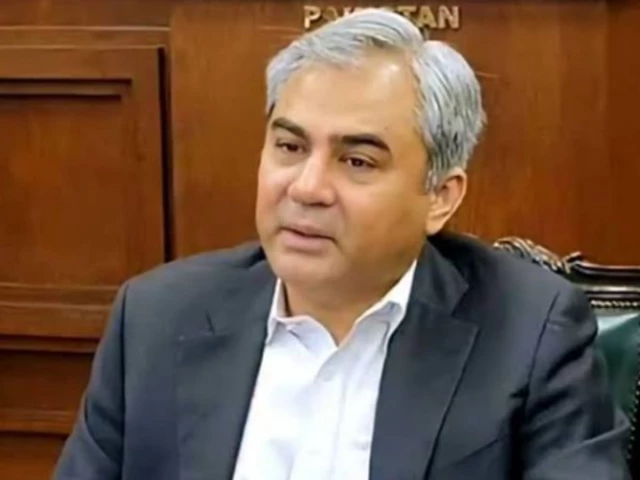
Says proposal not aimed at dismantling existing system
Assures smaller units could retain cultural identities
Ca
LAHORE:
Interior Minister Mohsin Naqvi on Saturday doubled down on his call for smaller administrative units, asserting that neither opposition from a political party nor the reservations of a government or individual could settle the matter, as he argued that the ultimate decision should rest with the people.
Apparently responding to PPP-led criticism, Naqvi, in a well-prepared speech, made a strong case for smaller units and responded point-by-point to the criticism directed at his proposal, arguing that the issue should be weighed on its merits before a workable proposal is taken to the people to let them decide.
Addressing a National Policy Dialogue at a private university in Lahore, Naqvi said his proposal had been misconstrued as being against the current government or as an insinuation of some new political arrangement.
The collapse of the system, he pointed out, was not a commentary on the performance of the current rule, but a reflection of the country’s combined performance over 79 years.
He also addressed criticism from the PPP and the PPP-led Sindh government, clarifying that his proposal was not aimed at depriving anyone of their cultural identity. Rather, the units within the provinces could be named South Sindh, North Sindh, and similarly in Punjab and other provinces.
Mohsin, reiterating his position on the subject, asserted that he would not back down, even if it costs him his ministry. He said resetting the current system did not mean that anything would happen overnight, nor did it mean that the system would be dismantled. Everything, he said, would be done within the confines of the Constitution.
He said instead of making passionate speeches on the issue, which would not make any difference, we should start weighing the proposal: how many units should there be – 15, 19, 20, 25 or 30 – what should their size be, and what would their fiscal impact be.
Once we have come up with a workable proposal, he said, we should take it to the people and let them decide.
Taking a jibe at political parties, he said they were ready to create more districts, divisions and tehsils, but not administrative units because they did not want to lose power.
Building his case, he cited the fact that 25 million children were out of school, four out of 10 children were malnourished, and 55 per cent did not have access to clean water.
He also pointed to the number of pending cases in courts. He asked whether there were any cities better than the provincial capitals in those provinces and, if so, why. The answer, he said, was simple: because the ruler lives there.
Citing statements by the country’s founding father, Quaid-e-Azam Muhammad Ali Jinnah, he said the Quaid, who foresaw provincialism as the greatest ill, had said in Dhaka on March 21, 1948, that provincialism was the biggest curse, as was groupism.
Later, on March 28 in Dhaka, the Quaid said that if we saw ourselves first as Bengali, Punjabi, Sindhi or any other identity, we would head towards fragmentation. On June 15, 1948, the Quaid said that we were all Pakistanis, not Baloch, Pathan, Sindhi, Punjabi or Bengali. He said the Quaid wanted Muslims to rid themselves of the ill of provincialism.
“Our debate is not on the basis of language, race or sect, nor would it be to prioritise one area over another.”
Addressing criticism, he said smaller units would not bleed resources. In fact, he added, they would generate their own revenue and be more productive. From decision-making to health, police and the judicial system, everything would be at a level where it would be open to accountability before the voters.
He said no one person, party or elected member would be able to stop this from going forward.
The dialogue was also addressed by veteran politicians, including Khawaja Saad Rafique, former PM Shahid Khaqan Abbasi, IPP leader Aoun Chaudhry, and senior journalists and experts.
Former federal minister Khawaja Saad Raffique said smaller units were not a panacea for all ills. He said he was personally in favour of smaller units and empowered local governments, but this would not resolve the problem; the main issue, he said, was our intent.
However, he said, if we wanted smaller units, we first needed a legitimate parliament that carried the trust of the people, along with respect for the Constitution. He said encroachment on the Constitution must stop and parliament must not turn into an elected dictatorship.
He said he had little hope in the system as every political party was run as a family enterprise. The only hope, he stressed, was civil society.
Former PM Shahid Khaqan Abbasi said that before experimenting with anything, there was a need to identify the issues facing the existing system and fix them.
He added that the system was finished and no longer had the potential to deliver. Here, he lamented, laws were not made for the public but for the rulers. Creating smaller units without first completing these prerequisites would not fix anything.