


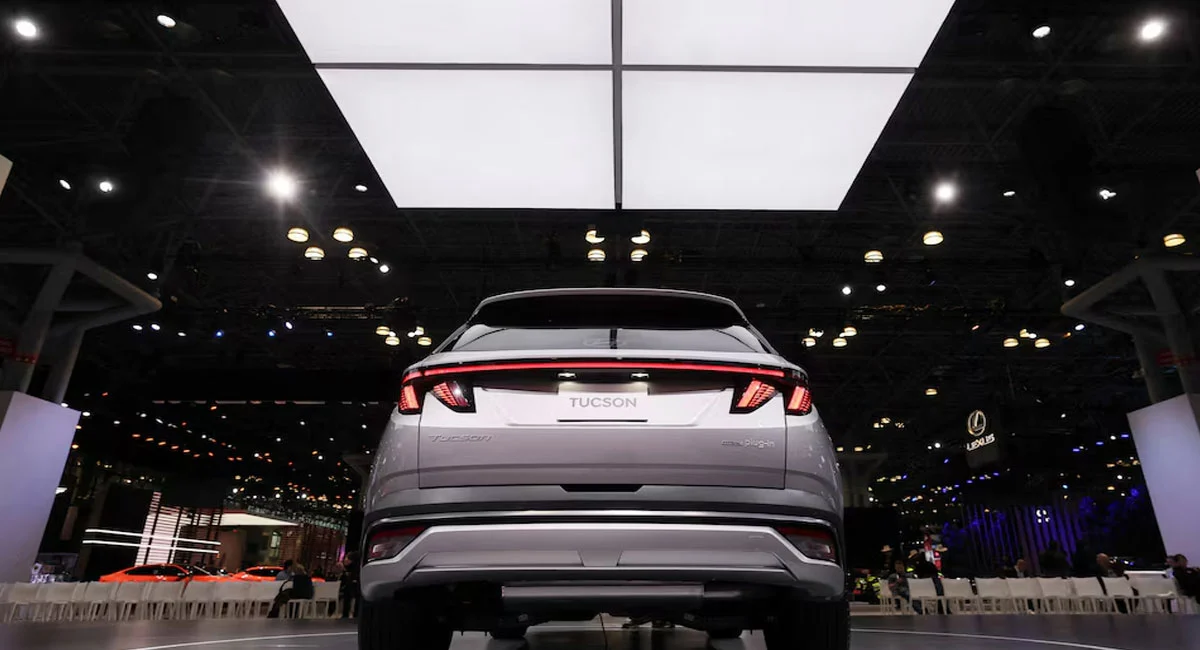
SEOUL: Hyundai Motor said on Wednesday it would launch or refresh more than 100 vehicles globally by 2030 and expand its U.S. hybrid lineup, as the South Korean automaker seeks to lift its operating profit margin above 9%.
In what it described as its largest-ever product rollout, Hyundai plans to introduce 58 models in North America by 2030 as it aims to gain share in segments where it has limited presence and fend off growing competition.
The strategy represents a “product offensive across every region,” Hyundai said in a statement from its 2026 CEO investor day in Seoul on Wednesday, adding that it was targeting “white spaces” where its brand remains underrepresented.
“These segments account for roughly 29% of all automotive sales, highlighting significant opportunities for growth.”
Hyundai Motor shares fell 3.3%, lagging the broader market’s 1.3% gain (.KS11), after the company maintained its shareholder return ratio of at least 35% of net profit.
HYBRID EXPANSION
Hyundai said it would add 1.27 million units of global production capacity by 2030, including 500,000 in North America.
“Our fundamentals have never been stronger,” CEO Jose Munoz said, pointing to Hyundai Motor Group’s global position.
Hyundai Motor, together with affiliate Kia (000270.KS) is the world’s third-largest automaker by sales.
It plans to introduce 10 hybrid models in North America by 2030 and said hybrids would account for half of its regional sales by then.
The push comes as higher gasoline prices linked to the Iran war have strengthened demand for fuel-efficient vehicles, particularly hybrids.
About 56% of U.S. car buyers said rising gasoline prices made them more likely to consider a hybrid, according to Cox Automotive. Hybrid sales rose 19% in the first half of 2026, according to Omdia, while Hyundai’s hybrid sales climbed 71% in the second quarter.
However, Hyundai’s U.S. expansion faces trade policy risks from the ongoing review of the U.S.-Mexico-Canada Agreement (USMCA), which governs duty-free access for vehicles and parts traded across North America.
U.S. officials have declined to extend the agreement automatically, raising the prospect of annual reviews and adding uncertainty for long-term investment plans that rely on cross-border supply chains.
Munoz told Reuters he was concerned about U.S. tariffs but said Hyundai would manage their impact.
The company faces a 15% U.S. tariff on autos under a trade deal signed by Seoul and Washington last year.
“Of course,” Munoz said when asked whether he was worried about tariffs. “We have to deal with them. We’ll have to handle the situation.”
“I’m not especially worried as long as it applies to everybody,” he added, when asked whether he was concerned tariffs could rise further.
Munoz also described Chinese automakers as “very good” and “getting better.”
He said it remained unclear whether Chinese automakers would enter the U.S. market directly, but noted their technology could increasingly reach U.S. consumers through partnerships with other automakers.
Competition from Chinese rivals had made Hyundai stronger, he said, adding the company was sharpening its edge through better technology and design, improved features, economies of scale, cost cuts and greater synergies across Hyundai Motor Group.
“I think we’re probably one of the few groups that could compete in any market where we have to compete with them,” he said.
ROBOTICS
Hyundai also outlined plans to broaden its businesses, including robotics, autonomous driving and robotaxis.
The company said it would begin mass production of software-driven vehicles equipped with Level 2+ advanced driver-assistance systems in 2028, in collaboration with Nvidia.
It said deliveries of IONIQ 5 vehicles to Alphabet’s Waymo for use as robotaxis would begin in the fourth quarter of 2026. Hyundai’s Motional venture is also due to launch driverless commercial services later this year, initially in Las Vegas.
The automaker said it would begin U.S. production of robots in 2028, targeting annual capacity of 30,000 units. It also plans to deploy Boston Dynamics’ Atlas humanoid robot at its Georgia Metaplant from 2028.
Hyundai is testing the use of humanoid robots in vehicle production at a Georgia facility that replicates factory-floor conditions.
The company raised its 2030 consolidated operating margin target to above 9% from its previous 8%-9% range, while keeping its 2026 margin guidance at 6.3%-7.3%.
Hyundai also reaffirmed its target of selling 5.55 million vehicles globally by 2030, equivalent to a 6% market share, and said electrified vehicles would account for 60% of sales by then, up from 23% in 2025.