


Iranian president says Tehran will not make concessions, urges end to ‘no war, no peace’ situation
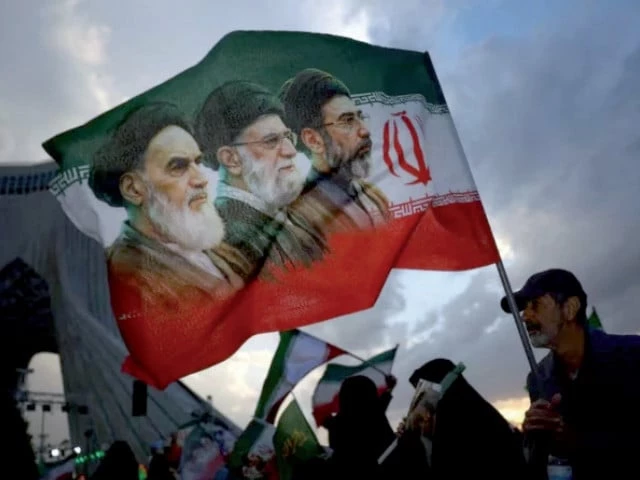
POLITICAL EXPRESSION: A man holds a flag with a picture of late leader of the Islamic Revolution Ayatollah Ruhollah Khomeini during a rally in Tehran on April 29, 2026. PHOTO: REUTERS/FILE
Iran warned neighboring countries on Saturday against joining the US “economic war,” threatening to target their interests and prevent oil exports from the Gulf if they cooperate with Washington.
“We tell all neighboring countries not to participate in the economic war with the US; otherwise, we will consider them an enemy,” said Supreme National Security Council Secretary Mohsen Rezaee, according to state broadcaster IRIB.
“We are not seeking to expand the war, but if the countries surrounding Iran join the Americans in the economic war, we will strike their interests,” he added.
Rezaee warned that if neighboring countries cooperated with the US campaign, “not a single drop of oil will leave the Persian Gulf or the Strait of Hormuz.”
He said Iran would also target other routes used to export oil from the Gulf. “If Trump wants to take action, we will respond in kind with earthquake-like force,” Rezaee said
Rezaee said the Strait of Hormuz remains closed despite US claims to the contrary and would not reopen until Washington “corrects its behavior.”
“This time, it is the United States that must first fulfill its commitments,” he said.
Rezaee said Iran accounts for more than 50% of the Gulf coastline and that it should therefore manage the Strait of Hormuz.
He added that Iran seeks an end to the war in West Asia and “stands against warmongers around the world.”
US President Donald Trump announced this week his intention to launch “the most crushing economic operation ever taken against any country,” describing his maximum-pressure campaign against Iran as “Economic Warfare and Isolation on an unprecedented scale.”
Iran says Strait of Hormuz will remain closed until US changes behaviour
Iran’s Supreme National Security Council Secretary Major General Mohsen Rezaei has warned that any country participating in the US-led economic blockade will face consequences, IRNA news agency reported.
“If the blockade continues, we will not allow a single drop of Persian Gulf oil to leave via any route,” Rezaei said, adding that Iran had not yet targeted US economic interests but that the option remained available if hostile actions continued.
On the Strait of Hormuz, Rezaei said: “The Strait of Hormuz is closed and will not reopen until the US changes its behaviour and honours its commitments; they must first take concrete action.”
Iran, Egypt FMs discuss regional tensions, efforts to restore stability
Iranian Foreign Minister Abbas Araghchi and his Egyptian counterpart, Badr Abdelatty, discussed the latest developments in West Asia and ways to restore regional stability, IRNA news agency reported.
In a telephone conversation late on Saturday, the ministers exchanged views on developments in the region, including the situation in the Persian Gulf and Red Sea, it added.
They also discussed recent diplomatic efforts to “de-escalate regional tensions” and explored ways to promote “peace and stability” in West Asia.
Iranian president says Tehran will not make concessions
Iranian President Masoud Pezeshkian said on Saturday that Tehran has no intention of making concessions and stressed the need to move beyond what he called a “no war, no peace” situation, Iran’s official IRNA news agency reported.
Pezeshkian said Iranian officials were discussing almost daily how to move beyond the situation and reach an understanding that would preserve Iran’s principles and values, while deterring adversaries from contemplating another attack.
He said war offered no solution, while prolonged uncertainty about whether fighting could resume was also taking an economic toll on the country.
Read: Iran’s military remains intact: acting deputy defence minister
Pezeshkian warned that investment would be difficult to attract as long as the threat of renewed conflict persisted, stressing the need to overcome the situation through logic while maintaining Iran’s strength.
The president also defended a recent memorandum with the US, saying it contained no provision that amounted to capitulation or required Tehran to make concessions.
Iran condemns US plans to announce new sanctions
Iran on Saturday denounced US plans to announce new sanctions that could put further strain on the Islamic Republic’s economy and have an impact on its most important trading partners, including China.
After nearly six months of war since the US and Israel launched airstrikes against Iran on February 28, the sides are not firing at each other but also showing no sign of pursuing peace talks.
Oil shipments are at a virtual standstill in the Strait of Hormuz, with Tehran threatening to strike any unauthorised oil tankers that try to transit the vital waterway, and Iran’s economy is already under immense pressure from sanctions.
US Treasury Secretary Scott Bessent is due to hold a press conference at 2:00 PM on Monday after threatening “the toughest sanctions in history” on Iran.
Bessent has also urged cooperation with Washington by China, which buys more than 80% of Iran’s shipped oil, according to 2025 data from analytics firm Kpler. Beijing has urged diplomacy.
Iran’s Foreign Ministry spokesperson, Esmaeil Baghaei, said on Saturday the imminent US announcement of new economic sanctions was an “assertion of extraterritorial sovereignty over every independent member state of the United Nations.”
“Such secondary sanctions find no foundation in international law,” he said in a post on X.
The secretary of Iran’s Supreme National Security Council, Mohsen Rezaei, told state television that Tehran would target the interests of countries helping the United States.
“We are telling all nearby countries not to join the US economic war, otherwise we will consider them as enemies,” Rezaei said.
Read more: US plans ‘toughest sanctions’ on Iran
US President Donald Trump, who has warned of economic consequences against any country that provides “any type of lifeline to Iran,” said on Friday that Washington was observing “what happens” in the conflict.
“They would love to make a deal, but they’re not ready to make the right deal, in my opinion,” Trump said of Iran.
Hormuz traffic halted
While the US has effectively blockaded Iranian vessels in their ports, the Strait of Hormuz remained bottled up with thousands of seafarers stranded on hundreds of vessels.
Only four commodity ships sailed along the strait on Thursday, none of them large crude carriers or liquefied natural gas tankers, ship-tracking data showed.
However, Iran has granted permission for a number of Iraqi oil tankers to pass through the Strait following repeated requests from Baghdad, Iran’s state news agency IRNA reported on Saturday.
IRNA said obtaining special permission for Iraqi tankers was one of Baghdad’s main requests during a visit to Iraq by Parliament speaker Mohammad Baqer Qalibaf.
US Energy Secretary Chris Wright said the US military helped move a seven-day average of 8 million barrels a day of oil through the strait. That’s down from more than 20 million per day before the war or about one of every five barrels consumed worldwide.
US attacks have severely diminished Iran’s economy and devastated its navy and air force, but Tehran maintains enough missile and drone capability to impede oil tanker traffic and attack regional rivals.
Also read: Iran claims neighbours seek new security order
Abdollahi, the armed forces chief of staff, sought to underline Iran’s missile capabilities during a visit to an underground plant manufacturing ballistic missiles that was reported by state television on Saturday.
“This plant has been able, much better than in the past, to produce equipment superior both in capacities and quality and in quantity,” he said.
Qalibaf, Iran’s parliamentary speaker, said Tehran had received “numerous messages” from neighbouring countries about establishing new regional security arrangements and economic cooperation.
Qalibaf, who did not say which countries he was referring to, accused the US of endangering the security of its allies in the region for the sake of Israel, adding that an independent, “homegrown” regional order would deliver peace and security.
Trump, meanwhile, has yet to achieve objectives he set at the start of the war, such as dismantling Iran’s nuclear programme – the state of which remains uncertain given that UN inspectors have been shut out since 2025 – and creating conditions for Iranians to overthrow their clerical rulers.
Thousands have been killed, mainly in Iran, where 168 Iranian school children were killed on the first day of the war. The US has reported more than 750 military personnel wounded and 18 killed.
While Iran remains defiant, President Masoud Pezeshkian has also called for a diplomatic solution.
“It would be better to end the war today, when we are powerful and have dignity, and the whole world acknowledges our victory and emphasizes that America, contrary to all regulations, attacked our schools, hospitals, and infrastructure and is hated in the world,” the ISNA news agency quoted him as saying on Friday.