


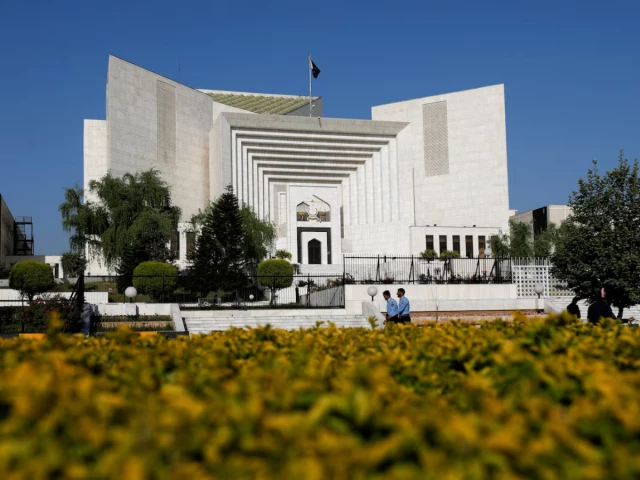
Police officers walk past the Supreme Court of Pakistan building, in Islamabad, Pakistan April 6, 2022. REUTERS
ISLAMABAD:
In a ruling with far-reaching constitutional implications, the Supreme Court has moved to plug a key legal lacuna created by the 27th Constitutional Amendment, holding that appeals arising from family and rent matters decided by high courts remain within its appellate jurisdiction.
The verdict settles an ambiguity that had triggered objections at the registry level and sparked debate within the legal community over whether such cases were now barred from reaching the apex court.
The clarification came in a five-page judgment authored by Chief Justice of Pakistan Yahya Afridi, while deciding the maintainability of a petition that had earlier been objected to by the Supreme Court Registrar.
The objection was raised on the ground that the impugned judgment had been rendered by a high court under Article 199 of the Constitution in a rent matter and was therefore not maintainable before the Supreme Court under the new constitutional dispensation introduced by the 27th amendment.
The court clarified that the constitutional bar on the SC’s appellate jurisdiction applies only to cases that actually fall within the scope of Article 175F(1).
Reading Article 185(3) together with its proviso, which states that no appeal shall lie in cases to which Article 175F(1) applies, the judgment held that the restriction is narrowly confined and cannot be extended beyond its express ambit.
Since rent and family matters are explicitly excluded from Article 175F(1)(c), such cases cannot be treated as falling under Article 175F at all. As a result, petitions arising from rent and family disputes remain within the SC’s appellate jurisdiction under Article 185(3), subject to the grant of leave.
Article 185(3) of the Constitution operates as a general source of appellate jurisdiction of the SC in respect of judgments, decrees, orders or sentences of a high court, subject to the exclusion contained in its provision, namely cases to which clause (1) of Article 175F applies.
Article 175F sets out the appellate jurisdiction of the Federal Constitutional Court and, by virtue of the proviso to clause (1)(c), expressly excludes cases relating to rent and family matters from its jurisdiction.
The judgment explained that first, “Article 185(3) of the Constitution operates as a general source of appellate jurisdiction of the Court in respect of judgments, decrees, orders or sentences of a High Court, subject to the exclusion contained in its provision, namely cases to which clause (1) of Article 175F applies. Article 175F(1), supra, in turn, sets out the appellate jurisdiction of the Federal Constitutional Court, and by virtue of the proviso to clause (1)(c), expressly excludes, inter alia, from its jurisdiction cases relating to rent and family matters”.
It noted that the question that consequently arises and is at the heart of the present objection is, whether judgments or orders of a high court pertaining to rent and family matters, which, by the reason of the express exclusion in its proviso, do not fall within the ambit of Article 175F(1) of the Constitution, and thus, are to be regarded as cases “to which clause (1) of Article 175F applies” for the purposes of the proviso to Article 185(3).
“Stated differently, the issue is whether the express exclusion of rent and family matters from the appellate jurisdiction of the Federal Constitutional Court operates to remove such matters altogether from the appellate framework beyond High Court, including the Supreme Court, or whether, by that very exclusion, they stand outside the operation of Article 175(1), thereby attracting the appellate jurisdiction of this Court under Article 185(3), subject to grant of leave,” the judgement observed.
‘Judicial overreach’
However, the order has divided legal opinion.
Former additional attorney general Waqar Rana termed the ruling judicial overreach, arguing that it amounted to interpretation being used to overcome drafting errors, which could also be viewed as an intended and deliberate omission by Parliament to give finality to such matters at the high court level.
“These matters, family and rent, used to come to SC only through petitions. What will happen if someone challenges the vires of the family law or rent law? In that case obviously SC cannot assume the jurisdiction and FCC has no jurisdiction in such matters as per the constitution. Moreover, in all matters arising out of/decisions given under article 199 the jurisdiction vests in FCC,” he added.
Rana further stated that jurisdiction has to be expressly granted to any court and not be implicitly assumed.
On the other hand, lawyer Waqas Ahmad said that the chief justice had addressed a major constitutional question and had effectively endorsed the reasoning of Justice R. Mansoor Ali Shah in the Dewan Motors case.
“In my opinion, this is the correct legal approach: a question of jurisdiction should be decided by the same bench before which the objection is raised,” he added.
Advocate Hafiz Ahsaan Ahmad Khokhar, however, fully supported the order, stating that the SC had undertaken a correct, purposive and harmonious interpretation of Articles 175(1)(f), 175(f)(c), and Article 185(3) of the Constitution, thereby reaffirming that the constitutional jurisdiction of the SC cannot be curtailed by inference or implication.
According to him, the judgment faithfully preserves the constitutional scheme governing judicial hierarchy and safeguards the appellate and constitutional jurisdiction of the SC.
He further stated that the ruling reflects a clear recognition and principled demarcation of jurisdiction between two of Pakistan’s most important superior courts, namely the SC and the FCC, which he said was a healthy and positive development in constitutional adjudication.
While family and rent matters have been expressly excluded from the jurisdiction of the FCC, he noted that no such exclusion exists with respect to the SC. Consequently, the apex court continues to possess full appellate jurisdiction to entertain such matters under Article 185(3) of the Constitution.