


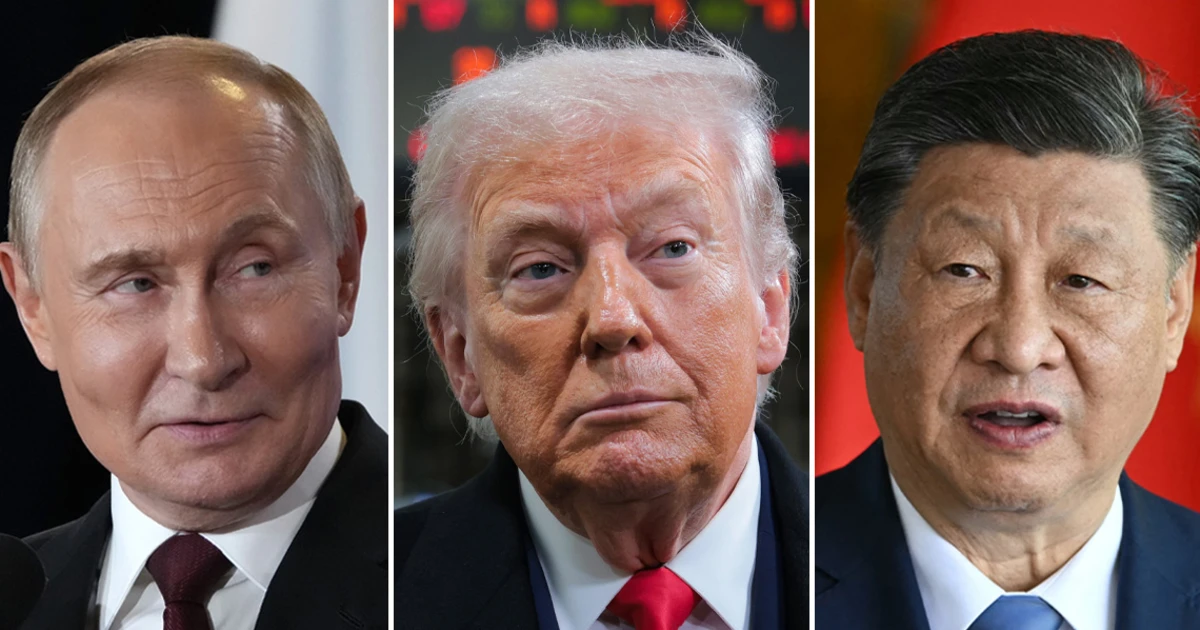
TEL AVIV — Russian President Vladimir Putin’s invited, along with Chinese leader Xi Jinping and strongmen from Hungary to Belarus and beyond.
A long and growing list of world leaders, including those of India, Pakistan and the European Union’s executive arm, say they’ve been offered the chance to join President Donald Trump’s “Board of Peace” to supervise the next phase of his plan for the Gaza Strip.
But the board’s charter makes no direct mention of Gaza and instead proposes a broad mandate for a new international organization that “seeks to promote stability, restore dependable and lawful governance, and secure enduring peace in areas affected or threatened by conflict.”
“We just created the Board of Peace, which I think is going to be amazing,” Trump said Tuesday at a White House press briefing. “I wish the United Nations could do more. I wish we didn’t need a Board of Peace, but the United Nations, and, you know, with all the wars I settled, United Nations never helped me on one war.”
While a few leaders have publicly accepted, it is not known if any have agreed to donate $1 billion to avoid renewing their membership after three years, according to the charter, the text of which was confirmed to NBC News by two sources whose countries received invitations.
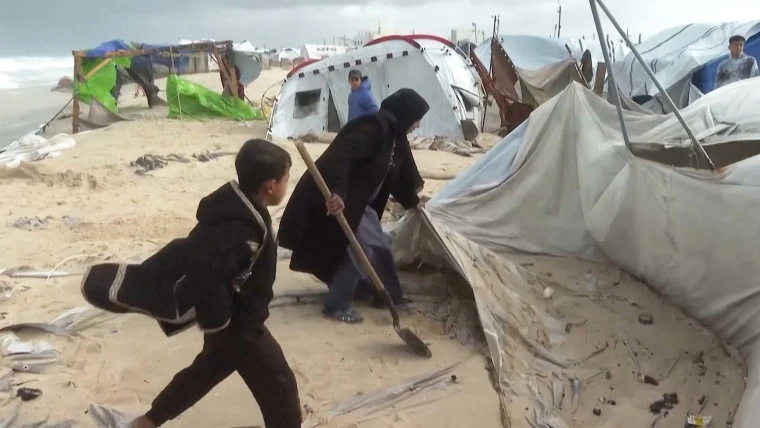
Many appear to have been taken aback by the board’s expanding ambitions. Key U.S. allies in Europe have already expressed reservations that the plan could undermine the primacy of the United Nations in conflict resolution, even as Trump has repeatedly threatened to use American military force to take over Greenland.
In letters sent Friday to various world leaders, Trump said the body would “embark on a bold new approach to resolving global conflict,” according to a copy of the letter posted to the website of Hungarian Prime Minister Viktor Orbán. Other media outlets quoted from the same letter received by other leaders.
A source close to French President Emmanuel Macron told NBC News that at this stage, he “does not intend to give a favorable response” to the invitation, citing major questions over respect for the U.N. and that the board might specifically act as a rival to the Security Council, the organization’s most powerful body created in the wake of World War II.
In a separate statement, Macron’s office said the board’s charter “goes beyond the sole framework of Gaza and raises serious questions, in particular with respect to the principles and structure of the United Nations, which cannot be called into question.”
Trump responded by threatening late Monday to hit French wines and champagnes with 200% tariffs in an apparent effort to pressure Macron to change his stance and join his board.
The Kremlin also demurred about Putin’s invitation. “We are currently studying all the details of this proposal, including hoping to contact the American side to clarify all the nuances,” spokesman Dmitry Peskov told journalists Monday.
Ukrainian President Volodymyr Zelenskyy said that he had been invited and that his diplomats were working on it.
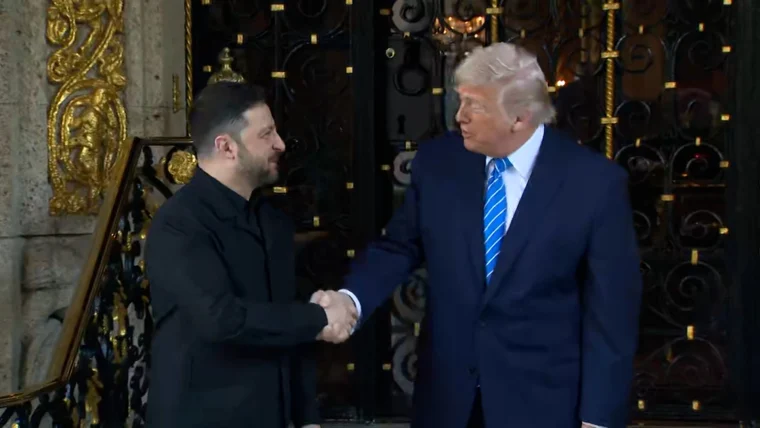
Orbán and Belarusian President Alexander Lukashenko, labeled “Europe’s last dictator,” have also said they received the letter from Trump. Orbán said he “accepted this honorable invitation,” and Lukashenko formalized his country’s ascension to the board Tuesday, according to a post on X from Belarus’ Foreign Ministry.
The list of those invited to participate runs to nearly two dozen, including countries as diverse as Kazakhstan, Vietnam, Canada and Australia, and helps shine a light on the structure and remit of Trump’s plan for Gaza’s post-war governance, bringing the next phase of the U.S.-negotiated ceasefire into sharper focus.
But in Israel, the plan has already been criticized by ultranationalist Finance Minister Bezalel Smotrich, who said Monday that it was time to explain to Trump “his plan is bad for the State of Israel and to cancel it,” according to The Associated Press.
Prime Minister Benjamin Netanyahu took a more diplomatic line, telling lawmakers Monday that there were differences with the U.S. about the composition of the advisory committee accompanying the next phase in Gaza, but that it would not harm his relationship with Trump, according to the AP.
Israeli politicians have been highly critical of Trump’s inclusion of diplomats from Qatar and Turkey on a separate advisory committee that will play a strong role in Gaza’s administration. Both have also been invited to the Board of Peace and both have a strained relationship with Israel after its two-year war in Gaza. Netanyahu said Monday that no soldiers from those countries would be allowed into the Palestinian enclave.
Another neighbor, the United Arab Emirates, said it had accepted the invitation Tuesday.
In a statement Saturday, Netanyahu’s office said that the Gaza executive committee was “not coordinated with Israel and is contrary to its policy” and that he had instructed Foreign Minister Gideon Saar to contact Secretary of State Marco Rubio.
In the months since the U.N. Security Council approved Trump’s ceasefire plan for Gaza, the White House’s original concept appears to have broadened, and the board’s new charter does not mention the enclave. The White House did not immediately respond to NBC News’ request for comment on the omission.
“This is an issue of on-the-ground diplomacy and leverage, not creating some global cosmic superstructure,” said Aaron David Miller, a senior fellow at the Carnegie Endowment for International Peace, a Washington-based think tank. Trump’s plan, he said, is “tethered to a galaxy far, far away, not to the realities here on planet earth.”
The charter also says Trump will serve as the inaugural chairman of the executive board who will vote on proposals put before it. “Such decisions shall go into effect immediately, subject to veto by the Chairman at any time thereafter,” it says.
The price tag, along with the board’s guaranteed American dominance, might make membership a tough sell, Miller said.
“If you sign up for the ‘Board of Peace,’ you will be aligning yourself with Trump’s vision,” said Miller, who worked closely on Middle East peace negotiations during his decadeslong career as an American diplomat. “Adding a billion-dollar entry fee as if this is getting a seasonal membership at Mar-a-Lago has created the sense that this is not serious.”