


.
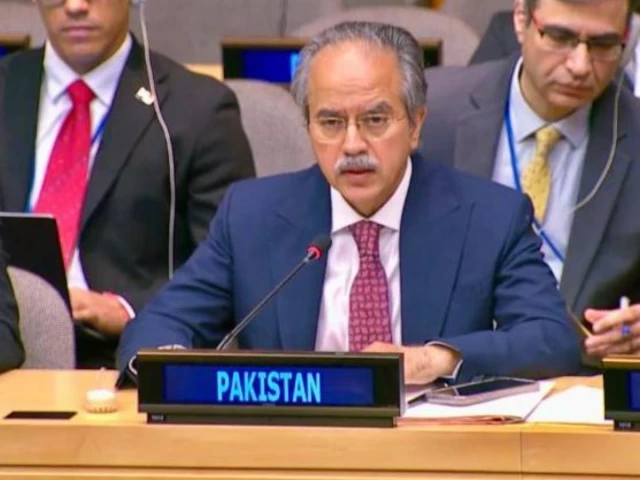
Permanent representative to the United Nations Ambassador Asim Iftikhar Ahmad Photo: APP
UNITED NATIONS:
Pakistan has called for an “inclusive” political settlement of the “protracted” conflict in Yemen, warning that millions of people are suffering due to the collapse of basic services, and demanded the release of detained UN and relief personnel.
“We encourage all Yemeni stakeholders and regional partners to engage constructively towards an inclusive and durable political settlement that reflects the aspiration of all the Yemeni people and safeguards regional peace and stability,” Ambassador Asim Ahmad, permanent representative of Pakistan to the United Nations, told the UN Security Council on Wednesday.
Speaking in a debate on the situation in Yemen, the Pakistani envoy voiced deep concern over the recent turn of the events and resurgence of violence and welcomed the call by Aden-based Presidential Leadership Council, the country’s internationally recognized government, to convene comprehensive talks in Riyadh, facilitated by Saudi Arabia, urging all Yemeni stakeholders to negotiate a political solution based on agreed parameters.
Pakistan, he said, reaffirms its commitment to the unity, sovereignty, independence and territorial integrity of Yemen, and strongly opposed unilateral actions by any Yemeni party that risk deepening divisions, escalate tensions and undermine peace efforts.
At the outset, UN Special Envoy Hans Grundberg, briefing the 15-member Council, said Yemen’s relative de-escalation since 2022 “was never intended to represent an end state”, warning that recent developments in the south show how quickly stability can unravel.
He stressed that the future of southern Yemen “cannot be determined by any single actor or through force”, underscoring the need for inclusive dialogue, economic stabilization, and a UN-facilitated nationwide political process.
While military de-escalation has been achieved in recent days, Grundberg cautioned that the security situation remains fragile, especially following rival deployments in southern governorates.
In December, he said, forces affiliated with the separatist Southern Transitional Council sought to expand their presence in Hadramout and Al Mahra, while government-aligned forces, backed by Saudi Arabia, moved in early January to reassert control over key infrastructure.
He welcomed President Rashad al-Alimi’s proposal to convene talks with a broad range of leaders in the south, calling it a potential step toward rebuilding a Yemen-wide political process under UN auspices.
Political uncertainty is being felt most sharply in Yemen’s economy, the UN special envoy added, with rising prices, unpaid salaries and faltering services eroding household resilience.
In his remarks, Ambassador Asim Ahmad, the Pakistani envoy, reiterated Pakistan’s support for a Yemeni-owned and Yemeni-led political process, grounded in full respect for Yemen’s institutions and the internationally recognized political framework.
Pakistan, he said, supports the active role of the UN and the Special Envoy and appreciates his recent engagements in the region.
Ambassador Asim Ahmad strongly condemned the continued arbitrary detention of UN and humanitarian personnel, diplomatic staff and the unlawful seizure of UN premises and assets in areas under Houthi control. He said this move is “blatant disregard” for international law.
The Pakistani envoy also demanded swift, sustained and unhindered humanitarian access, alongside predictable and adequate funding, to address the dire needs of the suffering of the Yemeni population.