


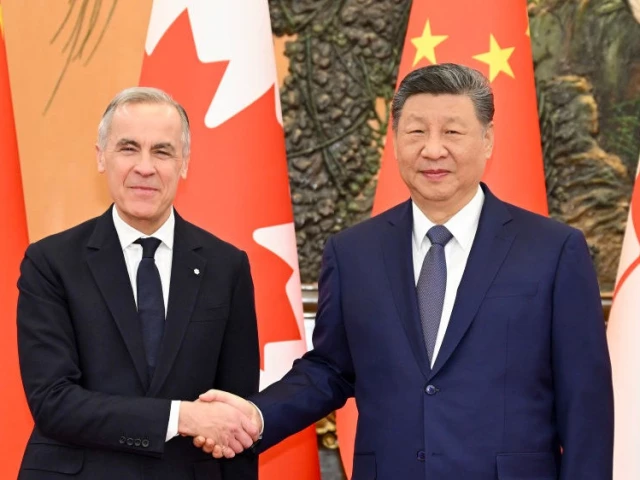
President Xi and Premier Carney signal reset in bilateral ties amid growing global uncertainty
Canadian Prime Minister Mark Carney held meetings with Chinese President Xi Jinping, Premier Li Qiang, and other senior Chinese leaders during his official visit to China between January 14–17, 2026. PHOTO: XINHUA
China and Canada on Friday agreed to advance the building of a new strategic partnership, pledging deeper cooperation across trade, energy, finance, security, and people-to-people exchanges, as leaders from both sides signalled a renewed commitment to stabilising and expanding bilateral relations amid global uncertainty.
The commitment was formalised in a Joint Statement issued by the Chinese foreign ministry following Canadian Prime Minister Mark Carney’s official visit to China from January 14–17, during which he held meetings with Chinese President Xi Jinping, Premier Li Qiang, and other senior Chinese leaders.
The visit marked the first major bilateral engagement at the leadership level since relations began showing signs of recovery, and both sides described the talks as pragmatic, in-depth, and constructive.
In the joint statement, Beijing and Ottawa reaffirmed their intention to advance the China–Canada new Strategic Partnership “in the spirit of mutual respect, equality, and mutual benefit,” to deliver tangible outcomes for both peoples.
Canada reiterated its long-standing commitment to the one-China policy, while both sides underscored the importance of maintaining stable and predictable ties in a complex international environment.
During his meeting with Carney in Beijing, President Xi called on both countries to approach the strategic partnership with “a sense of responsibility toward history, the people and the world,” stressing that healthy and stable China–Canada relations serve not only bilateral interests but also global peace and development.
“The healthy and stable development of China-Canada relations is in the common interests of the two countries and also conducive to world peace, stability, development and prosperity,” Xi said, according to CGTN.
Xi added that his previous meeting with Carney in October last year in Gyeongju, South Korea, had opened a new phase of positive development in bilateral relations, enabling both sides to restore dialogue and resume cooperation across a range of fields. He urged the two countries to place their relationship on a path of “healthy, stable and sustainable development” to better benefit their peoples.
Outlining Beijing’s vision for the partnership, President Xi put forward four key proposals. First, he said, China and Canada should be partners of mutual respect, drawing lessons from 55 years of diplomatic relations marked by both progress and setbacks. Despite differences in national conditions, Xi stressed that both sides should respect each other’s sovereignty, territorial integrity, political systems, and chosen development paths.
Second, Xi called for the two countries to act as partners in common development, describing China-Canada economic and trade ties as fundamentally based on mutual benefit and win-win cooperation. He said China’s high-quality development and continued opening up would create new opportunities for bilateral cooperation, urging both sides to expand cooperation and reduce restrictive “negative lists” to deepen shared interests.
Third, Xi highlighted the importance of mutual trust, saying that people-to-people exchanges form the most solid and enduring foundation of bilateral relations. He encouraged greater cooperation in education, culture, tourism, sports, and sub-national exchanges, alongside measures to facilitate travel and personnel exchanges.
Finally, Xi said China and Canada should be partners in collaboration on global challenges, arguing that a divided world cannot effectively address common problems. He called for the practice of “true multilateralism” and expressed China’s willingness to strengthen coordination with Canada within frameworks such as the United Nations, the G20, and the Asia-Pacific Economic Cooperation (APEC).
Carney, for his part, said his country seeks to build with China a “strong and enduring” strategic partnership, citing long-standing friendly engagement and strong economic complementarity between the two countries. He reaffirmed Canada’s one-China policy and expressed Ottawa’s readiness to work with Beijing on the basis of mutual respect and partnership.
“Canada wishes to build with China a new strategic partnership that is strong and enduring so as to deliver greater benefits to the two peoples,” Carney said. He voiced support for expanding cooperation in areas including economy and trade, energy, agriculture, finance, education, and climate change.
The joint statement outlined a broad roadmap for cooperation. Economically, both sides agreed to reinvigorate the China-Canada Economic and Financial Strategic Dialogue and strengthen the Joint Economic and Trade Commission to address trade issues through consultation.
The two sides welcomed the signing of the China–Canada Economic and Trade Cooperation Roadmap and committed to expanding bilateral trade, boosting two-way investment, and enhancing agricultural cooperation and food security.
In the energy sector, China and Canada agreed to deepen cooperation in clean energy as well as conventional energy such as oil and gas, and to launch a Ministerial Energy Dialogue. They also committed to responsible cooperation in civil nuclear energy and natural uranium trade in line with international standards.
Financial cooperation will be strengthened through a new Financial Working Group, while leaders welcomed the extension of the bilateral currency swap arrangement between the People’s Bank of China and the Bank of Canada. The two sides also pledged enhanced law enforcement cooperation to combat corruption, cyber fraud, telecommunications scams, and illegal drugs.
Beyond economics and security, both sides underscored the central role of people-to-people ties. They agreed to restart the China–Canada Joint Committee on Culture, expand exchanges in education, arts, and creative industries, facilitate media operations, and ease travel between the two countries.
On global issues, China and Canada reaffirmed their commitment to multilateralism, support for the UN-centered international system, and a rules-based multilateral trading order under the World Trade Organisation. Canada noted China’s Global Governance Initiative and expressed support for China’s hosting of the 2026 APEC meetings.
Carney thanked the Chinese government and people for their hospitality, while China welcomed Canada’s invitation for Chinese leaders to visit at a mutually convenient time. Both sides signalled that the renewed strategic partnership is intended not merely as a diplomatic reset, but as a framework for sustained cooperation in an increasingly uncertain world.
The outcomes of Carney’s visit and the joint statement signal a deliberate effort by both China and Canada to move beyond past frictions and anchor their relationship in a forward-looking strategic partnership. By reaffirming mutual respect, economic complementarity, and people-to-people connectivity, Beijing and Ottawa have outlined a framework that prioritises stability, dialogue, and practical cooperation.
As both countries navigate a rapidly fragmenting global order, the success of this renewed partnership will depend on translating political commitments into sustained engagement and concrete outcomes that benefit their peoples and contribute to wider international stability.
WITH ADDITIONAL INPUT FROM AGENCIES.