


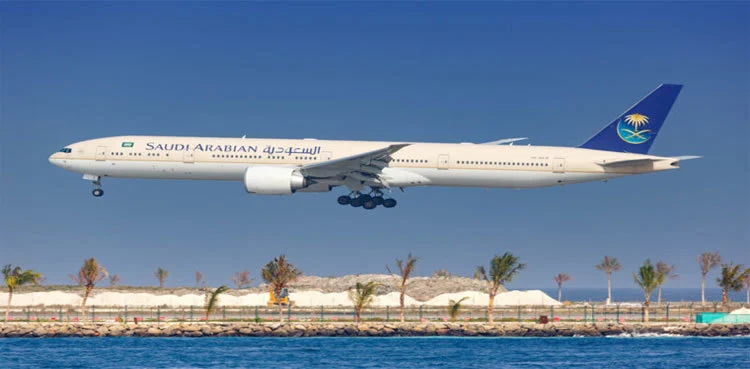
ISLAMABAD: Saudia (Saudi Airlines) has won the “Best Economy Class 2025” international award, ARY News reported.
The airline was honored at the Aviation Business Middle East Awards for its service excellence and modern approach.
The award recognizes Saudia’s commitment to modernization and superior service. Additionally, the carrier was ranked among the year’s best First Class airlines.
Following this achievement, Saudia expressed its determination to further improve travel standards for Pakistani passengers, highlighting that modern and digital travel services are already being prioritized for this market.
As part of its initiative to provide a world-class travel experience, the Saudi national carrier announced it will provide high-speed Wi-Fi across its entire fleet by 2027.
Rossen Dimitrov, the airline’s Chief Guest Experience Officer (CGEO), stated that the honor is a point of pride for Saudi Arabia.
He noted that significant transformations are underway through digital innovation, the Cabin Retrofit Program, and fleet expansion.
Saudia continues to provide extensive aerial connectivity between Pakistan and Saudi Arabia.
Earlier, in November this year, in a dramatic move, AGBI reported today that Saudi Arabia is planning to launch not one, not two, but three new airlines.
These new carriers will join its four existing airlines: Saudia, flynas, flyadeal, and the fledgling Riyadh Air, still in its first month of operations.
AGBI quoted the Saudi Tourism Authority’s chief executive, Fahd Hamidaddin, as saying, “They also say a successful national airline builds a destination, and they are yet to start. There is Riyadh Air, Saudia, and three more air carriers to be announced.”
Hamidaddin was speaking in the Saudi capital of Riyadh at the Cityscape Global real estate conference. The moves are part of Saudi Arabia’s ambitious gigaprojects. The kingdom is seeking to modernise, become a global tech centre, and diversify its economy from its reliance on oil.
One of the three new airlines will be a low-cost airline based in the city of Dammam at the King Fahd International Airport on the Gulf. By 2030, it will have a fleet of 45 aircraft and will be flying to 24 domestic and 57 international routes, carrying 10 million passengers annually.
The second airline will be based in the holy city of Medina and will be targeting religious tourism. Currently, Jeddah is the main gateway for pilgrims visiting Medina, with the two cities connected by a high-speed train. The new airline will allow pilgrims to fly directly to Medina.
The details of the third airline are not known, and the brands and launch dates of the three airlines have not yet been disclosed. Which aircraft these airlines will operate also remains unclear.
Saudi Arabia’s dramatic opening
Before 2019, the conservative Islamic kingdom was all but closed to international tourism. Most international visitors were only generally permitted to visit for business or religious pilgrimage. That changed in 2019, when Saudi Arabia flung open its doors to international tourism.
With this opening up came efforts to create a massive aviation sector connecting Saudi Arabia with every corner of the globe. Now, not only does Saudi Arabia permit tourism, but it has ambitious tourism targets.
The National Tourism Strategy, introduced six years ago, targets 100 million annual visitors by 2030. However, that strategy has now been increased to 150 million, including 50 million international arrivals.
Saudi Arabia’s booming aviation sector
For years, Qatar with Qatar Airways and the United Arab Emirates with Emirates and Etihad dominated the long-haul Middle Eastern aviation market.
While Saudi Arabia always had its flag carrier, Saudia, it was much smaller than its competitors. This is starting to change with the airline having over 100 modern airliners on order.
In March 2023, the Crown Prince of Saudi Arabia, Mohammed bin Salman, announced the second flag carrier, Riyadh Air. The new carrier commenced operations in October 2025.
As Riyadh Air grows, Saudia will focus on high-volume regional and Umrah and Hajj religious tourism from its base in Jeddah.
Riyadh Air is to function similarly to its regional counterparts like Qatar, Emirates, and Turkish Airlines. Flyadeal and flynas are low-cost carriers focusing on narrowbody aircraft fleets.
According to AGBI, the kingdom’s aviation sector handled some 128 million passengers in 2024, representing a 15% increase year-on-year.
Meanwhile, the country is pouring $100 billion into developing its aviation sector.
Hamidaddin stated, “Put simply, today Saudi Arabia is delivering the most significant aviation industry transformation within the 21st century.”